
Susan Hawthorne

Recent Media

Read this interview with Susan via StylusLit


Susan Hawthorne Profile in Queensland Writers Centre Newsletter
June 2020

Susan Hawthorne in Publishing Perspectives, Spring 2018
Susan Hawthorne is an award-winning writer of poetry, fiction and non-fiction. She is the author/editor of 30 books published in eight languages across 23 territories. Her non-fiction books include Lesbian: Politics, Culture, Existence (2024) Vortex: The Crisis of Patriarchy (2020), In Defence of Separatism (2019), Bibliodiversity (2014), Wild Politics (2002/2022), and The Spinifex Quiz Book (1993). Her works include nine collections of poetry. Her collection Cow (2011) was shortlisted for the Kenneth Slessor Poetry prize in the NSW Premier’s Literary Awards and was a Finalist in the Audre Lorde Lesbian Poetry Prize (USA). Earth’s Breath (2009) was shortlisted for the Judith Wright Poetry Prize. She is the author of three works of lesbian fiction, Dark Matters (2017), Limen (2013) and The Falling Woman (1992/2004). Susan has been the recipient on international residencies in Turkey, Italy and India. She has translated literary works from Sanskrit, Greek and Latin and her books have been translated into German, Spanish, Arabic, French, Czech, Tamil, Polish and Portuguese.
Susan Hawthorne has been active in the women’s liberation movement since 1973, was involved in Melbourne’s Rape Crisis Centre and performed as an aerialist in two women’s circuses. She has taught English to Arabic-speaking women, worked in Aboriginal education and has taught Philosophy, Literature, Creative Writing, Women’s Studies and Publishing Studies in universities. She was Adjunct Professor in the School of Humanities at James Cook University, Townsville for many years. She was the winner of the 2017 Penguin Random House Best Achievement in Writing in the Inspire Awards for her work increasing people’s awareness of epilepsy and the politics of disability. And in 2024 she and Renate Klein were co-winners of the Magdalen Berns Award. She has won awards for her contribution to the gay and lesbian community and to publishing. She is currently the Convenor of the Coalition of Activist Lesbians (CoAL) which advocates in Australia and internationally for the rights of lesbian women and girls.

RE-RELEASED WITH A NEW PREFACE
Offering an exciting ride into how the world could be, this book is the one we have been waiting for. Feminists have long been saying we could do life differently, here is the local and global exploration of what needs to change, what must go and how together we can make a new reality. A visionary book with a focus on local and global politics and social movements, Wild Politics presents a powerful critique of global western culture. Susan Hawthorne unpicks the structures of power and knowledge, law and international trade rules, as well as probing issues that intimately affect our daily lives. Wild Politics concludes with a compelling vision for a world inspired by biodiversity.
JUNE 2022 | 9781925950687 | Paperback | 140 x 216 mm | 484 pp

Renate Klein and Susan Hawthorne (eds)
What was it like to participate in the Women’s Liberation Movement? What made millions of women step forward from the 1960s onwards and join it in different ways? Many of the 56 women in this book were there. They describe how they have contributed in multitudinous ways across politics, the arts, health, education, environmentalism, economics and science and created wonderfully rebellious activism. And how they continue this activism today with determined grittiness. Here are women – all over 70 years of age – still railing against the patriarchal systemic oppression of women, still fighting back. “Don’t Call Me Sweetie,” “Never Waste a Good Crisis” and “Still Here, Still Clear and Still Lesbian” is some of what they want us to know.
The contributors to Not Dead Yet have created new analyses with new language and new kinds of organisations always aware of the ways in which the system is stacked against us, particularly against radical feminists. But we persist. We share the revolutionary zest we have carried with us over many decades. There is history, there is subversion and there are many extraordinary acts of courage. The language is full of irony and wit – as well as deadly serious.
The Women’s Liberation Movement has had a profound effect on the lives of millions of women and in turn those women have changed our world. But the struggle continues. May these riveting tales by the foremothers of the movement inspire young women readers. #NotDeadYet
6 JULY 2021 | ISBN 9781925950328 | Paperback | 233 x 150 mm | 464 pages

Do we want to live in a world without birdsong? The pesticides, the coal mines, the clear-felling forestry industry, the industrial farmers are destroying the earth with their insistence on profit. But what point is profit on a dead and silent planet?
In this enlightening yet devastating book, Susan Hawthorne writes with clarity and incisiveness on how patriarchy is wreaking destruction on the planet and on communities. The twin mantras of globalisation and growth expounded by the neoliberalism that has hijacked the planet are revealed in all their shabby deception.
Backed by meticulous research, the author shows how so-called advances in technology are, like a Trojan horse, used to mask sinister political agendas that sacrifice the common good for the shallow profiteering of corporations and mega-rich individuals.
The biotechnologists see the lure of cure, rising share prices and profits.
She details how women, lesbians, people with disabilities, Indigenous peoples, the poor, refugees and the very earth itself are being damaged by the crisis of patriarchy that is sucking everyone into its vortex. Importantly, this precise and insightful volume also shows what is needed to get ourselves out of this spiral of destruction: a radical feminist approach with compassion and empathy at its core.
Shame is an emotion of the powerless because they cannot change the rules.
The book shows a way out of the vortex: it is now up to the collective imagination and action of people everywhere to take up the challenges Susan Hawthorne shows are needed.
This is a vital book for a world in crisis and should be read by everyone who cares about our future.
NOVEMBER 2020 | ISBN 9781925950168 | Paperback | 152 mm x 228 mm | 196 pages

the Muses have been sacked
their role in the pantheon
sold up for some new
real estate venture
When the Muses are sacked, what are we to do? The Muses who inspire poetry, astronomy, history and daily living bring their song and dance into present-day political struggles. These Muses are for rebellion.
Susan Hawthorne’s poems span millennia of resistance by women. The earth itself is implicated. She writes about women's bodies, how they are used, abused and celebrated in birthing, in sexual pleasure, in grief, in imagining. She draws on stories from ancient and contemporary India, from Greece and Rome, through language, storytelling and translation.
we embrace our double lives
like actors and their alter egos
some say śleṣa a is unnatural
I've heard the same said about us
2019 | ISBN 9781925950007 | Paperback | 215 x 141 mm | 96 pp

In Defence of Separatism is a timely book. When it was first written in 1976, although it was an important subject of conversation among many feminists it was not welcomed by academics or publishers.
When a political group wants to strategise so that its members can arrive at agreed-on political tactics and ideas, they call for, and create, separate spaces. These might be in coffee shops, in community centres, in one another's homes or in semi-public spaces such as workers clubs, even cinemas. When the proletariat was rebelling, they did not ask the capitalists and aristocracy to join them (even if a few did); when the civil rights movement started it was not thanks to the ideas and politics of white people (even though some whites joined to support the cause); when the women's liberation movement sprang into life, it was women joining together to fight against their oppression.
The difference is that women are supposed to love men.
Through careful argument, Susan Hawthorne takes us through the ideas which are central to her argument. She analyses the nature of power, oppression, domination and institutions and applies these to heterosexuality, rape and romantic love. She concludes with a call for women, all women no matter their sexuality, to have separate spaces so they can work together to change the world and end patriarchy.
This 2019 edition includes a Preface, Afterword and additional commentary in italicised footnotes that bring the reader up to date on changes, developments and controversies in feminist theory.
2019 | ISBN 9781925950045 | Paperback | 112 pages
THIS BOOK IS PART OF THE SPINIFEX SHORTS COMPLETE COLLECTION

A love letter from Kate to Mercedes. Mercedes is shot in a dawn raid on their home in Melbourne. Kate is arrested. In her despair of not knowing if Mercedes is alive or dead Kate writes to her, about her, about their lives. She invents stories and rearranges the rich mythic traditions of Greece.
This is a novel of resilience in the face of trauma and uncertainty.
2017 | ISBN 9781925581089 | Paperback | 232 x 154 mm | 192 pp

This collection of imagist poems combines mythology, archaeology and translation. Susan Hawthorne draws on the history and prehistory of Rome and its neighbours to explore how the past is remembered. Under the guidance of Curatrix, Director of the Musæum Matricum, and Latin poet, Sulpicia, travellers Diana and Agnese are led through the mythic archives about wolves and sheep before attending an epoch-breaking party to which they are invited by Empress Livia.
2014 | 9781742199245 | Paperback | 172 pages

In a globalised world, megacorp publishing is all about numbers, about sameness, about following a formula based on the latest megasuccess. Each book is expected to pay for itself and all the externalities of publishing such as offices and CEO salaries. It means that books which take off slowly but have long lives, the books that change social norms, are less likely to be published.
Independent publishers are seeking another way. A way of engagement with society and methods that reflect something important about the locale or the niche they inhabit. Independent and small publishers are like rare plants that pop up among the larger growth but add something different, perhaps they feed the soil, bring colour or scent into the world.
Bibliodiversity is a term invented by Chilean publishers in the 1990s as a way of envisioning a different kind of publishing. In this manifesto, Susan Hawthorne provides a scathing critique of the global publishing industry set against a visionary proposal for organic publishing. She looks at free speech and fair speech, at the environmental costs of mainstream publishing and at the promises and challenges of the move to digital.
2014 | 9781742199306 | Paperback | 104 pages
THIS BOOK IS PART OF THE SPINIFEX SHORTS COMPLETE COLLECTION
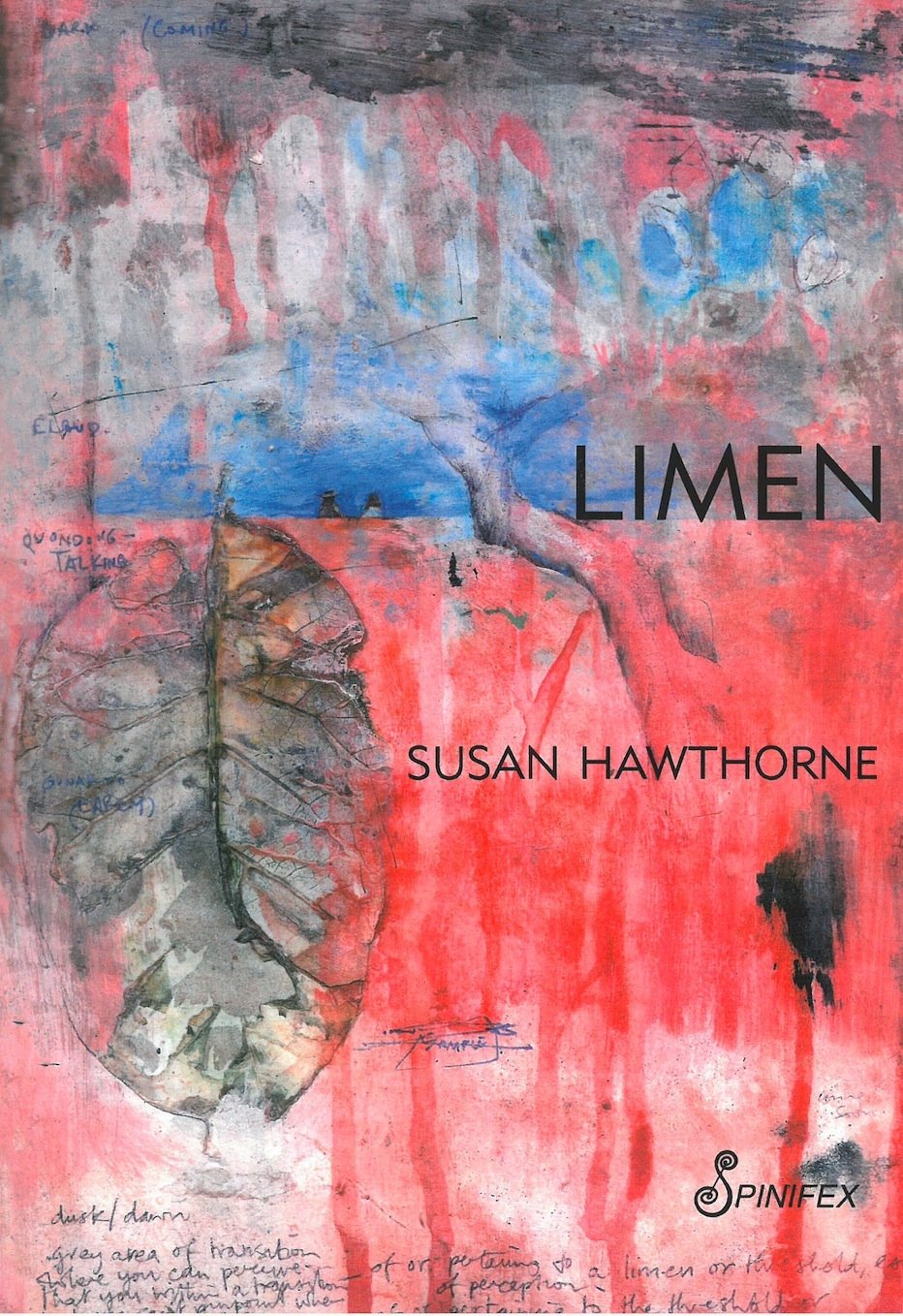
Jeanné Browne (Art)
this tiny crack
in our lives
wind and rain strewn
stranded on the limen
that space between
water and sky
rain and sun
cold and heat
When two women and a dog set off on a holiday they have no inkling of what’s to come.
They wake to find the river has crept up silently during the night. Trapped by floodwater, they devise escape routes only to be faced with more obstacles at every turn.
Only the dog remains calm.
This novella grips you with its language, its pace, its anxieties.
2013 | ISBN 9781742198606 | Paperback | 220 x 150 mm | 166 pp

Valence: Considering war through poetry and theory is a powerful rage against the brutality and greed of war; against the particular suffering of women in war; against our indifference but more importantly, our sense of powerless in the face of wars most of us neither support nor would ever instigate. Here is a poet of moral conscience in the fine tradition of Adrienne Rich; a poet writing across boundaries; striving with each form to elucidate, illuminate, change.
2011 | ISBN 9781876756987 | Paperback | 210 x 148 mm | 16 pages
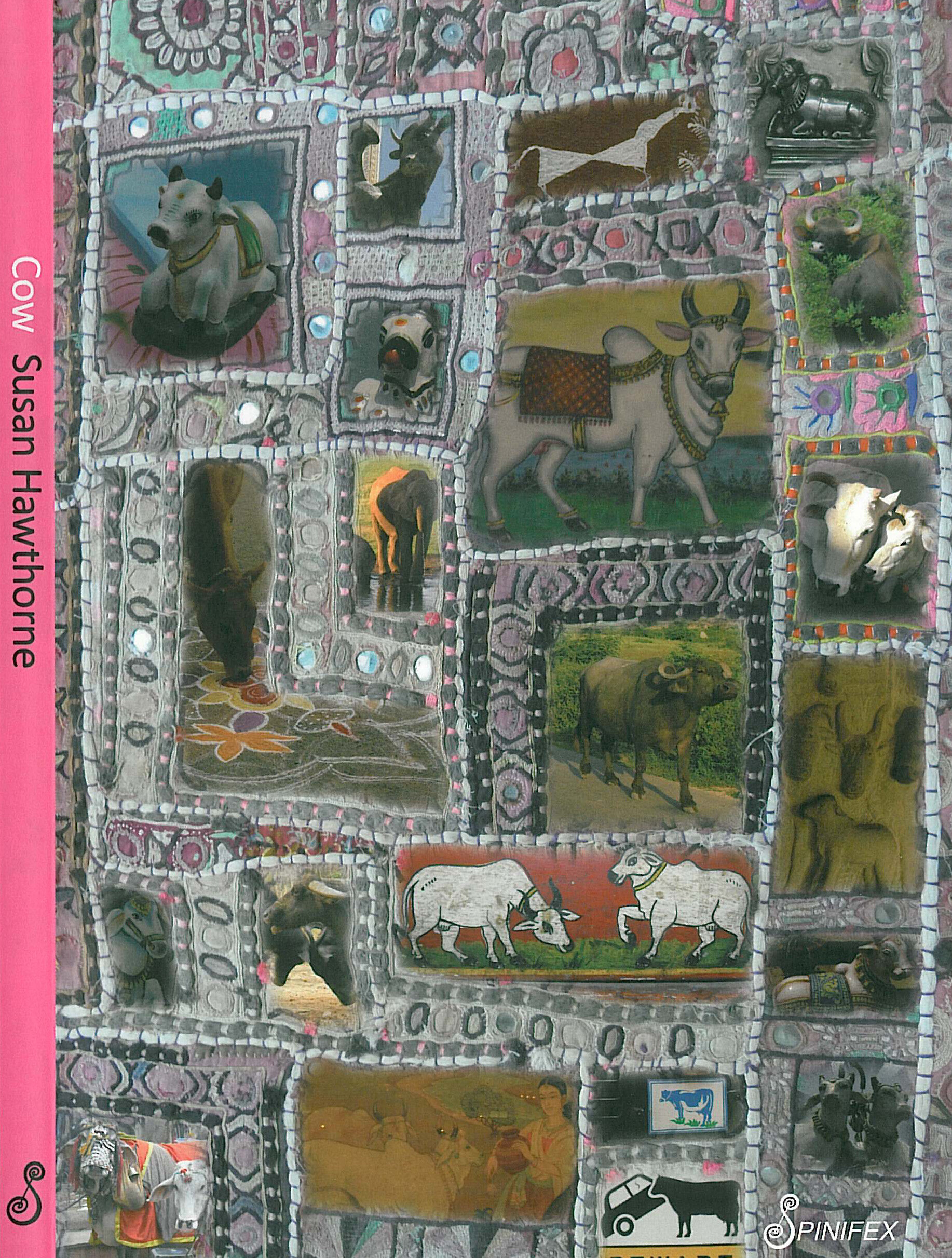
I am nothing special just a cow who wants to change the world a cow whose eyes are on the sky
Cow leaps and flies into imaginative realms carrying mythology and language. Cow creates the universe, the galaxies and travels through the sky as a herd of stars. Cow writes love poetry and ponders lost histories.
An intriguing approach to the rewriting of myth, this book takes the reader on a journey through the history of languages and symbolic traditions.
Through a main character, Queenie, a cow of many abilities and a history that takes in the creation of the universe, readers come to see the world in new ways. The collection draws on the author’s knowledge of ancient languages and its structure draws on philosophy and the Sangam poetry tradition of South India.
Finalist: Audre Lorde Award for Lesbian Poetry (USA)
Shortlisted: Kenneth Slessor Prize for Poetry, NSW Premier's Literary and History Awards
2011 | ISBN 9781876756888 | Paperback | 210 x 150 mm | 166 pp

Cyclonic storms inform the still eye of Earth's Breath. It's an eye that radiates out from the personal to the communal, tracking its subject matter through the lenses of history and myth. Susan Hawthorne's poetry shifts with seismic intensity, from tranquility to roar, bureaucratic inertia to survival, and the slow recovery from destruction to regeneration.
2009 | ISBN 9781876756734 | Paperback | 200 x 130 mm | 84 pp

This chapbook, Unsettling the Land, is a celebration of a marvellous thirty-year friendship between Suzanne Bellamy and Susan Hawthorne. They have produced many combined performance works in Australia and overseas, combining image, music, circus and text. The Drought Project curated by Lella Cariddi, opened up a new way of joint production with Susan's poem taking visual form in Suzanne's art which in turn created additional poetic text.
2008 | ISBN 9781876756703| Paperback | 210 x 149 mm | 13 pages

No, here there's not a
straight line to be seen anywhere - chaos
in the shape of two vulval wings -
the butterfly effect.
The butterfly effect is a concept from physics in which it is surmised that small actions can have enormous consequences, and that the flutter of a butterfly's wing on one side of the world can cause devastating storms on the other side. Susan Hawthorne explores the impact of the love between lesbians. The butterfly effect is a force that can destroy families and bring down governments, but also a force full of vitality and world changing creativity.
She evokes the ancient worlds of pre-Vedic and Sapphic lovers, of Mediaeval jonglaresas and nuns 'fingering petals and hips' as well as the contemporary world of circuses and global politics.
2005 | ISBN 9781876756567 | Paperback | 200 x 130 mm | 248 pp

Horses and women have always shared a bond. Why else do little girls plaster their schoolbooks with pony pictures? Why do women spend weekends devotedly mucking out paddocks? Or willingly go out in public wearing tight, unforgiving, pale jodhpurs? How is it that otherwise fastidious females cheerfully fill their cars with hay, their nails with dirt and their boots with mud, while turning out gleaming horses, with barely a tail-hair out of place? It seems that in days when urban sprawl is overtaking paddocks and trails, and country life seems so far away, little girls (and big ones!) still dream of horses.
HorseDreams explores the beautiful, intense and often funny relationships between women and horses – creatures that carry their female friends through life, offering strong, silent companionship, and the chance to escape, if only in their imagination. Humour, devotion, warmth and enthusiasm shine through tales of scruffy childhood ponies, sleek brave thoroughbreds and even the occasional donkey, seahorse or carousel steed.
Contributors include: Marge Piercy, Caroline Taylor, Rebecca Gorman, Jenny Barnes, Di Gatehouse, Julie Copeland, Tatyana Mamonova, Pat Hodgell.
2004 | ISBN 9781876756475 | Paperback | 212 x 212 mm | 220 pp

A sister volume to the internationally successful A Girl's Best Friend, this book explores the relationships between women and their cats - or more aptly, cats and their women.
There are cats of all colours and sizes - from the city, the farm, the bush; cats who can open fridges, sign contracts, and cats-in-drag. They get stuck in strange places and survive amazing ordeals. Some disappear only to return mysteriously; others live on as most treasured memories. They entertain, amuse, frustrate and delight us; they tug at our hearts and offer insight into our lives.
Cat Tales: The Meaning Of Cats In Women's Lives is a delightful collection of writing from women and girls all around the world, accompanied by beautiful photographs of their feline friends.
2003 | ISBN 9781876756376 | Paperback | 212 x 210 mm | 219 pp
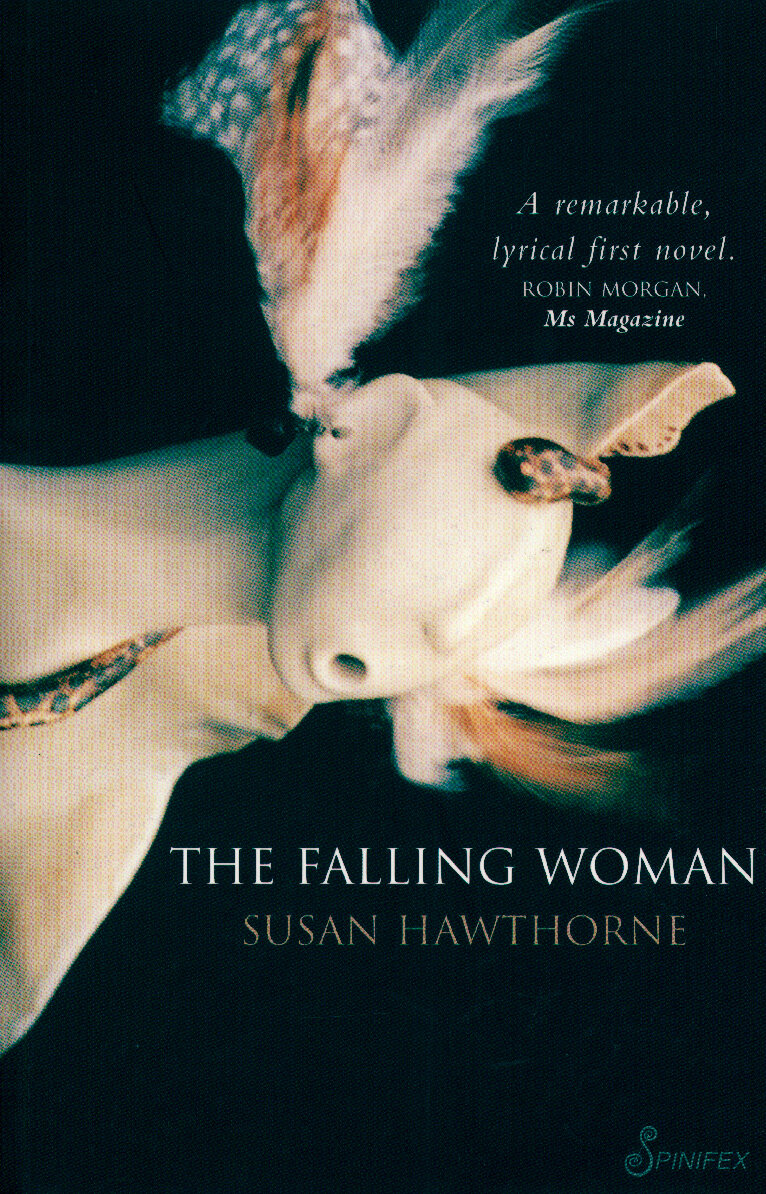
A vivid desert odyssey, The Falling Woman travels through a haunting landscape of memory, myth and mental maps. Told in three voices – Stella, Estella and Estelle – this is an inspiring story drawn from childhood memories, imagined worlds and the pressing realities of daily life.
The Falling Woman charts one woman’s journey into the heartland. It is a journey taken across the desert, into the heart of memory, and into the mythic heart, that place to which we return in times of crisis.
2003 | ISBN 9781876756369 | Paperback | 200 x 130 mm | 270 pp

After September 11, feminists around the world spoke out, wrote for newspapers, for email lists and for the Internet. But in the male-dominated mass media, it was hard to find feminist perspectives. This collection brings together women who discuss the connections between war, terrorism, fundamentalism, racism, global capitalism and male violence. From the USA to Afghanistan, from Pakistan to Palestine, from Australia to Europe they have deconstructed this story and retold it from a feminist perspective in a powerful indictment of current global politics. Contributors include Barbara Kingsolver and Ani DiFranco, Naomi Klein.
2002 | ISBN 9781876756277 | Paperback | 228 x 152 mm | 538 pp
Older titles

An international anthology of writings on cyberculture and feminist interventions. A diverse and at times fractious discussion of issues raised by these new forms of cultural expression. The contributors engage with a range of questions including: What is cyberfeminism? How does feminism influence multimedia production? What are the possibilities for feminist activism and research on the internet? How are colonisation, cybersex and virtuality to be theorised? How do these technologies affect our theories about bodies and minds? And what are the implications for creative artists?
1999 | ISBN 9781875559688 | Paperback | 217 x 138 mm | 434 pp

Birds don't fly with leads...Safety belts are to learn with, not to live with - I'm safer on the trapeze than crossing the road. And I do that every day, often by myself.
Thirteen-year-old Avis confronts the limitations imposed on her at school. She has epilepsy and some of the teachers want to stop her participating in the sport she loves most. Susan Hawthorne captures the voice and longings of a child at the edge of self-realisation. This collection draws on the experience of epilepsy mixed with imagination, mythic consciousness and an intense realisation of life.
The language in my tongue dissolves all history. It dissolves all expectation of the future. The language in my tongue is a big red balloon.
1999 | ISBN 9781875559886 | Paperback | 200 x 130 mm | 100 pages

What is mythic? / What is true? Asks the opening anonymous poet of this collection. Lesbians have become cultural amphibians. This anthology reflects the varied tongues, the inventiveness of lesbian culture and the diversity of lesbian writing. It explores the mechanics of daily life, the explosiveness of relationships and the geography of love. Here is toughness, conviction, perseverance and passion, writing which makes a difference. Contributors include Stella Duffy, Lisa Bellear, Donna Jackson, Gill Hanscombe, Marou Izumo, Helen Hodgamn, Sandra Shotlander, Sue Fitchett, Sandy Jeffs, Marg Vandeleur, Annamarie Jagose, Finola Moorhead, Susan Hampton, Renée, Miriel Lenore and more.
1997 | ISBN 9781875559626 | Paperback | 200 x 130 mm | 353 pp|
For more paperback copies, please visit IPG Book in the US
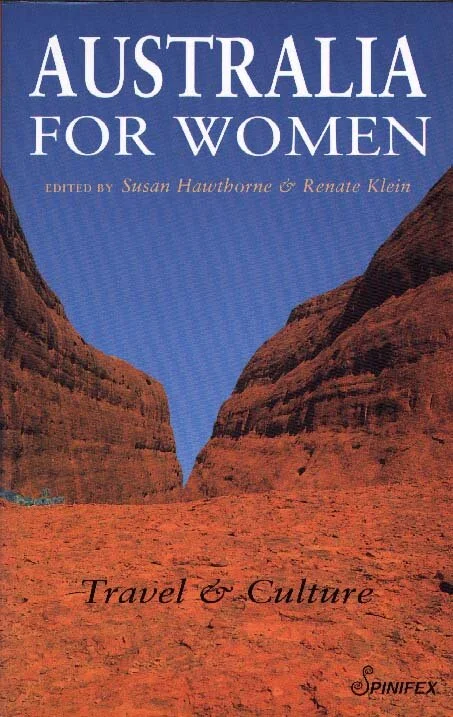
Renate Klein & Susan Hawthorne (Ed)
An indispensable book for anyone travelling in Australia who wants to understand how women have contributed to the culture and the history. With contributions from Indigenous writers on land, culture and life and from women who trace their heritage to one of the many waves of migrants over more than 200 years. From landscape to literature, from the history of feminism to women’s involvement in film, theatre and the visual arts, from myth to music this book shows a different side of travelling in Australia.
1994 | ISBN 9781875559275 | Paperback | 218 x 140 mm | 432 pp

Who invented hieroglyphics? Who did Einstein’s mathematics? Who led the defence of Viet Nam in 40 AD? Who invented the first computer? Who built the pyramid at Giza? Who developed the merino sheep? Who was the first writer in the world? Who invented the wheel? All were women. When the next person asks: Where are all the famous women artists/inventors/architects/writers/scientists? – this book will make it easy to find their names.
1993 | ISBN 9781875559152 | Paperback | 200 x 130 mm | 113 pp
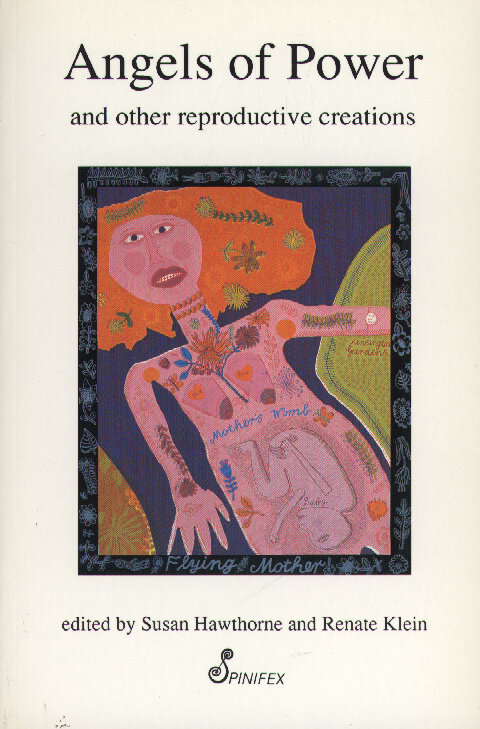
In the tradition of Mary Shelley's Frankenstein, these writers rework images of the body. Imagination, vision and a sense of the absurd come together and demonstrate that women can resist the power of god-like scientists who long to create monsters and angels.
1991 | ISBN 9781875559008 | Paperback | 197 x 130 mm | 252 pp
Ebooks
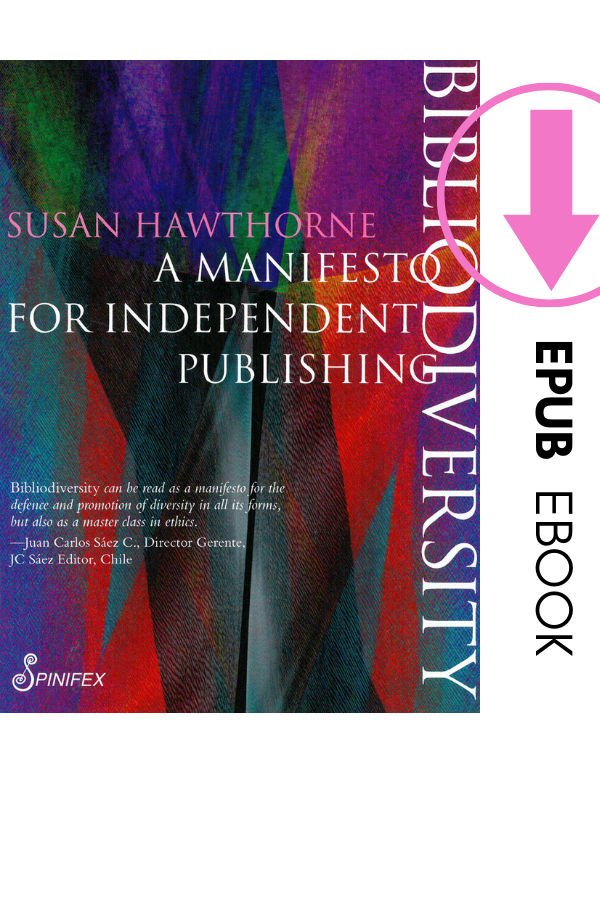
In a globalised world, megacorp publishing is all about numbers, about sameness, about following a formula based on the latest megasuccess. Each book is expected to pay for itself and all the externalities of publishing such as offices and CEO salaries. It means that books which take off slowly but have long lives, the books that change social norms, are less likely to be published.
Independent publishers are seeking another way. A way of engagement with society and methods that reflect something important about the locale or the niche they inhabit. Independent and small publishers are like rare plants that pop up among the larger growth but add something different, perhaps they feed the soil, bring colour or scent into the world.
Bibliodiversity is a term invented by Chilean publishers in the 1990s as a way of envisioning a different kind of publishing. In this manifesto, Susan Hawthorne provides a scathing critique of the global publishing industry set against a visionary proposal for organic publishing. She looks at free speech and fair speech, at the environmental costs of mainstream publishing and at the promises and challenges of the move to digital.

In a globalised world, megacorp publishing is all about numbers, about sameness, about following a formula based on the latest megasuccess. Each book is expected to pay for itself and all the externalities of publishing such as offices and CEO salaries. It means that books which take off slowly but have long lives, the books that change social norms, are less likely to be published.
Independent publishers are seeking another way. A way of engagement with society and methods that reflect something important about the locale or the niche they inhabit. Independent and small publishers are like rare plants that pop up among the larger growth but add something different, perhaps they feed the soil, bring colour or scent into the world.
Bibliodiversity is a term invented by Chilean publishers in the 1990s as a way of envisioning a different kind of publishing. In this manifesto, Susan Hawthorne provides a scathing critique of the global publishing industry set against a visionary proposal for organic publishing. She looks at free speech and fair speech, at the environmental costs of mainstream publishing and at the promises and challenges of the move to digital.

Birds don't fly with leads...Safety belts are to learn with, not to live with - I'm safer on the trapeze than crossing the road. And I do that every day, often by myself.
Thirteen-year-old Avis confronts the limitations imposed on her at school. She has epilepsy and some of the teachers want to stop her participating in the sport she loves most. Susan Hawthorne captures the voice and longings of a child at the edge of self-realisation. This collection draws on the experience of epilepsy mixed with imagination, mythic consciousness and an intense realisation of life.
The language in my tongue dissolves all history. It dissolves all expectation of the future. The language in my tongue is a big red balloon.
1999 | 100 pages

Birds don't fly with leads...Safety belts are to learn with, not to live with - I'm safer on the trapeze than crossing the road. And I do that every day, often by myself.
Thirteen-year-old Avis confronts the limitations imposed on her at school. She has epilepsy and some of the teachers want to stop her participating in the sport she loves most. Susan Hawthorne captures the voice and longings of a child at the edge of self-realisation. This collection draws on the experience of epilepsy mixed with imagination, mythic consciousness and an intense realisation of life.
The language in my tongue dissolves all history. It dissolves all expectation of the future. The language in my tongue is a big red balloon.
1999 | 100 pages

No, here there's not a
straight line to be seen anywhere - chaos
in the shape of two vulval wings -
the butterfly effect.
The butterfly effect is a concept from physics in which it is surmised that small actions can have enormous consequences, and that the flutter of a butterfly's wing on one side of the world can cause devastating storms on the other side. Susan Hawthorne explores the impact of the love between lesbians. The butterfly effect is a force that can destroy families and bring down governments, but also a force full of vitality and world changing creativity.
She evokes the ancient worlds of pre-Vedic and Sapphic lovers, of Mediaeval jonglaresas and nuns 'fingering petals and hips' as well as the contemporary world of circuses and global politics.
2005 | 248 pp

No, here there's not a
straight line to be seen anywhere - chaos
in the shape of two vulval wings -
the butterfly effect.
The butterfly effect is a concept from physics in which it is surmised that small actions can have enormous consequences, and that the flutter of a butterfly's wing on one side of the world can cause devastating storms on the other side. Susan Hawthorne explores the impact of the love between lesbians. The butterfly effect is a force that can destroy families and bring down governments, but also a force full of vitality and world changing creativity.
She evokes the ancient worlds of pre-Vedic and Sapphic lovers, of Mediaeval jonglaresas and nuns 'fingering petals and hips' as well as the contemporary world of circuses and global politics.
2005 | 248 pp

I am nothing special just a cow who wants to change the world a cow whose eyes are on the sky
Cow leaps and flies into imaginative realms carrying mythology and language. Cow creates the universe, the galaxies and travels through the sky as a herd of stars. Cow writes love poetry and ponders lost histories.
An intriguing approach to the rewriting of myth, this book takes the reader on a journey through the history of languages and symbolic traditions.
Through a main character, Queenie, a cow of many abilities and a history that takes in the creation of the universe, readers come to see the world in new ways. The collection draws on the author’s knowledge of ancient languages and its structure draws on philosophy and the Sangam poetry tradition of South India.
2011 | 166 pp

I am nothing special just a cow who wants to change the world a cow whose eyes are on the sky
Cow leaps and flies into imaginative realms carrying mythology and language. Cow creates the universe, the galaxies and travels through the sky as a herd of stars. Cow writes love poetry and ponders lost histories.
An intriguing approach to the rewriting of myth, this book takes the reader on a journey through the history of languages and symbolic traditions.
Through a main character, Queenie, a cow of many abilities and a history that takes in the creation of the universe, readers come to see the world in new ways. The collection draws on the author’s knowledge of ancient languages and its structure draws on philosophy and the Sangam poetry tradition of South India.
2011 | | 166 pp

An international anthology of writings on cyberculture and feminist interventions. A diverse and at times fractious discussion of issues raised by these new forms of cultural expression. The contributors engage with a range of questions including: What is cyberfeminism? How does feminism influence multimedia production? What are the possibilities for feminist activism and research on the internet? How are colonisation, cybersex and virtuality to be theorised? How do these technologies affect our theories about bodies and minds? And what are the implications for creative artists?
1999 | 434 pp

An international anthology of writings on cyberculture and feminist interventions. A diverse and at times fractious discussion of issues raised by these new forms of cultural expression. The contributors engage with a range of questions including: What is cyberfeminism? How does feminism influence multimedia production? What are the possibilities for feminist activism and research on the internet? How are colonisation, cybersex and virtuality to be theorised? How do these technologies affect our theories about bodies and minds? And what are the implications for creative artists?
1999 | 434 pp

When Desi inherits her aunt Kate’s house in Brunswick she begins to read the contents of the boxes in the back room. She discovers a hidden life, one which could not be shared with Kate’s family.
Among the papers are records of arrest, imprisonment and torture at the hands of an unknown group who persecute her for her sexuality and activism. Scraps of memoir, family history and poems complete this fragmented story.
Can Desi find Mercedes? The woman Kate has loved so much. Mercedes, who had escaped from Pinochet’s Chile. Where is she and can she help unravel Kate’s story?
Susan Hawthorne’s dark story uncovers the hidden histories of organised violence against lesbians. She traces fear and uncertainty, and finds a narrative of resilience created through the writing of poems. The author asks: how do we pass on stories hidden by both shame and resistance to shame? A novel that is poetic and terrifying.

When Desi inherits her aunt Kate’s house in Brunswick she begins to read the contents of the boxes in the back room. She discovers a hidden life, one which could not be shared with Kate’s family.
Among the papers are records of arrest, imprisonment and torture at the hands of an unknown group who persecute her for her sexuality and activism. Scraps of memoir, family history and poems complete this fragmented story.
Can Desi find Mercedes? The woman Kate has loved so much. Mercedes, who had escaped from Pinochet’s Chile. Where is she and can she help unravel Kate’s story?
Susan Hawthorne’s dark story uncovers the hidden histories of organised violence against lesbians. She traces fear and uncertainty, and finds a narrative of resilience created through the writing of poems. The author asks: how do we pass on stories hidden by both shame and resistance to shame? A novel that is poetic and terrifying.

Cyclonic storms inform the still eye of Earth's Breath. It's an eye that radiates out from the personal to the communal, tracking its subject matter through the lenses of history and myth. Susan Hawthorne's poetry shifts with seismic intensity, from tranquility to roar, bureaucratic inertia to survival, and the slow recovery from destruction to regeneration.
2009 | I84 pp

Cyclonic storms inform the still eye of Earth's Breath. It's an eye that radiates out from the personal to the communal, tracking its subject matter through the lenses of history and myth. Susan Hawthorne's poetry shifts with seismic intensity, from tranquility to roar, bureaucratic inertia to survival, and the slow recovery from destruction to regeneration.
2009 | 84 pp

A vivid desert odyssey, The Falling Woman travels through a haunting landscape of memory, myth and mental maps. Told in three voices – Stella, Estella and Estelle – this is an inspiring story drawn from childhood memories, imagined worlds and the pressing realities of daily life.
The Falling Woman charts one woman’s journey into the heartland. It is a journey taken across the desert, into the heart of memory, and into the mythic heart, that place to which we return in times of crisis.
2003 | 270 pp

A vivid desert odyssey, The Falling Woman travels through a haunting landscape of memory, myth and mental maps. Told in three voices – Stella, Estella and Estelle – this is an inspiring story drawn from childhood memories, imagined worlds and the pressing realities of daily life.
The Falling Woman charts one woman’s journey into the heartland. It is a journey taken across the desert, into the heart of memory, and into the mythic heart, that place to which we return in times of crisis.
2003 | 270 pp

In Defence of Separatism is a timely book. When it was first written in 1976, although it was an important subject of conversation among many feminists it was not welcomed by academics or publishers.
When a political group wants to strategise so that its members can arrive at agreed-on political tactics and ideas, they call for, and create, separate spaces. These might be in coffee shops, in community centres, in one another's homes or in semi-public spaces such as workers clubs, even cinemas. When the proletariat was rebelling, they did not ask the capitalists and aristocracy to join them (even if a few did); when the civil rights movement started it was not thanks to the ideas and politics of white people (even though some whites joined to support the cause); when the women's liberation movement sprang into life, it was women joining together to fight against their oppression.
The difference is that women are supposed to love men.
Through careful argument, Susan Hawthorne takes us through the ideas which are central to her argument. She analyses the nature of power, oppression, domination and institutions and applies these to heterosexuality, rape and romantic love. She concludes with a call for women, all women no matter their sexuality, to have separate spaces so they can work together to change the world and end patriarchy.
This 2019 edition includes a Preface, Afterword and additional commentary in italicised footnotes that bring the reader up to date on changes, developments and controversies in feminist theory.

In Defence of Separatism is a timely book. When it was first written in 1976, although it was an important subject of conversation among many feminists it was not welcomed by academics or publishers.
When a political group wants to strategise so that its members can arrive at agreed-on political tactics and ideas, they call for, and create, separate spaces. These might be in coffee shops, in community centres, in one another's homes or in semi-public spaces such as workers clubs, even cinemas. When the proletariat was rebelling, they did not ask the capitalists and aristocracy to join them (even if a few did); when the civil rights movement started it was not thanks to the ideas and politics of white people (even though some whites joined to support the cause); when the women's liberation movement sprang into life, it was women joining together to fight against their oppression.
The difference is that women are supposed to love men.
Through careful argument, Susan Hawthorne takes us through the ideas which are central to her argument. She analyses the nature of power, oppression, domination and institutions and applies these to heterosexuality, rape and romantic love. She concludes with a call for women, all women no matter their sexuality, to have separate spaces so they can work together to change the world and end patriarchy.
This 2019 edition includes a Preface, Afterword and additional commentary in italicised footnotes that bring the reader up to date on changes, developments and controversies in feminist theory.

A history of feminist and lesbian thinking from the 1970s to the present
Across almost 50 years of writing, Susan Hawthorne’s essays on lesbian culture and politics take the reader on a journey through the concerns of radical feminists engaged in the Women’s Liberation Movement. Not only does she trace the experiments of lesbians creating a vibrant woman-loving culture, but she also traces the backlash against lesbians and a history of violence perpetrated by the state, corporations and individual men.
She begins with a recollection of a rape in her pre-feminist days, followed by a critique of the institution of heterosexuality and the role of lesbian feminism as a strategy. She is soon asking questions about lesbian existence. The essays span reflections on lesbian literature and the development of lesbian culture, including the politics of physical expression in circus.
Susan Hawthorne writes about cultural appropriation, depoliticisation and the erasure of lesbian inventiveness. She researches violence against lesbians including rape, torture and murder and the way in which this violence is ignored and often distorted by the media.
Her investigations include lesbian refugees, lesbian economics, violation of lesbian human rights and the impact of the transgender industrial complex on the existence of lesbians as a political force.
ISBN 9781925950991 | 360 pages

A history of feminist and lesbian thinking from the 1970s to the present
Across almost 50 years of writing, Susan Hawthorne’s essays on lesbian culture and politics take the reader on a journey through the concerns of radical feminists engaged in the Women’s Liberation Movement. Not only does she trace the experiments of lesbians creating a vibrant woman-loving culture, but she also traces the backlash against lesbians and a history of violence perpetrated by the state, corporations and individual men.
She begins with a recollection of a rape in her pre-feminist days, followed by a critique of the institution of heterosexuality and the role of lesbian feminism as a strategy. She is soon asking questions about lesbian existence. The essays span reflections on lesbian literature and the development of lesbian culture, including the politics of physical expression in circus.
Susan Hawthorne writes about cultural appropriation, depoliticisation and the erasure of lesbian inventiveness. She researches violence against lesbians including rape, torture and murder and the way in which this violence is ignored and often distorted by the media.
Her investigations include lesbian refugees, lesbian economics, violation of lesbian human rights and the impact of the transgender industrial complex on the existence of lesbians as a political force.
ISBN 9781925950991 | 360 pages

Jeanné Browne (Art)
this tiny crack
in our lives
wind and rain strewn
stranded on the limen
that space between
water and sky
rain and sun
cold and heat
When two women and a dog set off on a holiday they have no inkling of what’s to come.
They wake to find the river has crept up silently during the night. Trapped by floodwater, they devise escape routes only to be faced with more obstacles at every turn.
Only the dog remains calm.
This novella grips you with its language, its pace, its anxieties.
2013 | 166 pp

Jeanné Browne (Art)
this tiny crack
in our lives
wind and rain strewn
stranded on the limen
that space between
water and sky
rain and sun
cold and heat
When two women and a dog set off on a holiday they have no inkling of what’s to come.
They wake to find the river has crept up silently during the night. Trapped by floodwater, they devise escape routes only to be faced with more obstacles at every turn.
Only the dog remains calm.
This novella grips you with its language, its pace, its anxieties.
2013 | 166 pp
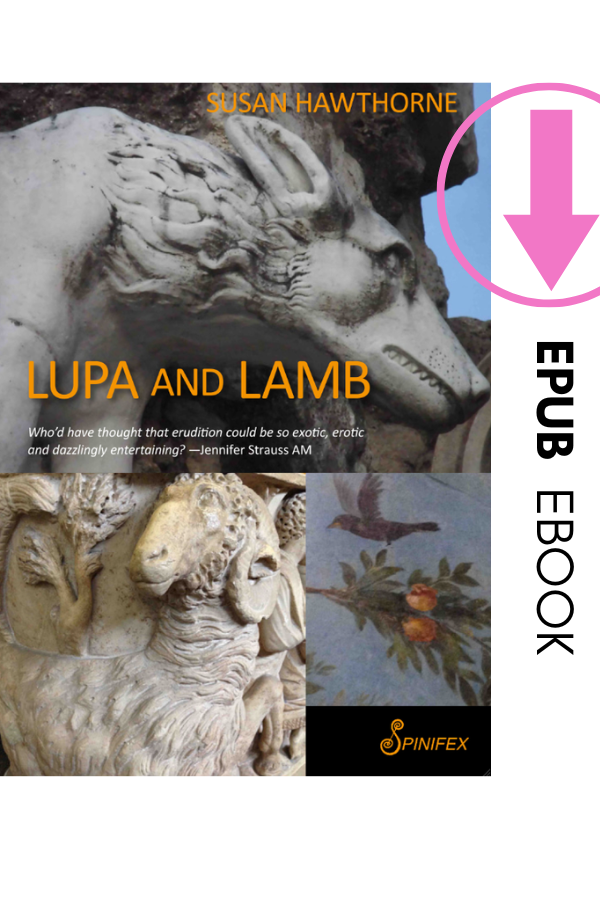
This collection of imagist poems combines mythology, archaeology and translation. Susan Hawthorne draws on the history and prehistory of Rome and its neighbours to explore how the past is remembered. Under the guidance of Curatrix, Director of the Musæum Matricum, and Latin poet, Sulpicia, travellers Diana and Agnese are led through the mythic archives about wolves and sheep before attending an epoch-breaking party to which they are invited by Empress Livia.
2014 | 172 pages

This collection of imagist poems combines mythology, archaeology and translation. Susan Hawthorne draws on the history and prehistory of Rome and its neighbours to explore how the past is remembered. Under the guidance of Curatrix, Director of the Musæum Matricum, and Latin poet, Sulpicia, travellers Diana and Agnese are led through the mythic archives about wolves and sheep before attending an epoch-breaking party to which they are invited by Empress Livia.
2014 | 172 pages

Renate Klein and Susan Hawthorne (eds)
What was it like to participate in the Women’s Liberation Movement? What made millions of women step forward from the 1960s onwards and join it in different ways? Many of the 56 women in this book were there. They describe how they have contributed in multitudinous ways across politics, the arts, health, education, environmentalism, economics and science and created wonderfully rebellious activism. And how they continue this activism today with determined grittiness. Here are women – all over 70 years of age – still railing against the patriarchal systemic oppression of women, still fighting back. “Don’t Call Me Sweetie,” “Never Waste a Good Crisis” and “Still Here, Still Clear and Still Lesbian” is some of what they want us to know.
The contributors to Not Dead Yet have created new analyses with new language and new kinds of organisations always aware of the ways in which the system is stacked against us, particularly against radical feminists. But we persist. We share the revolutionary zest we have carried with us over many decades. There is history, there is subversion and there are many extraordinary acts of courage. The language is full of irony and wit – as well as deadly serious.
The Women’s Liberation Movement has had a profound effect on the lives of millions of women and in turn those women have changed our world. But the struggle continues. May these riveting tales by the foremothers of the movement inspire young women readers. #NotDeadYet

Renate Klein and Susan Hawthorne (eds)
What was it like to participate in the Women’s Liberation Movement? What made millions of women step forward from the 1960s onwards and join it in different ways? Many of the 56 women in this book were there. They describe how they have contributed in multitudinous ways across politics, the arts, health, education, environmentalism, economics and science and created wonderfully rebellious activism. And how they continue this activism today with determined grittiness. Here are women – all over 70 years of age – still railing against the patriarchal systemic oppression of women, still fighting back. “Don’t Call Me Sweetie,” “Never Waste a Good Crisis” and “Still Here, Still Clear and Still Lesbian” is some of what they want us to know.
The contributors to Not Dead Yet have created new analyses with new language and new kinds of organisations always aware of the ways in which the system is stacked against us, particularly against radical feminists. But we persist. We share the revolutionary zest we have carried with us over many decades. There is history, there is subversion and there are many extraordinary acts of courage. The language is full of irony and wit – as well as deadly serious.
The Women’s Liberation Movement has had a profound effect on the lives of millions of women and in turn those women have changed our world. But the struggle continues. May these riveting tales by the foremothers of the movement inspire young women readers. #NotDeadYet

the Muses have been sacked
their role in the pantheon
sold up for some new
real estate venture
When the Muses are sacked, what are we to do? The Muses who inspire poetry, astronomy, history and daily living bring their song and dance into present-day political struggles. These Muses are for rebellion.
Susan Hawthorne’s poems span millennia of resistance by women. The earth itself is implicated. She writes about women's bodies, how they are used, abused and celebrated in birthing, in sexual pleasure, in grief, in imagining. She draws on stories from ancient and contemporary India, from Greece and Rome, through language, storytelling and translation.
we embrace our double lives
like actors and their alter egos
some say śleṣa a is unnatural
I've heard the same said about us

the Muses have been sacked
their role in the pantheon
sold up for some new
real estate venture
When the Muses are sacked, what are we to do? The Muses who inspire poetry, astronomy, history and daily living bring their song and dance into present-day political struggles. These Muses are for rebellion.
Susan Hawthorne’s poems span millennia of resistance by women. The earth itself is implicated. She writes about women's bodies, how they are used, abused and celebrated in birthing, in sexual pleasure, in grief, in imagining. She draws on stories from ancient and contemporary India, from Greece and Rome, through language, storytelling and translation.
we embrace our double lives
like actors and their alter egos
some say śleṣa a is unnatural
I've heard the same said about us

Bronwyn Winter Susan Hawthorne (eds)
After September 11, feminists around the world spoke out, wrote for newspapers, for email lists and for the Internet. But in the male-dominated mass media, it was hard to find feminist perspectives. This collection brings together women who discuss the connections between war, terrorism, fundamentalism, racism, global capitalism and male violence. From the USA to Afghanistan, from Pakistan to Palestine, from Australia to Europe they have deconstructed this story and retold it from a feminist perspective in a powerful indictment of current global politics. Contributors include Barbara Kingsolver and Ani DiFranco, Naomi Klein.
2002 | 538 pp

Bronwyn Winter Susan Hawthorne (eds)
After September 11, feminists around the world spoke out, wrote for newspapers, for email lists and for the Internet. But in the male-dominated mass media, it was hard to find feminist perspectives. This collection brings together women who discuss the connections between war, terrorism, fundamentalism, racism, global capitalism and male violence. From the USA to Afghanistan, from Pakistan to Palestine, from Australia to Europe they have deconstructed this story and retold it from a feminist perspective in a powerful indictment of current global politics. Contributors include Barbara Kingsolver and Ani DiFranco, Naomi Klein.
2002 | 538 pp
Translations & Rights Sales


Photo (above): The Canadian edition of September 11, 2001: Feminist Perspectives with Raincoast (out of print) on the left
Photo (left): Australia for Women edited by Susan Hawthorne and Renate Klein. German edition: Australien der Frauen, Frauenoffensive. Commissioned by Frauenoffensive in 1989. They were released almost simultaneously and also published by The Feminist Press USA.

Spanish translation of Bibliodiversity: Bibilodiversidad Chile: JC Sáez and the one from Argentina from la marca editora

Wild Politics - the Spinifex edition on the left with the Indian edition 2008 by Aarkar Books on the right.

The Spinifex Quiz Book: Spanish publisher: horas y horas and the German edition from Zweitausendeins with the Australian book published by Spinifex Press.

Portuguese edition of Bibliodiversity from Brazil.
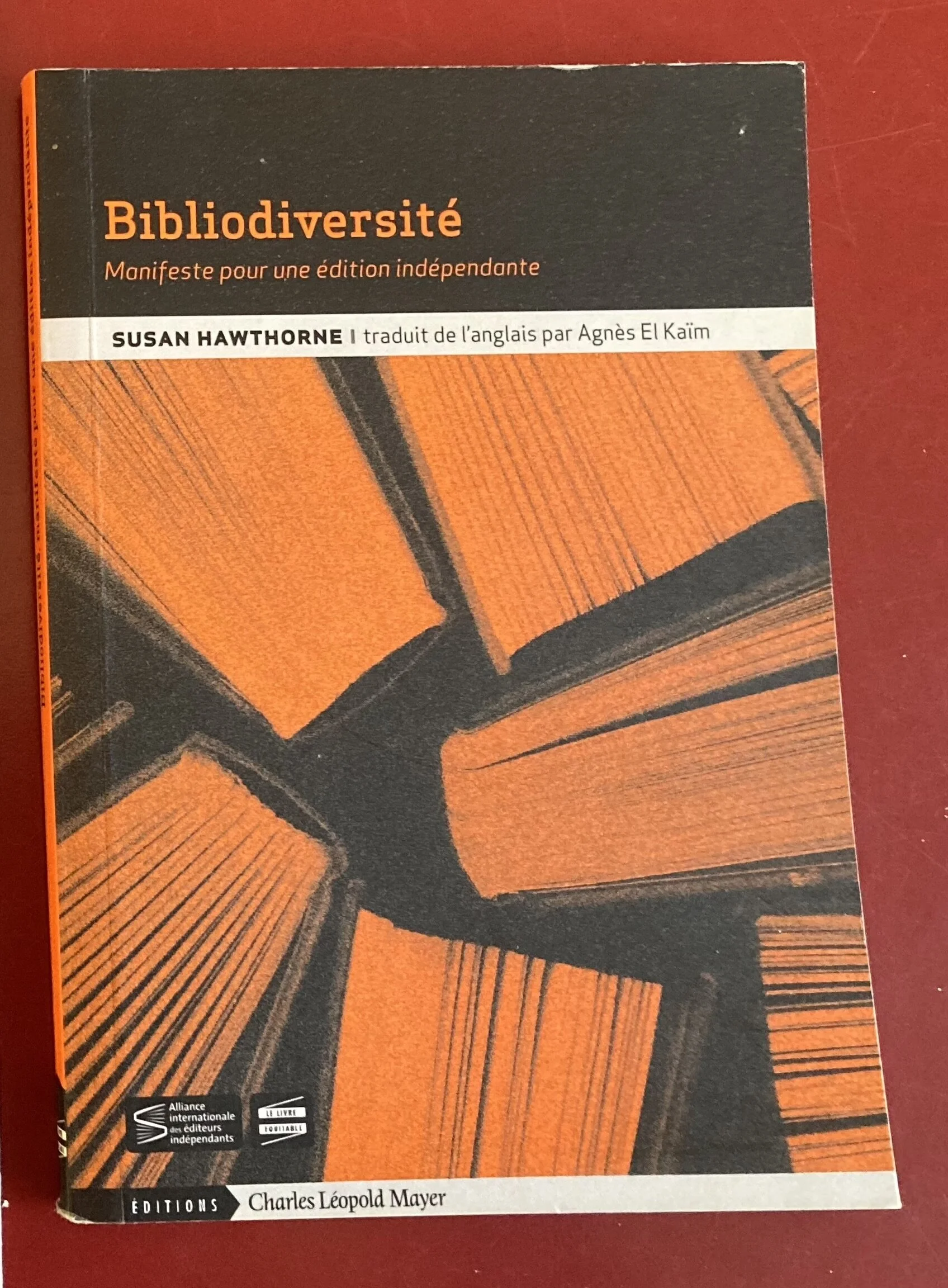
Photo (above): Bibliodiversity in French: 4 countries
French: Bibliodiversité (France: Charles Léopold Mayer, Switzerland: Éditions d'en bas, Mali: Éditions Jamana, Éditions Ruisseaux, Cameroun:Presses Universitaires d'Afrique Benin);
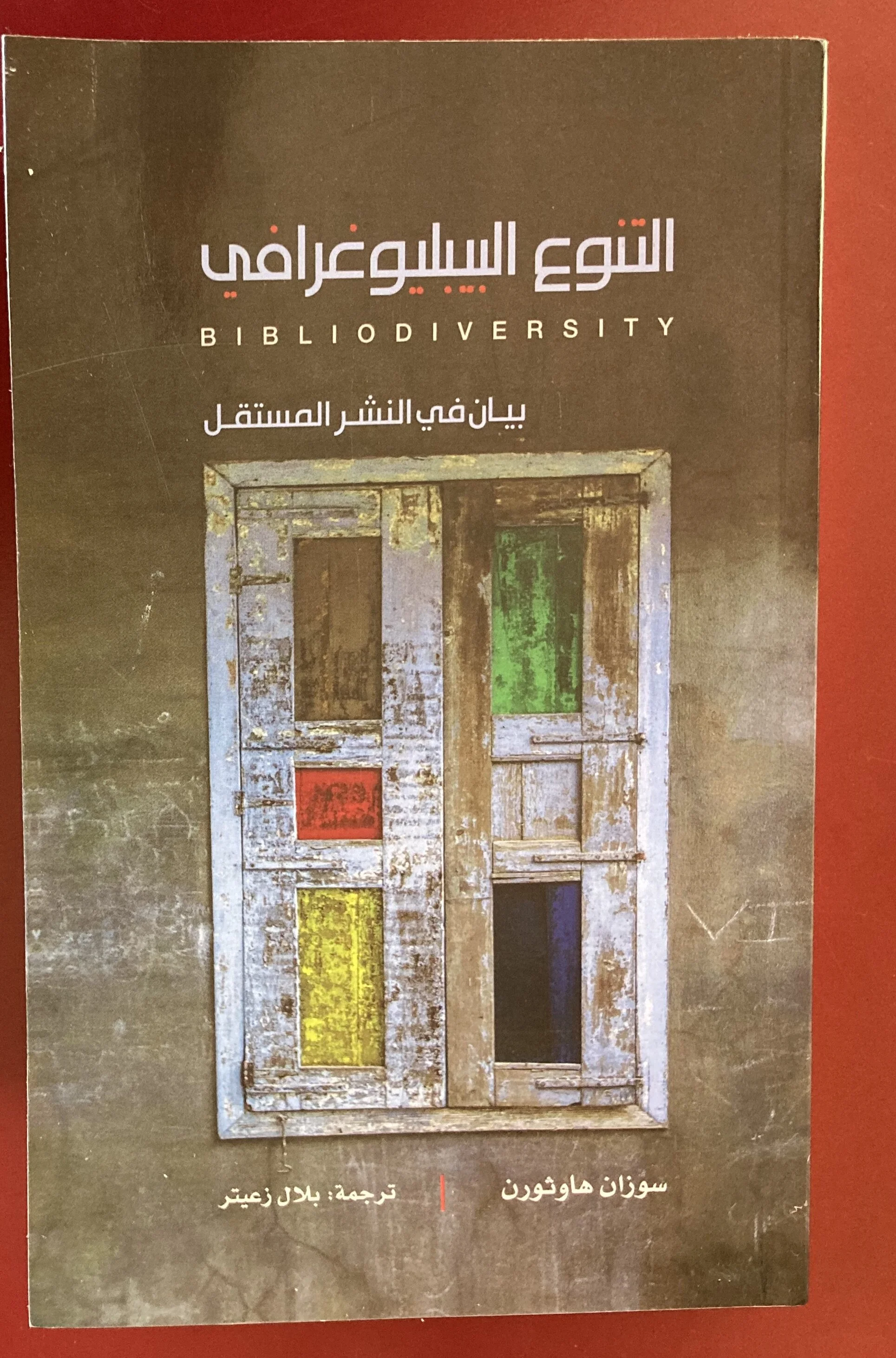
Photo (left): Bibliodiversity in Arabic: 5 countries (2 publishers in Lebanon)
Arabic: Lebanon: Al Intishar, Syria: Atlas Publishing, Lebanon: Dar Al Farabi, Egypt: Elain publishing, Tunisia: Med Ali);

Photo (above): Bibliodiversity German edition: Bibiodiversität, Verbrecher Verlag, Czech: Bibliodiverzita, wo-men publishing.
Photo (below): Co-edition with Fernwood Publishing, Canada

Below: Tamil edition of Dark Matter

Susan Hawthorne
A history of feminist and lesbian thinking from the 1970s to the present
Across almost 50 years of writing, Susan Hawthorne’s essays on lesbian culture and politics take the reader on a journey through the concerns of radical feminists engaged in the Women’s Liberation Movement. Not only does she trace the experiments of lesbians creating a vibrant woman-loving culture, but she also traces the backlash against lesbians and a history of violence perpetrated by the state, corporations and individual men.
She begins with a recollection of a rape in her pre-feminist days, followed by a critique of the institution of heterosexuality and the role of lesbian feminism as a strategy. She is soon asking questions about lesbian existence. The essays span reflections on lesbian literature and the development of lesbian culture, including the politics of physical expression in circus.
Susan Hawthorne writes about cultural appropriation, depoliticisation and the erasure of lesbian inventiveness. She researches violence against lesbians including rape, torture and murder and the way in which this violence is ignored and often distorted by the media.
Her investigations include lesbian refugees, lesbian economics, violation of lesbian human rights and the impact of the transgender industrial complex on the existence of lesbians as a political force.
SEPTEMBER 2024 | ISBN 9781925950984 | Paperback | 360 pages | 152mm x 228mm