 Image 1 of 2
 Image 2 of 2
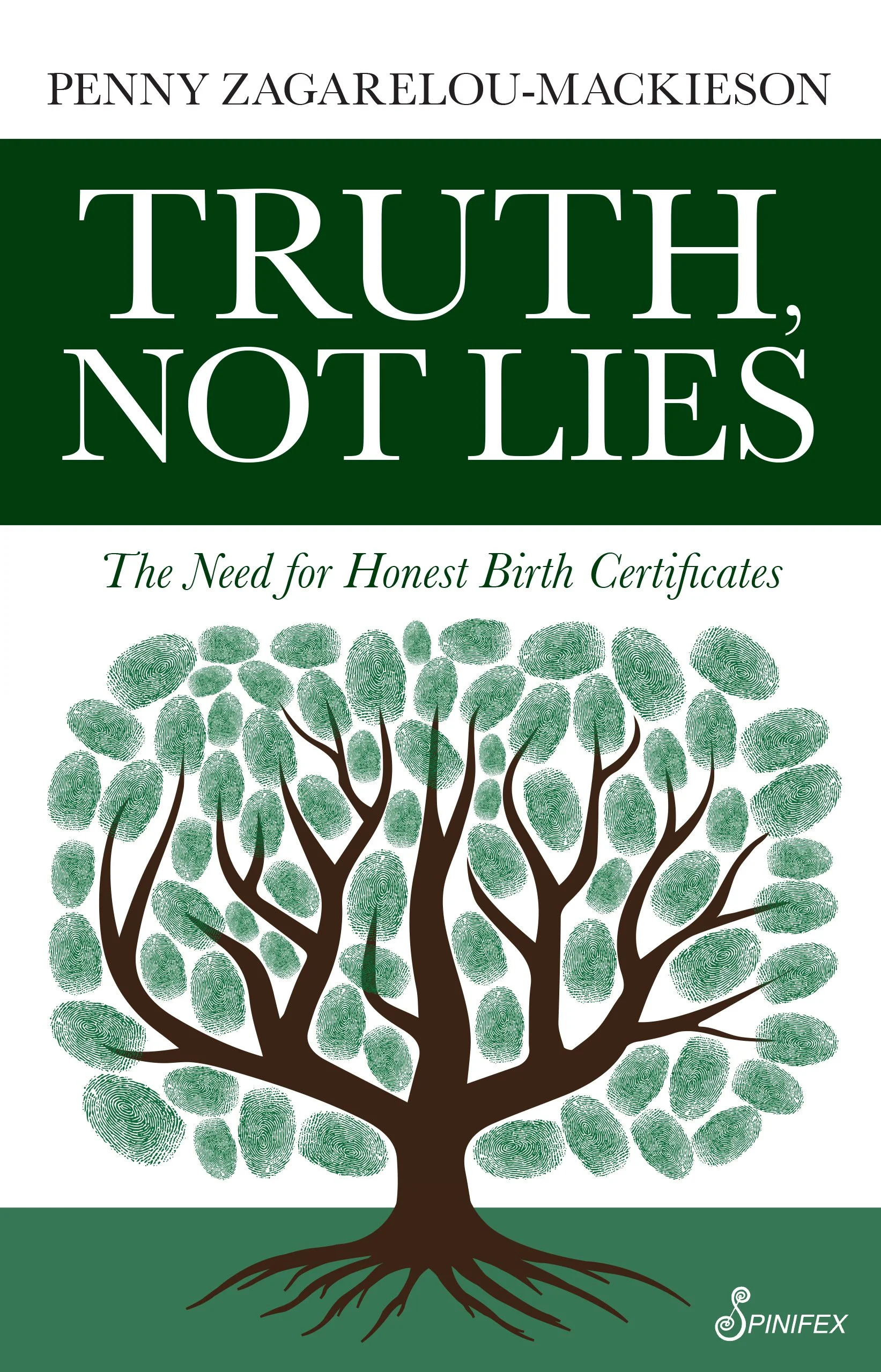
Truth, Not Lies: The Need for Honest Birth Certificates


Endorsements
Penny Zagarelou-Mackieson's contribution to the literature about adoption and donor conceived people cannot be overstated. Hers is a comprehensive, well-researched look at birth certificates and their vital importance to all of us, but especially to those who are marginalized through adoption or those conceived through surrogacy. While this book pertains mostly to the laws in Australia, the concerns, no question, should be universal. No government should be allowed to tamper with the essence of people at their core and the truth about their birth. Dr. Penny Zagarelou-Mackieson will make her readers certain of that.
—Dr Mary Cardaras, Founder and Director, the Demos Center of the American College of Greece, Greek-Born Adoptee
Having previously related her deeply personal and difficult experiences as an adoptee, Penny Zagarelou-Mackieson now turns her attention to fundamental questions of the future of adoption and surrogacy. In an extremely well researched and very readable work, we are challenged to consider the issue of the need for identity which is fundamental to us all.This is a significant contribution to our understanding of a very important issue concerning the welfare of children to know they truth of their birth. I congratulate Penny on her excellent work.
—Professor the Honourable Nahum Mushin AM, Monash University
Truth Not Lies is a masterclass in advocacy and irresistible reason.
Based on her own intimate experience, passion, professionalism and timeless principles, Penny Zagarelou-Mackieson has constructed a compelling case for truth. In some jurisdictions, altering official records is unacceptable and can be a criminal act. In Australia, individual war service records may include errors but remain sacrosanct and cannot be changed.
But in the now complex world of identity politics, adoption, ART, surrogacy and DNA testing, the foundational status of Birth Certificates has been sacrificed. Only some stakeholders are afforded the choice of access to the truth, others not – particularly the most vulnerable, children. Penny maps the problems, the inconsistencies, the inequities. She charts options for the future based on research, analysis, consultation, observation, principles and critiques.
This is a must-read text for every Australian political decision maker. Truth Not Lies will also be embraced internationally. Hats off to Penny. And lids off the truth.
—Ted Baillieu AO, Premier of Victoria 2010-2013
Penny Zagarelou-Mackieson
Dr Penny Zagarelou-Mackieson delves into the minefield of issues and political interests associated with the seemingly mundane topic of birth certificates.
She outlines why a birth certificate is an important legal document of universal concern – because it is a person’s primary means of identification throughout their entire life with intergenerational significance for the identities of their offspring.
Penny highlights that for certain individuals, however – those who are adopted, donor-conceived, or born of surrogacy – governments treat the parentage information on their official birth certificate differently to most people’s.
In the case of adoptees, the original birth certificate is cancelled and replaced with a new birth certificate that records the name(s) of the adoptive parents – as if the adoptee were naturally born to them. Penny provides an extensive history of changes to birth registration requirements and birth certificates in Australia since compulsory birth registration was introduced there in 1838, demonstrating that the treatment of birth certificates in adoptions was designed last century for the purpose of secrecy. Increasingly, closed adoption practices were intended to prevent adoptees from knowing that they were adopted, the identities of their natural parents, and their own natural identity.
In the cases of those who are donor-conceived and born from surrogacy arrangements, the parentage information recorded on their official birth certificates is treated in a similarly deceptive manner through the application of legal presumptions and mechanisms of parentage – which are genetically/biologically incorrect. As in adoption, these practices promote secrecy and erasure of birth mothers.
Penny addresses several significant challenges and harms associated with the intentionally different treatment of parentage information on birth certificates; considers options to address those problems; and argues a case for birth certificate reform – with a view to achieving equal treatment of genetic/biological parentage information on all birth certificates regardless of the circumstances of one’s conception, birth or socio-legal parenting arrangements.
This book is an important read for people genuinely concerned about human rights, identity, birth mothers and equality.
AUGUST 2026 | 9781922964472 | 270 pages