
Janice G. Raymond

Janice G. Raymond is a longtime feminist scholar-activist on violence against women and sexual exploitation. She is the former co-director of the international Coalition Against Trafficking in Women (CATW). She is the author of many books and articles, most recently the book Not a Choice, Not a Job: Exposing the Myths about Prostitution and the Global Sex Trade (Potomac Press, US; Spinifex Press, Australia). Dr Raymond is professor emerita of women’s studies and medical ethics at the University of Massachusetts, Amherst (USA) where she taught for 28 years. In 2007, Dr Raymond was awarded the International Woman Award from the Zero Tolerance Trust in Scotland.

New edition
Under the guise of liberatory science, the biomedical establishment is using women's bodies as the biological laboratories of the future. In Women as Wombs leading feminist ethicist Janice Raymond's scathing analysis of high-tech biomedical reproductive techniques contributes groundbreaking insights into the raging debate over reproductive technology and its ethical, legal, and political implications. Raymond asserts that far from being liberatory issues of ‘choice’, these techniques – including in vitro fertilization, surrogacy, and sex selection – are a threat to women’s basic human rights.
A tough brilliant mind at dance, a mind propelled by a passion for justice.
—Gena Corea, author of The Mother Machine
2019 | ISBN 9781925581874 | Paperback | 216 x 140 mm | 296 pages

A generation ago, most people did not know how ubiquitous and grave human trafficking was. Now many people agree that the $35.7 billion business is an appalling violation of human rights. But when confronted with prostitution, many people experience an odd disconnect because prostitution is shrouded in myths, among them the claims that “prostitution is inevitable,” and “prostitution is a job or service like any other.” In Not a Choice, Not a Job, Janice Raymond challenges both the myths and their perpetrators.
Raymond demonstrates that prostitution is not sex but sexual exploitation, and that legalizing and decriminalizing the system of prostitution—as opposed to the prostituted women—promotes sex trafficking, expands the sex industry, and invites organized crime. Specifically, Raymond exposes how legalized prostitution in the Netherlands, Germany, Australia, and Nevada worsens crime and endangers women. In contrast, she reveals, when governments work to prevent the demand for prostitution by prosecuting pimps, brothels, and prostitution users—as in Norway, Sweden, and Iceland—trafficking does not increase, women are better protected, and fewer men buy sex. Raymond expands the boundaries of scholarship in women’s studies, making this book indispensable to human rights advocates around the world.
2013 | ISBN 9781742198682 | Paperback | 230 x 150 mm | 249 pp

An award-winner when first published, this book has become a classic text for health activists and feminists interested in the complexities of how drugs are developed, marketed and sold to women around the world. In this book the authors review the unusual history of the French abortion pill, RU 486 (mifepristone). They scrutinize the science and politics from inception through to its use on women.
• Is RU 486 a miracle drug for abortion that is a safe and effective alternative to conventional abortion procedures?
• Does it privatize and de-medicalize the abortion experience?
• Is its availability a ‘victory’ for women?
• Is RU 486 safe for use in Third World countries and remote rural areas?
• Who benefits from chemical abortion and how does RU 486 affect existing abortion services?
The authors argue that the positive claims made for RU 486 (mifepristone) are filled with myths and misconceptions. RU 486 used on its own is a failed abortifacient and needs the addition of a prostaglandin, a dangerous drug. But the 'success' rates of the drug cocktail RU 486/prostaglandin remain at 92 to 95 per cent compared with 98 to 99 per cent for suction abortions. Suction abortions, which are best done with a local anesthetic, involve no harmful drugs and are completed in 30 minutes. By contrast, RU 486/PG abortions last for days, sometimes weeks.
Heavy bleeding, transfusions, vomiting, severe pain and infection are among the unpredictable adverse effects. Women have died from sepsis and cardiovascular events. RU 486/PG abortion benefits the medical profession, drug companies and government health economies.
Through painstaking research and analysis the authors uncover the truth that chemical abortion is ill-conceived and unethical. They caution that low-tech abortion services are under threat as the mainstream hails RU 486 abortion as 'safe and effective' which it is not.
2013 | ISBN 9781742198408 | Paperback | 200 x 130 mm | 149 pp

Janice Raymond offers a vision of female friendship that is as exhilarating as it is controversial. In this feminist classic, she explores the many manifestations of friendship between women, including the ancient Greek hetairai, the sisterhood of medieval nuns and the marriage resisters of China. Thousands of women have created their own communities and destinies through friendship. She also examines the contemporary women's movement and its networks and friendships – as well as the forces operating against friendship between women. A tough and clear-sighted analysis, and a book to read again and again.
2001 | ISBN 9781876756086 | Paperback | 230 x 154 mm | 275 pp
VERY SLOW STOCK - EBOOK AVAILABLE
Ebooks

In an age when falsehoods are commonly taken as truth, Janice Raymond’s new book illuminates the ‘doublethink’ of a transgender movement that is able to define men as women, women as men, he as she, dissent as heresy, science as sham, and critics as fascists. Meanwhile, trans mobs are treated as gender patriots whose main enemy is feminists and their dissent from gender orthodoxies.
The medicalization of gender dissatisfaction depicted by Raymond in her early visionary book, The Transsexual Empire, has today expanded exponentially into the transgender industrial complex built on big medicine, big pharma, big banks, big foundations, big research centers, some attached to big universities. And the current rise of treating young children with puberty blockers and hormones is a widespread scandal that has been named a medical experiment on children.
Whereas transsexualism was mainly a male phenomenon in the past with males undertaking cross-sex hormones and surgery, today it is notably young women who are self-declaring as men in large numbers. The good news is that these young women who formerly identified as ‘trans men’ or gender non-binary, are now de-transitioning. In this book, they speak movingly about their severances from themselves and other women, their escape from compulsive femininity, their sexual assaults, the misogyny they experienced growing up, and their journeys in recovering their womanhood.
Doublethink: A Feminist Challenge to Transgenderism makes us aware of the consequences of a runaway ideology and its costs — among them what is at stake when males are allowed to compete in female sports and when parents are not aware of school curricula that confuse sex with gender and that can facilitate a child’s hormone treatments without parental consent.
OCTOBER 2021 | 281 pages | 1MB

In an age when falsehoods are commonly taken as truth, Janice Raymond’s new book illuminates the ‘doublethink’ of a transgender movement that is able to define men as women, women as men, he as she, dissent as heresy, science as sham, and critics as fascists. Meanwhile, trans mobs are treated as gender patriots whose main enemy is feminists and their dissent from gender orthodoxies.
The medicalization of gender dissatisfaction depicted by Raymond in her early visionary book, The Transsexual Empire, has today expanded exponentially into the transgender industrial complex built on big medicine, big pharma, big banks, big foundations, big research centers, some attached to big universities. And the current rise of treating young children with puberty blockers and hormones is a widespread scandal that has been named a medical experiment on children.
Whereas transsexualism was mainly a male phenomenon in the past with males undertaking cross-sex hormones and surgery, today it is notably young women who are self-declaring as men in large numbers. The good news is that these young women who formerly identified as ‘trans men’ or gender non-binary, are now de-transitioning. In this book, they speak movingly about their severances from themselves and other women, their escape from compulsive femininity, their sexual assaults, the misogyny they experienced growing up, and their journeys in recovering their womanhood.
Doublethink: A Feminist Challenge to Transgenderism makes us aware of the consequences of a runaway ideology and its costs — among them what is at stake when males are allowed to compete in female sports and when parents are not aware of school curricula that confuse sex with gender and that can facilitate a child’s hormone treatments without parental consent.
OCTOBER 2021 | 281 pages | 2.2MB

Janice Raymond offers a vision of female friendship that is as exhilarating as it is controversial. In this feminist classic, she explores the many manifestations of friendship between women, including the ancient Greek hetairai, the sisterhood of medieval nuns and the marriage resisters of China. Thousands of women have created their own communities and destinies through friendship. She also examines the contemporary women's movement and its networks and friendships – as well as the forces operating against friendship between women. A tough and clear-sighted analysis, and a book to read again and again.
2001 | EPUB | 275 pp

Janice Raymond offers a vision of female friendship that is as exhilarating as it is controversial. In this feminist classic, she explores the many manifestations of friendship between women, including the ancient Greek hetairai, the sisterhood of medieval nuns and the marriage resisters of China. Thousands of women have created their own communities and destinies through friendship. She also examines the contemporary women's movement and its networks and friendships – as well as the forces operating against friendship between women. A tough and clear-sighted analysis, and a book to read again and again.
2001 | PDF | 275 pp
New edition
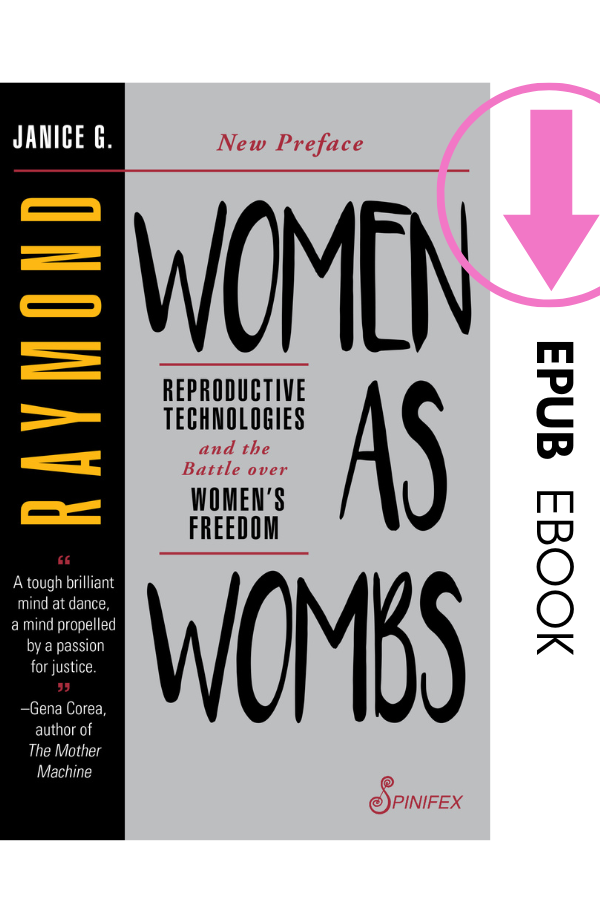
Under the guise of liberatory science, the biomedical establishment is using women's bodies as the biological laboratories of the future. In Women as Wombs leading feminist ethicist Janice Raymond's scathing analysis of high-tech biomedical reproductive techniques contributes groundbreaking insights into the raging debate over reproductive technology and its ethical, legal, and political implications. Raymond asserts that far from being liberatory issues of ‘choice’, these techniques – including in vitro fertilization, surrogacy, and sex selection – are a threat to women’s basic human rights.
A tough brilliant mind at dance, a mind propelled by a passion for justice.
—Gena Corea, author of The Mother Machine
2019 | 296 pp
New edition
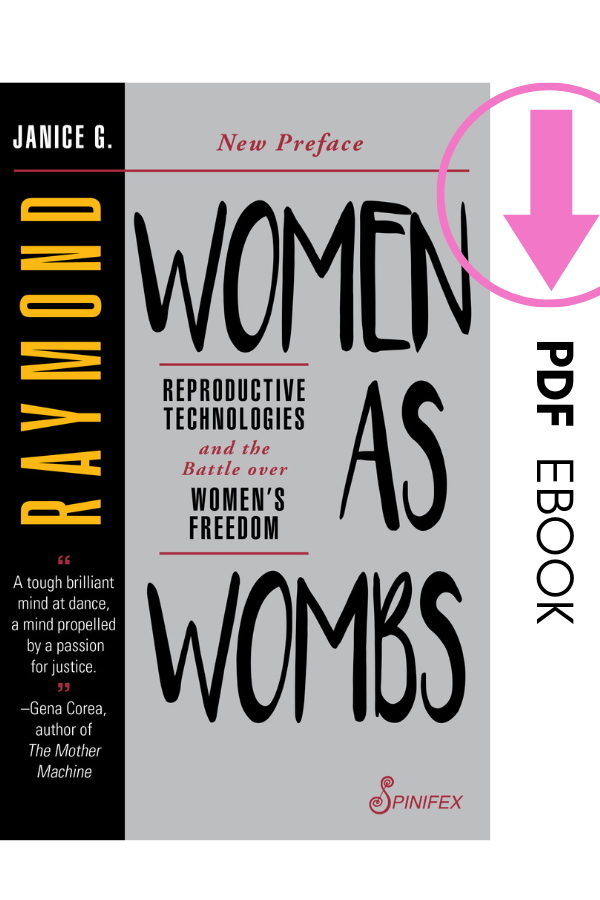
Under the guise of liberatory science, the biomedical establishment is using women's bodies as the biological laboratories of the future. In Women as Wombs leading feminist ethicist Janice Raymond's scathing analysis of high-tech biomedical reproductive techniques contributes groundbreaking insights into the raging debate over reproductive technology and its ethical, legal, and political implications. Raymond asserts that far from being liberatory issues of ‘choice’, these techniques – including in vitro fertilization, surrogacy, and sex selection – are a threat to women’s basic human rights.
A tough brilliant mind at dance, a mind propelled by a passion for justice.
—Gena Corea, author of The Mother Machine
2019 | 296 pp
Janice G Raymond
In an age when falsehoods are commonly taken as truth, Janice Raymond’s new book illuminates the ‘doublethink’ of a transgender movement that is able to define men as women, women as men, he as she, dissent as heresy, science as sham, and critics as fascists. Meanwhile, trans mobs are treated as gender patriots whose main enemy is feminists and their dissent from gender orthodoxies.
The medicalization of gender dissatisfaction depicted by Raymond in her early visionary book, The Transsexual Empire, has today expanded exponentially into the transgender industrial complex built on big medicine, big pharma, big banks, big foundations, big research centers, some attached to big universities. And the current rise of treating young children with puberty blockers and hormones is a widespread scandal that has been named a medical experiment on children.
Whereas transsexualism was mainly a male phenomenon in the past with males undertaking cross-sex hormones and surgery, today it is notably young women who are self-declaring as men in large numbers. The good news is that these young women who formerly identified as ‘trans men’ or gender non-binary, are now de-transitioning. In this book, they speak movingly about their severances from themselves and other women, their escape from compulsive femininity, their sexual assaults, the misogyny they experienced growing up, and their journeys in recovering their womanhood.
Doublethink: A Feminist Challenge to Transgenderism makes us aware of the consequences of a runaway ideology and its costs — among them what is at stake when males are allowed to compete in female sports and when parents are not aware of school curricula that confuse sex with gender and that can facilitate a child’s hormone treatments without parental consent.
OCTOBER 2021 | ISBN 9781925950380 | Paperback | 300 pages | 228 x 152 mm
THIS BOOK IS PART OF THE GENDER CRITICAL COLLECTION