In Truth, Not Lies: The Need for Honest Birth Certificates, Dr Penny Zagarelou-Mackieson asks why governments continue to record inaccurate information about people's genetic and biological origins, and why reform is long overdue.
Why did Penny write this book?
For Penny Zagarelou-Mackieson, the question of identity is deeply personal. Separated from her mother after her birth in 1963 and adopted under practices now known as forced adoption, Penny discovered through DNA testing in 2016 that she had been misidentified as a newborn in hospital. She was de-adopted in 2022.
In the Preface to Truth, Not Lies, she explains:
This book sets out to explain several significant problems associated with the intentionally different treatment of parentage information on the birth certificates of adopted, donor-conceived, and surrogacy-born persons. This book also advocates for equal treatment of genetic/biological parentage information and legal parenting responsibility information on all birth certificates, and considers options for birth certificate reform.
What's wrong with birth certificates?
Most people assume their birth certificate accurately records the facts of their birth. But for people who have been adopted, donor-conceived or born through surrogacy, this is not necessarily the case.
In Australia, a person's original birth certificate is generally cancelled and replaced following a plenary adoption, with the adoptive parents recorded as though they were the child's natural parents. Similar issues arise in donor conception and surrogacy, where legal parenting arrangements can take precedence over genetic and biological parentage.
Penny writes:
After all, the facts of one’s birth are precisely that – facts – and facts do not change over time, even if the social interpretations of and value accorded to them does.
Why should we care about honest birth certificates?
A birth certificate is much more than an administrative document. It establishes identity, provides access to essential services and carries information about a person's origins that can matter throughout their life and across generations.
As Penny explains:
This book argues for equality in relation to the parentage information recorded on official birth certificates both because birth certificates are crucial documents for individual identity and because equality matters.
What needs to change?
In Truth, Not Lies, Penny examines the historical, legal and ethical problems associated with birth certificates and considers possible reforms, including integrated birth certificates and the accurate recording of genetic and biological parentage.
Her aim is clear:
I hope that this book will make a difference – to help inform general understanding of problems associated with the parentage information currently recorded on particular birth certificates; to help stimulate meaningful discussion on the topic; and, ultimately, to help generate an environment conducive to birth certificate reform.
Truth, Not Lies: The Need for Honest Birth Certificates by Penny Zagarelou-Mackieson (2026) is out now.

Read more about Penny here
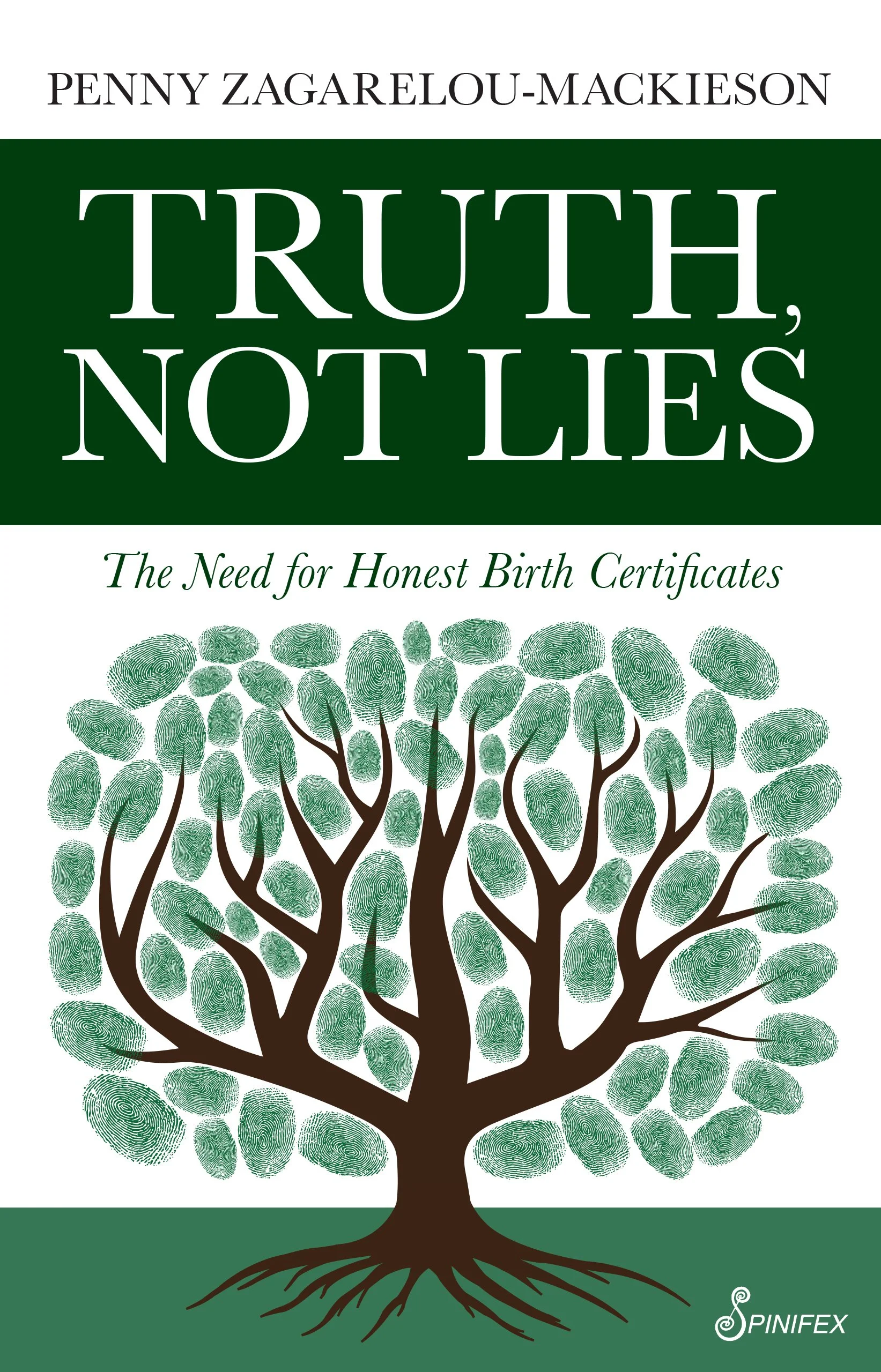
Dr Penny Zagarelou-Mackieson delves into the minefield of issues and political interests associated with the seemingly mundane topic of birth certificates.
She outlines why a birth certificate is an important legal document of universal concern – because it is a person’s primary means of identification throughout their entire life with intergenerational significance for the identities of their offspring.
Penny highlights that for certain individuals, however – those who are adopted, donor-conceived, or born of surrogacy – governments treat the parentage information on their official birth certificate differently to most people’s.
In the case of adoptees, the original birth certificate is cancelled and replaced with a new birth certificate that records the name(s) of the adoptive parents – as if the adoptee were naturally born to them. Penny provides an extensive history of changes to birth registration requirements and birth certificates in Australia since compulsory birth registration was introduced there in 1838, demonstrating that the treatment of birth certificates in adoptions was designed last century for the purpose of secrecy. Increasingly, closed adoption practices were intended to prevent adoptees from knowing that they were adopted, the identities of their natural parents, and their own natural identity.
In the cases of those who are donor-conceived and born from surrogacy arrangements, the parentage information recorded on their official birth certificates is treated in a similarly deceptive manner through the application of legal presumptions and mechanisms of parentage – which are genetically/biologically incorrect. As in adoption, these practices promote secrecy and erasure of birth mothers.
Penny addresses several significant challenges and harms associated with the intentionally different treatment of parentage information on birth certificates; considers options to address those problems; and argues a case for birth certificate reform – with a view to achieving equal treatment of genetic/biological parentage information on all birth certificates regardless of the circumstances of one’s conception, birth or socio-legal parenting arrangements.
This book is an important read for people genuinely concerned about human rights, identity, birth mothers and equality.
4 AUGUST 2026 | 9781922964465 | Paperback | 152 × 228 mm | 270 pages