
Renate Klein presents Radical Reckonings at FiLiA
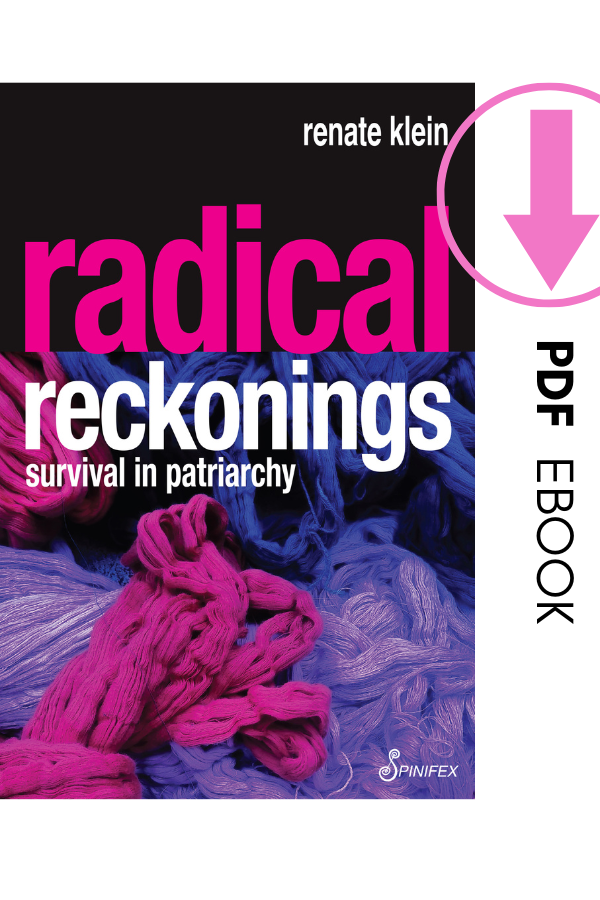
Renate Klein, author of Radical Reckonings: Survival in Patriarchy
Radical Feminist Voices: Spinifex Panel 2, FiLiA, Brighton, UK, 12 October
https://www.spinifexpress.com.au/shop/p/9781925950960
Renate Klein writes
This book has been in the making for 20 years. It started in 2006 when my partner Susan Hawthorne and my friend Belinda Morris surprised me, having put together a collection of my papers and talks. I was deeply moved. But when I took a closer look, the book would have been bigger than Ben Hur …. I tinkered around the edges, but eventually gave up as I had new papers to write, new campaigns to run. It was embarrassing, as the book had already made itself into the Spinifex catalogue …
10 years later, when we were preparing to move up North to the tropical rainforest of Australia, I found a box marked ‘Radical Reckonings’. Yet again I thought a historical collection of papers on topics I had worked on, was a great idea, but meanwhile I had of course written more … so I sighed dejectedly … but decided that the box had to travel with me, which it did – and then sat unopened in my cupboard for another 6 years when I finally took the plunge and … voilà: we have a book after a few more passionate “I give up” declarations which did NOT amuse my publisher, as Radical Reckonings was again in the Spinifex Catalogue …
Publishing old papers is a terrible ordeal. First the selections are painful, then papers need to be scanned, are unreadable and have lines all over them, etc etc. The process is not for the fainthearted and I don’t recommend it. BUT as I will never ever have to go through it again, I am VERY happy and pleased with the result!!!! And in spite of the ordeal, I hope other old lesbian radical feminists will publish similar collections. We need our history recorded in order to understand where we are going.
I describe Radical Reckonings as a ‘skeleton journey’ through my life. Even last year the manuscript was still too long and I had to lose more important papers and a whole section on Population Control. A difficult process. And it’s still a heavy tome.
What is left are six sections on topics on which I did a great deal of work. For each section i wrote a new Introduction. If you want to do a quick read of my book, just read these introductions. I talk about the papers I included, which ones I had to omit, and contextualise the papers from the 1980s, 1990s and 2000s within the current situation.
The first section in my book deals with Women’s Studies (WS) into which I plunged headlong moving on from neurobiology. I did this at the University of California at Berkeley, starting in 1978. Apart from soon co-teaching a seminar called Theories of WS with Gloria Bowles which would become a powerful book of the same title in 1983 on the need for autonomous WS, I also studied WS and I am very proud of my BA (Honours) in WS. For 3 years I immersed myself in the women-only space of WS, became a radical feminist and had my first ‘fling‘ with a woman which made me deliriously happy as I had begun to fear that I was hopelessly heterosexual. And I heard Andrea Dworkin talking at the first ever Take Back the Night Rally in San Francisco.
Clearly, I had found my new aim in life. In 1981, I moved to London and enrolled in a PhD on the Dynamics of International WS at London University. In this book I include an article entitled ‘Passion and Politics in WS in the 1990s’. I also include a 1983 paper which has been a perennial favourite: ‘The Men Problem in WS: The Expert, the Ignoramus and the Poor Dear‘. For my PhD research, I sat in on lots of WS classes and observed these men, whether they were teachers or students. I concluded then - and conclude now - that WS has to be a ‘men-free’ space. When men are present, they divide the women in the classes, with some supporting the presence of men, others being annoyed about them, which is not what WS should be about: researching the past and creating new knowledge by and for women.
My PhD research was massively interrupted by the emergence of reproductive technologies after the birth of Louise Brown, the first test-tube baby, in 1978. A woman I did not know asked me at a party what I thought about reproductive technologies and their impact on women. When I said I hadn‘t thought about it much, she suggested that, as I was a biologist, I should do a book about reprotechs. I thought I should focus on my PhD and get on with it …
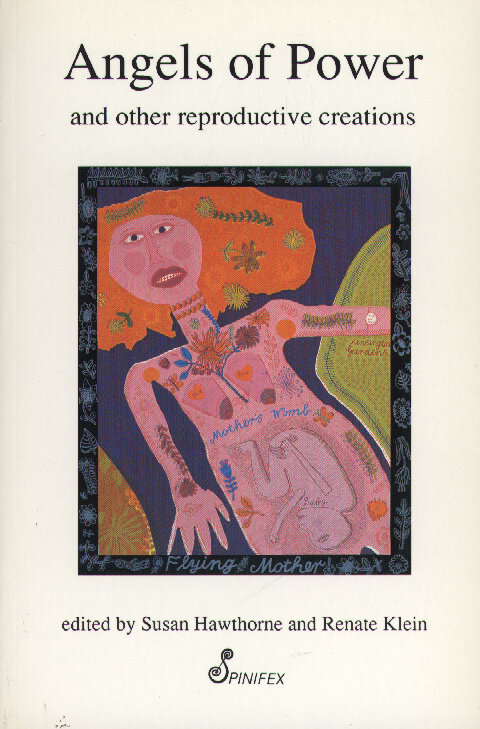
But sometimes weird ideas have long-lasting consequences, and so, together with two American friends, a biologist and a geneticist, Rita Arditti and Shelley Minden, two years later in 1984, I would co-publish the first ever feminist anthology on this topic: Test-Tube Women: What Future for Motherhood? (TTW) This book already contained articles on surrogacy, on sex selection, on the eugenic nature of these technologies and the ‘real aim‘ behind the benign façade of “helping infertile couples” - which was to gain control over which women in which part of the world should be encouraged to have children - and which other ones - poor women in poor countries - should be contracepted to the hilt and/or forced to abort their children. The three of us had been massively educated in a short time and amongst the contributors to TTW were women who would themselves write their own important books on this topic: Gena Corea, The Mother Machine (1985), Robyn Rowland, Living Laboratories (1992) and Janice Raymond, Women as Wombs (1993).
Reproductive Technologies and Genetic Engineering became the focus of my work until now as I still work almost daily for the global abolition of surrogacy. I ended up in Australia in 1986 (with PhD in hand) as I had received the Georgina Sweet fellowship to study the experiences of women with IVF. Which I did and the first paper in Section 2 on Reproductive Technologies is a summary of that study. None of the 40 women, some of whom had gone through several cycles of IVF, ended up with a live baby. Instead, they blamed themselves for ‘failing‘ even with these technologies, had gotten very ill from the strong drugs, were heavily indebted because of the high cost of IVF, and taught me a lot about how disheartening, heartbreaking and painful their IVF time had been.
After my fellowship finished I accepted a post doc at Deakin University and later started teaching and researching in the WS program. But a strong focus of my work remained on reprotechs. Together with Robyn Rowland we built up our WS program to become the largest in Australia with over 1000 students until it was cruelly felled in 2002 by a woman-hating female Dean, and turned into Gender Studies. Unsurprisingly, student numbers crashed to 50, and Gender Studies barely lasted two years, but the Dean’s aim had been achieved: rid the university of this ‘separatist’ women-centred radical lesbian feminist program!! And yes, while we had autonomy when it came to teaching our courses, we did NOT control the purse strings which meant, we could not withstand the attack on us. In Radical Reckonings I include the link to an interview from 2022 with Holly Lawford Smith on this sordid WS saga.
But back to reproductive technologies. Together with Gena Corea, Janice Raymond, Farida Akhter from Bangladesh, Robyn Rowland and Jalna Hanmer, I co-founded FINRRAGE - the Feminist International Network of Resistance to Reproductive and Genetic Engineering. We were very successful with thousands of members and chapters in 20+ countries, many books published and a journal. The media listened to us and the so-called woman on the street was not in favour of reprotechs. This success lasted till the mid 90s, when we were infiltrated with lots of money from the liberal US population control movement. It was quite similar to what happened with the Transcult. In Radical Reckonings, I include a paper about the history of FINRRAGE - its heydays and demise (although we keep going in Australia): ‘From Test Tube Women to Bodies without Women‘. I also include a talk I gave on the heterosexualisation of lesbians who all of a sudden were told that they too had to use IVF. Today this has gotten even worse: a lesbian is encouraged to have an embryo made from her partner‘s egg inserted in her womb. This, IVF experts say - and lesbians swallow it - should increase ‘bonding‘ between the two women. What they are not told is that the implantation of a ‘foreign‘ embryo greatly increases pregnancy complications such as pre-eclampsia, placenta praevia, gestational diabetes and other life-threatening problems. Like in surrogacy and in fact all IVF where donor eggs are used, women‘s bodies are not meant to carry the baby of another woman. It is dangerous.
The BIG scandal with reprotechs is how wildly unsuccessful they are. Even today, the so-called success rate - failure rate would be a better term - is in the low 20%s: not the 50 or 60% that IVF clinics brag about. It is absolutely scandalous that no long-term studies have ever been undertaken on the 80% of women who go through a multitude of IVF cycles without a baby at the end. We are told that in 2025, 10 million babies have been born from IVF which sounds impressive until you realise that this means that 40 million women have gone through IVF … so what is their physical and mental health like today? Their rates of cancer? Their experience of menopause?
The same scandal is the absence of similar longitudinal studies on children born of IVF. No one appears to care, but we know from small local studies that teenagers have already greatly elevated blood pressure, and by age 40, serious cardiovascular problems begin to show. Recently, in the UK magazine, The Critic, a 30+ year old woman born of IVF was scathing about her mode of conception. She pointed out that she had been frequently ill during her life, but that no one had ever linked her illnesses with IVF. Let‘s not forget that no one born of IVF has yet reached the age of 50, so we have no idea how their older years will pan out. In my next book project, together with Jennifer Lahl from the US, we will dig into these unsavoury questions. The ‘normalisation‘ of IVF has to stop.
Section 3 in Radical Reckonings is called ‘Medicalised for Life: Contraception, Abortion - as in RU486, the French Abortion pill - Gardasil and HRT‘. In the 80s and 90s we had feminist health centres where all these new ‘miracle pills‘ were discussed, and women could get information on the pros and cons. These days, whatever is left of these health centres appear to have become cheerleaders for the pharma industry and it is virtually impossible to even have a discussion of these dangerous developments. Take HRT as an example: after a giant Nurses Health Study in Canada was prematurely ended in 2002 because of the high numbers of study participants with invasive breast cancer, blood clots, strokes and heart attacks - women globally stopped taking HRT. But since 2024, it is back with a vengeance - and a new name: MHT (menopausal hormone therapy) - despite the fact it is exactly the same drug. Doctors encourage ever younger women to take HRT again - and to my sheer horror, their PR campaigns are working.
I think, women really need to take a deep breath and examine their renewed faith in medical men and these days medical women. What happened to the rejection of ‘doctor knows best‘ with books like How to Stay Out of the Gynecologist‘s Office from the 1970s? Women, and especially young women, need to stop blindly believing that every test and every screen - and then as a consequence - every new pill - is good for us. When I hear one more person talking about women‘s ‘mental health‘ and urging everyone to undergo a test for ADHD - even grown up women - or indeed autism - I might just scream! We need more irreverence and much more belief in being ‘Our Bodies, Ourselves‘, the crucially important slogan from the Women‘s Liberation Movement. We only have one body. Imperfect as it may be and become more so when getting older, it is who we are and we must trust and treasure it and not abdicate it to some expert who will do blood tests, genetic tests, screen every inch of our flesh and then tell us what‘s wrong with us! We have to resist this new medical colonisation of our bodies and lives and not meekly surrender.
Section 4 is on this exact topic – ‘Our Bodies, Ourselves‘, and no doubt the main message of my book is to doggedly reclaim our bodies. If we don‘t, and even increase our belief in medical miracle men, we are working right into the hands of postmodernists and queer genderists who are moving towards transhumanism, where all biological matter is reviled and indeed made redundant. As there is no Truth, no objectivity, no facts, the transcult has been able to sway governments into changing laws and earnestly repeat the delusion that human beings can change sex as it is on a spectrum. By forgetting Biology 101 which tells us that XX makes you female and XY male, such ‘wrongthink‘ mutilates bodies and creates sick patients for life (but the coffers of Big Pharma will remain full).
Section 4 also contains my 1996 chapter from my book Radically Speaking: Feminism Reclaimed which I co-edited with Diane Bell. The book contains a long section of critical papers on post-modernism. In order to write my own paper ‘(Dead) Bodies Floating in Cyberspace: Post-modernism and the Dismemberment of Women‘, I had immersed myself for over a year in reading papers by so-called ‘feminist‘ post-modernists in which they wrote about/through/in/around bodies that are texts and surfaces. What I could not find were the breathing and laughing WOMEN amidst these body fragments. Just as reprotechs use knives to cut women into pieces - wombs, fallopian tubes, ovaries - post-modernists are cutters with words. In another paper in this book ‘If I‘m a CYBORG rather than a goddess, will patriarchy go away?‘ from 1999, I scrutinise work in progress by transhumanist researchers Donna Haraway, Hans Moravec and Ray Kurzweil - the latter two are today continuing their work at the Robotics Institute at Carnegie Mellon University and at Google. At the turn of the century, the writing was already on the wall, this was - and is - the movement to do away with living bodies and exchange them for artificial robots, removed from our control. Again, I ask you to take back our bodies, to embrace ‘our bodies, ourselves‘. If we don‘t, it might soon be too late and we‘ll be gobbled up in a mix of desirable and undesirable DNA profiles, with decisions about our lives taken out of our hands: the stakes are really incredibly high.
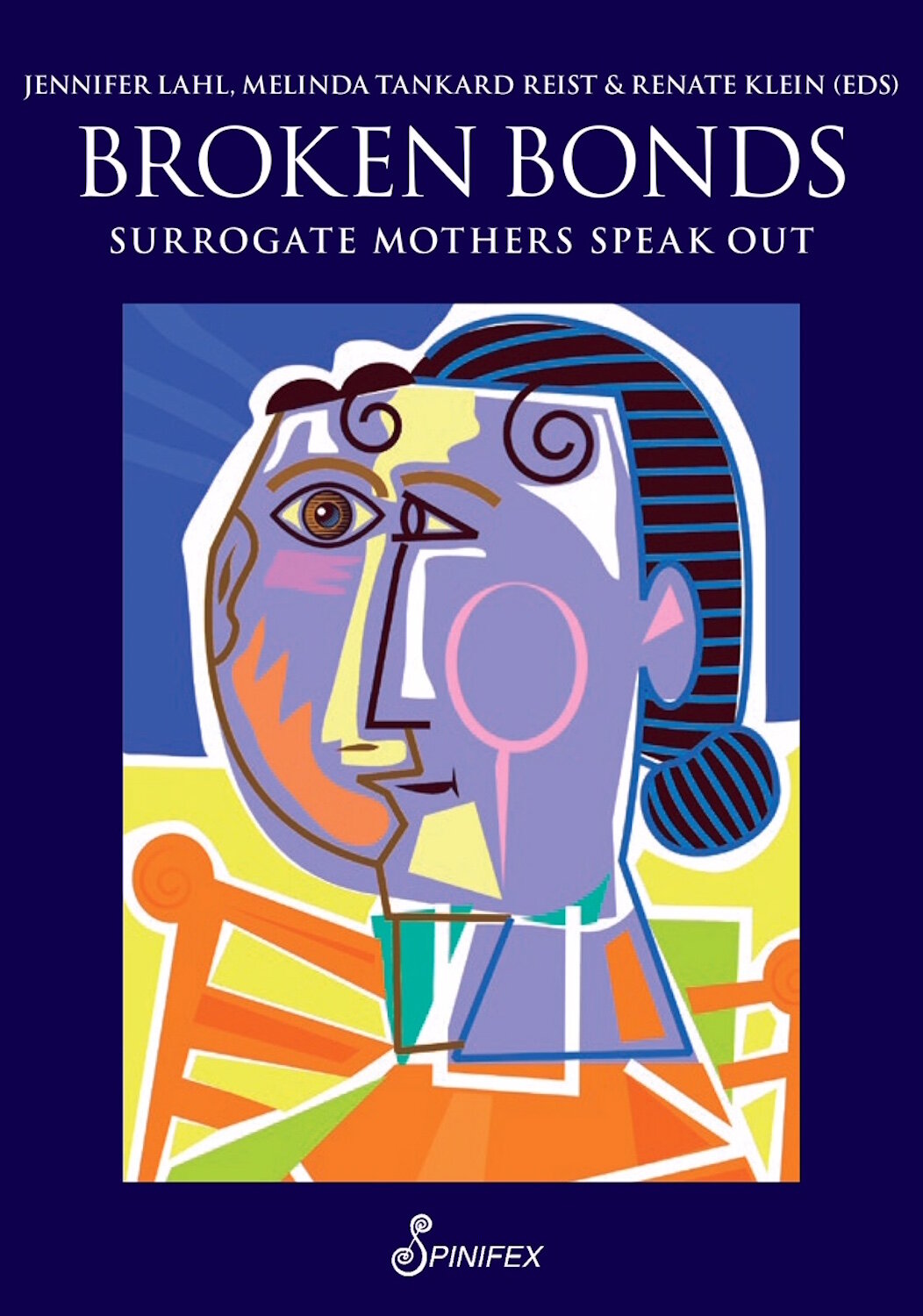
Section 5 of Radical Reckonings focusses on international surrogacy and I have no time to talk about it except to say that I want ALL surrogacy abolished globally about which we had a few recent wins: Italy and Slovakia have outlawed all surrogacy in and outside their countries. Surrogacy is a human rights violation of women and children. No one has a right to a child whether heterosexual, homosexual, in a couple or single. The 2025 report by the UN Special Rapporteur on violence against women and girls, Reem Alsalem, agrees and demands of states to start making surrogacy illegal. You have fantastic organisations in the UK like the Nordic Model, Stop Surrogacy UK and Surrogacy Concerns and together with CIAMS and the Declaration of Casablanca with Olivia Maurel as its powerful spokeswoman (both from France), i think there is hope. Together with FINRRAGE and ABSA in Australia and Stop Surrogacy in the USA, we battle on. But the gay ‘mafia’ is strong and won’t go away quietly.
And finally, we have arrived at Section 6 which I called Radical Feminist Resistance. This is my 20th book and as I turned 80 this year, it absolutely had to be finished. In this section I ask again for a new radical feminist awakening, an uproar, a rebellion. I also ask for women not to fall into The Compassion Trap by which I mean not to be always kind and giving and put others first. And I wrote a new paper in 2025 about the many patterns by which women‘s achievements are erased, invisibilised, reversed or just plain ignored. I hope this map will help us with the daily assaults by patriarchy we have to negotiate. And the last paper in Radical Reckonings is, fittingly, the Keynote i delivered in 1996 here in Brighton, in this same venue, entitled ‘Patriarchal Control of Women‘s Lives: Globalised Fragmentation of Bodies and Mind‘. With this battle cry I ask you to resist wherever you can.

Renate Klein
What happens when an old radical lesbian feminist has an idea of publishing a collection of her papers? She looks at her writings and despairs. She has written too much. The idea gets shelved. Fifteen years later, she revisits the project. But it is worse now because she has written more … But being stared down by her publisher she gets a grip and (painfully) pares down her oeuvre to a manageable size.
This then is a skeleton journey through Renate’s life and her survival in patriarchy. The book starts with her passion for autonomous Women’s Studies as an intellectual necessity and radical feminist research methodology to give women a voice. And why men don’t belong in Women’s Studies classes. Next, she documents her immersion in a critique of reproductive technologies as a member of FINRRAGE. We hear about the exploitation of a desire in IVF followed with problems of egg ‘donations’, cloning, and of course the human rights violation of women and children in surrogacy. A critique of the illusion of ‘choice’ – endorsed by liberal feminists – has to be in the book and with it papers on long-acting contraceptives. Necessary warnings about the unethics of hormone replacement therapy and the French abortion pill RU 486 are included too.
As a feminist women’s health activist, Renate Klein has always been concerned about the fact that women are our bodies and that reproductive technologies in tandem with postmodern and queer theories result in the fragmentation and dismemberment of women: from the one an egg, from the other a uterus … this erasure of women is helped by dissociation and a belief in delusions – such as the assault on women’s existence by transgender ideologues.
Aged 80, Renate Klein continues her quest for the liberation of all women, whatever age, sexuality, abilities and wherever we live. She is ‘not dead yet’ and hopes this collection will stir young women into action to continue the crucial rebellion against the system of patriarchy before it fully crushes women, animals and nature.
9 SEPTEMBER 2025 | ISBN 9781925950960 | Paperback | 152 mm x 229mm | 492 pages

Read more about Renate Klein here.




Older titles



Renate Klein
What happens when an old radical lesbian feminist has an idea of publishing a collection of her papers? She looks at her writings and despairs. She has written too much. The idea gets shelved. Fifteen years later, she revisits the project. But it is worse now because she has written more … But being stared down by her publisher she gets a grip and (painfully) pares down her oeuvre to a manageable size.
This then is a skeleton journey through Renate’s life and her survival in patriarchy. The book starts with her passion for autonomous Women’s Studies as an intellectual necessity and radical feminist research methodology to give women a voice. And why men don’t belong in Women’s Studies classes. Next, she documents her immersion in a critique of reproductive technologies as a member of FINRRAGE. We hear about the exploitation of a desire in IVF followed with problems of egg ‘donations’, cloning, and of course the human rights violation of women and children in surrogacy. A critique of the illusion of ‘choice’ – endorsed by liberal feminists – has to be in the book and with it papers on long-acting contraceptives. Necessary warnings about the unethics of hormone replacement therapy and the French abortion pill RU 486 are included too.
As a feminist women’s health activist, Renate Klein has always been concerned about the fact that women are our bodies and that reproductive technologies in tandem with postmodern and queer theories result in the fragmentation and dismemberment of women: from the one an egg, from the other a uterus … this erasure of women is helped by dissociation and a belief in delusions – such as the assault on women’s existence by transgender ideologues.
Aged 80, Renate Klein continues her quest for the liberation of all women, whatever age, sexuality, abilities and wherever we live. She is ‘not dead yet’ and hopes this collection will stir young women into action to continue the crucial rebellion against the system of patriarchy before it fully crushes women, animals and nature.
SEPTEMBER 2025 | ISBN 9781925950977 | 473 pages