
Ecology of the Book
Presentation by Susan Hawthorne | International Alliance of Independent Publishers | Pamplona Spain | 23 November 2021
Production: organic farming and organic publishing
Farida Akhter in Bangladesh is both a farmer and a publisher and she writes of farming that “the New Agricultural Movement is not to produce more food for consumers, but to create life, diversity and Ananda [to live a happy life]” (2001). I too come from a farming background and when Renate Klein and I set up Spinifex Press in 1991, we made a conscious decision to stay small. We were not interested in growth for growth’s sake, instead what we wanted was small-scale publishing, like the organic farmer who has her best results on limited acreage. Staying small enables the farmer to produce something unique, to retain flavour that can’t be produced industrially. Industrial scale agribusiness claims that organic is only for the rich, but Farida has shown by example how people with few resources can create nutritious food grown without pesticides or the intervention of big seed companies
The world’s paper is produced industrially in plantation forests. Native forests are clear-felled and replaced by exotics. This destroys biodiversity. The bigger the publishing company the bigger the print runs. In turn, large print runs create excess stock returned by booksellers: wasted books, wasted paper, wasted trees. Returns lead to unnecessary use of oil and diesel and create high book miles. As a small independent, we have small print runs, PODs, ebooks and very low returns. We also insist that our papers are either FSC (Forest Stewardship Council) and PEFC (Programme for Endorsement for Forest Certification). The latter are mostly Australian based. We have looked into the use of inks – whether vegetal or chemical – and at this stage because soy is the basis of most vegetal inks, and because soy is a problematic industrialised crop, we have not moved towards using those inks. While we have noticed quite a few journal publishers using unlaminated stock on covers, we have not yet gone down this path, but it is something we are considering.
Other aspects of production include ebooks which we have been producing since 2006. With a few exceptions, almost our entire list is digitised and it is a standard part of our publication of a book. Co-productions – working with other independent publishers – has been a consistent part of our process since 1992. We have worked with publishers in India, South Africa, Canada, the Philippines, USA and UK.
In summary, reducing book miles, keeping print runs short, using paper grown in registered sustainable forests and staying small are at the core of keeping waste out of our production systems. I believe that organic publishing produces better books and wish that readers understood more about the ecology of publishing. A sustainable industry is one in which books have more than a three-month shelf-life. We have discovered that zoom launches can be just as successful as book tours that involve expensive air miles. Small is beautiful, and so is independent.
Interconnection between the different actors
What about content? Our books are more than products, they are the considered thoughts of authors, the work of editors, designers and typesetters, all of which affect the look and feel of a book, its readability and the way a book sits inside a culture. The ideas and the way in which a book is received are important. The selling and marketing of books is often a challenge for small and independent publishers who cannot pay to have our books noticed. In the mega publishing world publishers become booksellers; booksellers (like Amazon) become publishers; they set up different language offices where translation can happen in-house; they sponsor writers festivals that put their authors on the biggest stages. These are systems in which the power of money distorts speech into a commodity. It removes the imaginative because the books published by these systems are formulaic, genre bound and resemble a dangerous weed that has infested an ecosystem destroying biodiversity.
For bibliodiversity to be resilient we need the concept of fair speech. In 2010, Betty Mclellan in her book Unspeakable invented the term ‘fair speech’ and I picked up on it in my book Bibliodiversity. Fair speech can be compared to fair trade and free speech to free trade. Most of us are familiar with the idea of free speech, but what is rarely taken into account is the libertarian nature of free speech. Pornographers are all for free speech because it makes them billions of dollars in profits. What we get is the speech of the powerful. By contrast, fair speech takes account of context and of the power relations between the speakers. The freedom to be a bigot takes precedence over fairness in social relations.
To summarise the difference:
Free trade / free speech favours the powerful
Free trade / free speech fosters and entrenches inequality
Free trade / free speech focuses on the individual
Free trade / free speech ignores quality of life (McLellan 2010 pp. 52-58)
Fair trade / fair speech decentralises power
Fair trade / fair speech fosters justice and fair treatment
Fair trade / fair speech focuses on the common good and engagement
Fair trade / fair speech highlights the importance of life over justice
The upsurge of cancel culture purports to be an instance of fair speech because it claims to be the disempowered speaking out. But in fact, it is an appropriation of the free speech model that enables those who feel silenced to speak up whatever the cost. Cancel culture is used by those with loud voices steamrolling over their targets. An instance of this to which Spinifex has been subjected, is the cancel culture of the transgender lobby, funded by billionaires who run medical and pharmaceutical companies making huge profits from lifelong use of dangerous drugs and dangerous surgery that will affect the lives of the now mostly young women (especially lesbians) for the rest of their lives. Several of our authors have been subjected to cancel culture simply for writing on this subject.
Bibliodiversity
Just as biodiversity is an indicator of the health of an ecosystem, the health of an eco-social system can be found in its multiversity and the health of the publishing industry in its bibliodiversity. These are complex systems that are in dynamic balance. Here are six principles that are important to foster bibliodiversity.
Networks: interconnected social relationships such as that sponsored by the Alliance. It could include a poem that generates a musical composition or the ways in which traditional knowledges pollinate the culture. We are seeing a lot of this in Australia with many works by Indigenous writers, artists, film makers.
Nested systems: this is about systems within other systems. Publishing houses are nested within specific cultures, for example Spinifex is nested in the feminist culture both in Australia and internationally and we have a responsibility towards those cultures and our content reflects that.
Cycles: members of an eco-social system depend on the continual exchange of energy through ideas and storytelling.
Flows: every culture needs a continual flow of ideational energy. Publishers have a responsibility to contribute to that flow in respectful and imaginative ways.
Development: all culture changes over time whether it’s a child’s story or the shifts in technology that changes how stories are told. Consider orature (oral storytelling, myth and legend) to literature (papyrus, palm leaf, hand-copied manuscripts, printed books); and finally the shift from the printed book, to ebooks and digital devices.
Dynamic balance: this is achieved with dynamic feedback loops so that a bibliodiverse and multiverse community maintains a reasonable steady state. It is the basis of cultural resilience. The importance of languages. For Spinifex, the publication of the book Karu: Growing Up Gurindji by three Aboriginal women elders and a translator in Gurindji and English is a political and cultural statement about Indigenous languages in Australia. QR codes in the book allow the reader to listen to the spoken language. This was a bringing together of new and old technologies.
I want to give a few examples of books which contribute to bibliodiversity. With almost 300 books published these are just a few of them.
The Poetics of a Plague, A Haiku Diary by poet and disability advocate Sandy jeffs. Written in response to the world’s longest lockdown in Melbourne during 2020 and 2021. It is funny, insightful, sometimes melancholic but always full of clear and precise observation of the human condition.
Detransition: Beyond before and after by Max Robinson a young US lesbian activist who unpacks the profitable industries involved in this wholesale violation of women. She refers to the assimilation industries including liposuction, rhinoplasty (nose operation) and blepharoplasty (eye operation) – all of which are profitable surgeries to ‘normalise’ those who are different – ie fat, Jewish, Asian.
Towards the Abolition of Surrogate Motherhood, an anthology produced in collaboration with the International Coalition for the Abolition of Surrogate Motherhood based in Paris. French and Spanish editions of the book will be published in 2022. This is an area in which women living in poverty, in countries with lax or no laws about exploitation are used as ‘baby machines’.
Locust Girl by Philippine-Australian writer Merlinda Bobis, a novel about climate change, the theft of water and the consequences of war. It won the Christina Stead Award for Fiction in 2016.
All these books contribute to bibliodiversity, taking up issues of poverty, war, Indigenous languages, profiteering on women’s bodies, disability and lesbian exclusion. As the US singer songwriter Alix Dobkin said, “There are only two responses to freedom. One is trying to control everything. The other is to be creative and take risks.” We are on the side of creative risk taking.
One final statement: our abuses of nature are resulting in an over-heated planet driving headlong towards catastrophic climate change. Our abuses of culture are resulting in an increasing levels of violence reflected in books that are the cultural equivalent of climate change: promoting the violence of pornography, hatred and misogyny, monocultural and racist violence against the ‘other’, and war-mongering. Independent publishers must keep publishing risky, innovative and long-lasting books out of our passion for telling stories. Books from now for the future.


In a globalised world, megacorp publishing is all about numbers, about sameness, about following a formula based on the latest megasuccess. Each book is expected to pay for itself and all the externalities of publishing such as offices and CEO salaries. It means that books which take off slowly but have long lives, the books that change social norms, are less likely to be published.
Independent publishers are seeking another way. A way of engagement with society and methods that reflect something important about the locale or the niche they inhabit. Independent and small publishers are like rare plants that pop up among the larger growth but add something different, perhaps they feed the soil, bring colour or scent into the world.
Bibliodiversity is a term invented by Chilean publishers in the 1990s as a way of envisioning a different kind of publishing. In this manifesto, Susan Hawthorne provides a scathing critique of the global publishing industry set against a visionary proposal for organic publishing. She looks at free speech and fair speech, at the environmental costs of mainstream publishing and at the promises and challenges of the move to digital.
2014 | 9781742199306 | Paperback | 104 pages
THIS BOOK IS PART OF THE SPINIFEX SHORTS COMPLETE COLLECTION
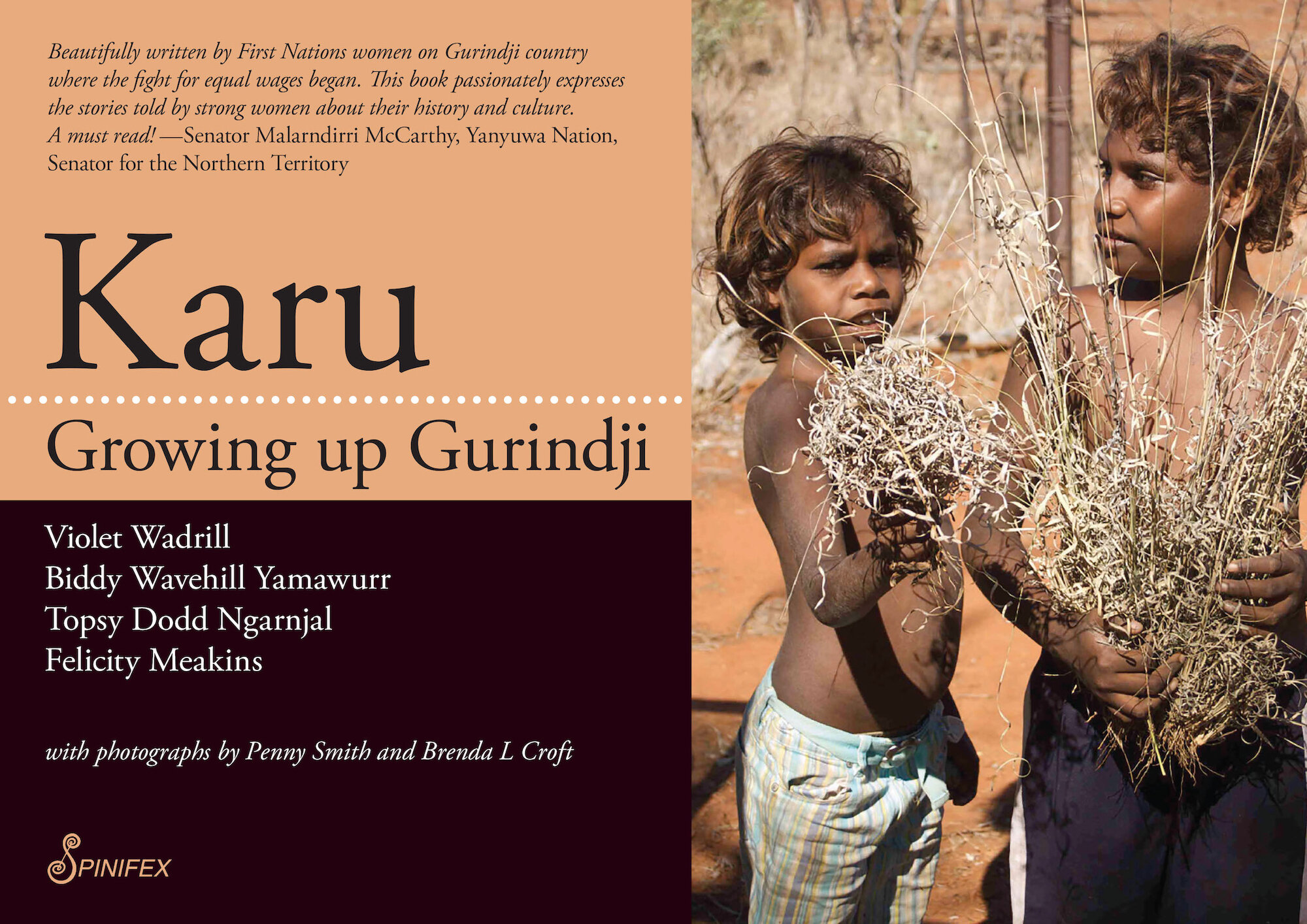

Biddy Wavehill Yamawurr, Felicity Meakins, Topsy Dodd Ngarnjal, Violet Wadrill
Gurindji country is located in the southern Victoria River in the Northern Territory of Australia. Gurindji people became well known in the 1960s and 1970s due to their influence on Australian politics and the Indigenous land rights movement. They were instrumental in gaining equal wages for Aboriginal cattle station employees and they were also the first Aboriginal group to recover control of their traditional lands.
In Karu, Gurindji women describe their child-rearing practices. Some have a spiritual basis, while others are highly practical in nature, such as the use of bush medicines. Many Gurindji ways of raising children contrast with non-Indigenous practices because they are deeply embedded in an understanding of country and family connections. This book celebrates children growing up Gurindji and honours those Gurindji mothers, grandmothers, assistant teachers and health workers who dedicate their lives to making that possible.
2019 | ISBN 9781925581836 | Paperback | 210 x 297 mm | 96 pp | Four colour + QR codes

The 2020-2021 Covid-19 Pandemic
What was it like to live in Melbourne during the 2020-2021 lockdowns? Capturing the day-to-day struggles of lockdown, the daily news, Dan Andrews’ 11am morning press conferences, the tensions between Victorians and the rest of Australia, Trump’s chaotic America, the conspiracy theories that circulated and battling her own mental health, Sandy Jeffs takes us through the whirlwind of events in imaginative haiku poems. These became her sanity while the world spiralled into madness.
First wave fear is back.
Before an end was in sight
now there is no end.
Trying to make sense
of an unravelling world
that is downright mad.
This is not only a book about the pandemic but also about political wins and political failures. From Dan Andrews to Donald Trump. Each day brings news that creates despair or joy: the pandemic numbers and the voting numbers side by side. And as the world is in the grip of COVID madness, sanity is found in poetry.
NOVEMBER 2021 | ISBN 9781925950366 | Paperback | 191 x 235 mm | 300 pp

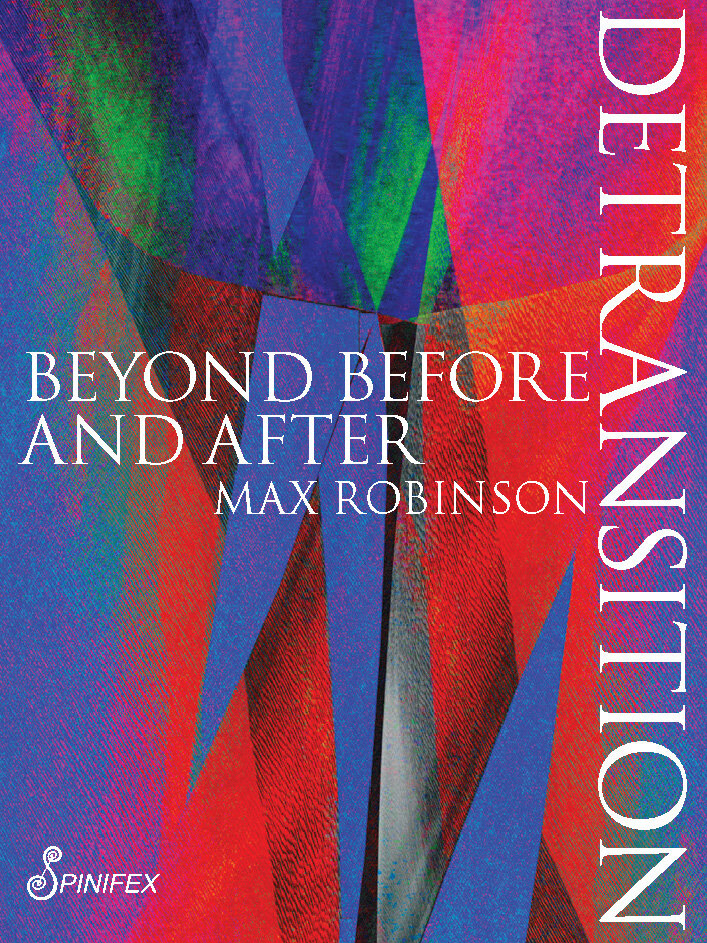
I experienced my transition as a form of resistance, but in reality it only affirmed the same stereotypes that had done me harm to begin with. Trying to prevent myself from committing suicide by becoming less recognizably female was an attempt at resistance that, politically, functioned in many ways as a form of capitulation.
Many feminists are concerned about the way transgender ideology naturalizes patriarchal views of sex stereotypes, and encourages transition as a way of attempting to escape misogyny.
In this brave and thoughtful book, Max Robinson goes beyond the ‘before’ and ‘after’ of the transition she underwent and takes us through the processes that led her, first, to transition in an attempt to get relief from her distress, and then to detransition as she discovered feminist thought and community.
The author makes a case for a world in which all medical interventions for the purpose of assimilation are open to criticism. This book is a far-reaching discussion of women’s struggles to survive under patriarchy, which draws upon a legacy of radical and lesbian feminist ideas to arrive at conclusions. Robinson’s bold discussion of both transition and detransition is meant to provoke a much-needed conversation about who benefits from transgender medicine and who has to bear the hidden cost of these interventions.
Transition is not an unconstrained choice when we are fast-tracked to medical intervention as if being female was a tumor that required immediate removal to save our lives.
SEPTEMBER 2021 | ISBN 9781925950403 | Paperback | 135 x 180 mm | 200 pages
THIS BOOK IS PART OF THE GENDER CRITICAL COLLECTION & THE SPINIFEX SHORTS COMPLETE COLLECTION


Marie-Josèphe Devillers and Ana-Luana Stoicea-Deram (Eds)
Surrogacy is not liberty. It is a crime. Women will not settle for junk liberty. We want real freedom – the substance, not just the appearance. We want real nourishment for our spirits. We want human dignity. We want it for all of us. We want it for women in Thailand and Bangladesh and Mexico as well as for the women who have not yet been born.
—Gena Corea
In this eloquent and blistering rejection of surrogacy, a range of international activists and experts in the field outline the fundamental human rights abuses that occur when surrogacy is legalised and reject neoliberal notions that the commodification of women’s bodies can ever be about the ‘choices’ women make.
Yoshie Yanagihara shows how feminist ideas have been twisted to extend men’s freedom and their rights to access surrogacy. Catherine Lynch rails against surrogacy as the creation of babies for the express purpose of removal from their mothers, outlining the tragic outcomes for adopted people. Phyllis Chesler argues that commercial surrogacy is matricidal, “slicing and dicing biological motherhood” into egg donor, ‘gestational’ mother and adoptive mother. Melissa Farley debunks the myth of ‘choice’ in surrogacy, arguing that in a male-dominated and racist system, the exploitative sale of women in surrogacy, like in prostitution, is inherently harmful —rich women do not make the choice to become surrogates or prostitutes.
Other contributors to this book, which is published in conjunction with the International Coalition for the Abolition of Surrogate Motherhood, are Gena Corea, Renate Klein, Gary Powell, Rita Banerji, Marie-Josèphe Devillers, Laura Isabel Gómez García, Alexandra Clément-Saby, Taina Bien-Aimé, Silvia Guerini, Laura Nuño Gómez and Eva Maria Bachinger.
Editors Marie-Josèphe Devillers and Ana-Luana Stoicea-Deram are long-term activists against surrogacy and live in France.
Harm cannot be regulated, because this would mean spreading and universalising it.
—Silvia Guerini
NOVEMBER 2021 | ISBN 9781925950427 | Paperback | 232 pages | 228 x 152 mm


Most everything has dried up: water, the womb, even the love among lovers. Hunger is rife, except across the border. One night, a village is bombed after its men attempt to cross the border. Nine-year old Amedea is buried underground and sleeps to survive. Ten years later, she wakes with a locust embedded in her brow. This political fable is a girl’s magical journey through the border. The border has cut the human heart. Can she repair it with the story of a small life? This is the Locust Girl’s dream, her lovesong—
For those walking to the border for dear life
And those guarding the border for dear life
Awards
Winner, Christina Stead Prize for Fiction, 2016
Winner, Philippine National Book Award for Best Novel in English
Shortlisted, ACT Book of the Year Award, 2016
2015 | ISBN 9781742199627 | Paperback | 192 pages