
 Image 1 of 2
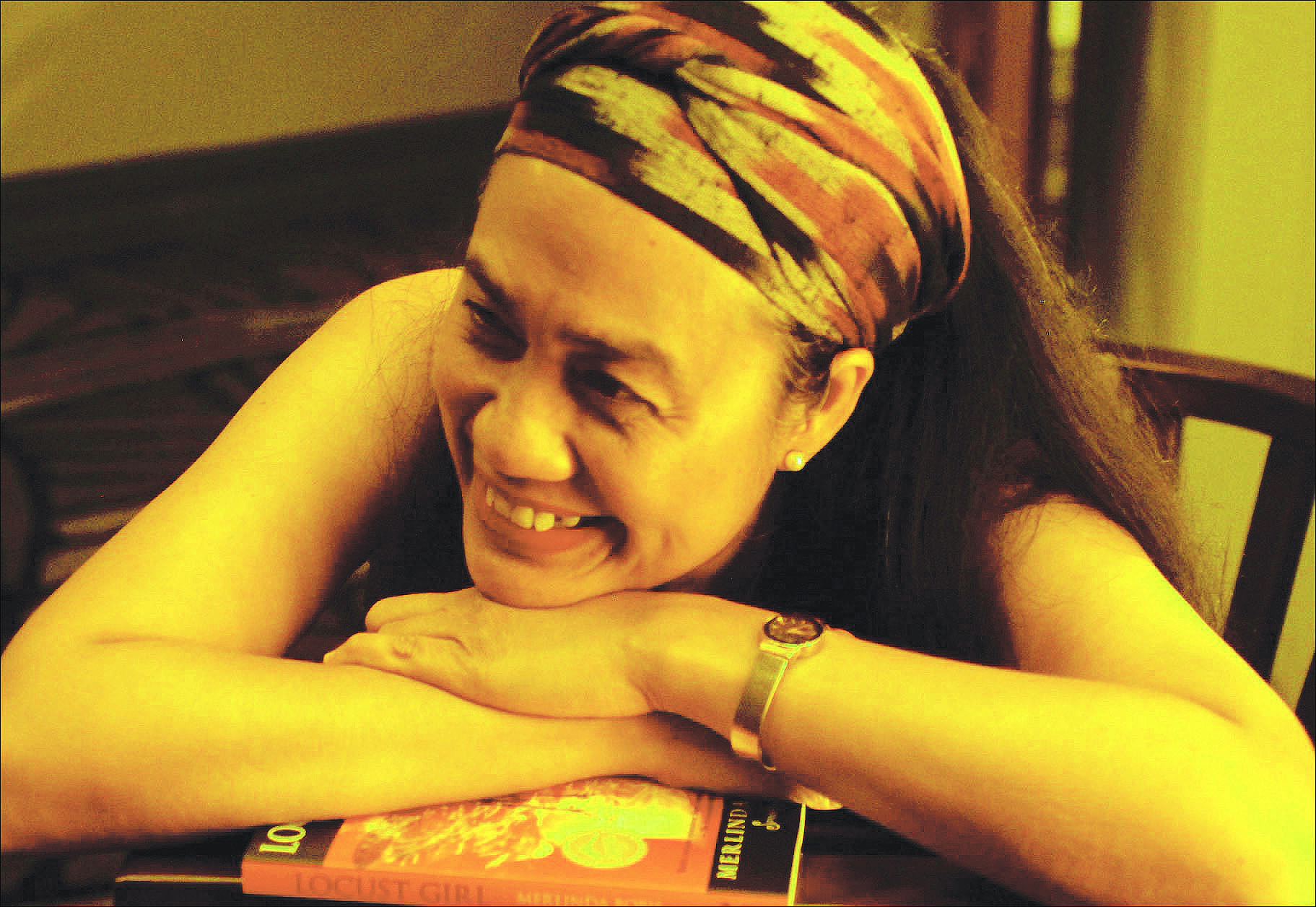 Image 2 of 2
Accidents of Composition
The eyes catch a black bird close to an eerie sun. Instantly, a poem: an accident of composition. Or a tree, rock, light from a story heard, dreamt, read or remembered returns as if it were the only tree, rock, light in the planet. The poet is caught, returned to her first heart: poetry.
After four novels, Merlinda offers seventy-six poems from the stillness of contemplation to the spinning of tales, then to passage across different histories. Glass becomes eternal greens underwater, fish gossip about colonisation, a gumnut turns dissident, and the dreams of Captain Cook and Pigafetta circumnavigate the globe leaving a trail of blood, beads, and the scent of cloves. But in between, the poet hopes: ‘there could be accidents / of kindness here.’
In her latest collection of poetry, award-winning author Merlinda Bobis traces the accidents of art and life. Drawing on the journal of Pigafetta whose writings have become an accident of history, Merlinda Bobis composes with an attuned ear and her poems are rich with imagery; with breath and heart.
2017 | ISBN 9781742199986 | Paperback | 210 x 148 mm | 184 pp
The eyes catch a black bird close to an eerie sun. Instantly, a poem: an accident of composition. Or a tree, rock, light from a story heard, dreamt, read or remembered returns as if it were the only tree, rock, light in the planet. The poet is caught, returned to her first heart: poetry.
After four novels, Merlinda offers seventy-six poems from the stillness of contemplation to the spinning of tales, then to passage across different histories. Glass becomes eternal greens underwater, fish gossip about colonisation, a gumnut turns dissident, and the dreams of Captain Cook and Pigafetta circumnavigate the globe leaving a trail of blood, beads, and the scent of cloves. But in between, the poet hopes: ‘there could be accidents / of kindness here.’
In her latest collection of poetry, award-winning author Merlinda Bobis traces the accidents of art and life. Drawing on the journal of Pigafetta whose writings have become an accident of history, Merlinda Bobis composes with an attuned ear and her poems are rich with imagery; with breath and heart.
2017 | ISBN 9781742199986 | Paperback | 210 x 148 mm | 184 pp


As if we fit together like old shards
orphan, unfortunate, drunk, prostitute
in a neat history of broken glass
The Abbotsford Convent becomes more than the setting, the grey mince-meat walls, of this collection. It emerges as presence, intimate and familiar as well as constraining and forbidding. But it is childhood itself which becomes the subterranean geography and pulse. Subject to an overworld of lay and religious adults, the razor of power having such adult force, the voices in these poems create multiple pathways through memory and time as they map and navigate the many-stranded mysteries of their institutionalised lives.
The Abbotsford Mysteries incorporates a medley of voices and experiences, drawn from official histories and other archives: the memories of Patricia and her sisters, and the oral memoirs of over seventy women, interviewed by Patricia during 2003-04. All had been resident at the Good Shepherd Convent at some stage during 1927-74.
Voice is central to the work: the persona speaking the poems does so on behalf of all the voices who contributed their memoirs. Often their words are woven verbatim into the poems, giving a particular and poetic resonance to a significant aspect of Melbourne and Australia’s institutional, religious, social, and architectural history.

The eyes catch a black bird close to an eerie sun. Instantly, a poem: an accident of composition. Or a tree, rock, light from a story heard, dreamt, read or remembered returns as if it were the only tree, rock, light in the planet. The poet is caught, returned to her first heart: poetry.
After four novels, Merlinda offers seventy-six poems from the stillness of contemplation to the spinning of tales, then to passage across different histories. Glass becomes eternal greens underwater, fish gossip about colonisation, a gumnut turns dissident, and the dreams of Captain Cook and Pigafetta circumnavigate the globe leaving a trail of blood, beads, and the scent of cloves. But in between, the poet hopes: ‘there could be accidents / of kindness here.’
In her latest collection of poetry, award-winning author Merlinda Bobis traces the accidents of art and life. Drawing on the journal of Pigafetta whose writings have become an accident of history, Merlinda Bobis composes with an attuned ear and her poems are rich with imagery; with breath and heart.
2017 | 184 pp

between wind and water, is to be in a vulnerable place, the place where people and planet are. When industrial wind arrives in the neighbourhood, some locals find that living with their new neighbour has brought a whirlwind of troubles. Their health and that of the community take a nosedive. Their complaints are filed into obscurity, their stories dismissed and they belittled. What sort of world do we want? We ask how can we have a better world if people and planet are not equally respected?
These poems speak the stories of people who have been denied a voice. A local story told with a global perspective … these are small fragments of a very complex story, an attempt to distil the experiences of some people in small rural locations across the world.
At the heart of between wind and water is an intimate portrayal of the vulnerable place people and planet find themselves. When home no longer feels safe as houses, when health has so deteriorated, and the local community divided and toxic, people leave their homes and the lives they have known.
between wind and water, a series of poems, tells the stories of people who, after a windfarm is built in their neighbourhood, find that they begin to experience problems: among others sleep disruption, headaches, nausea, anxiety. They complain to the Company, local council, and government. Lost in the labyrinth of doublespeak and duplicity, anxiety, disillusionment and a sense of abandonment grow. These poems tell of their experience and try to make sense of what is happening.
The broader ideological framework that these stories are set in: the earth is being plundered; consumerism is rife; bias and zealotry on all sides are rampant. Who do you believe? Where do we go from here, when respect for people and the planet is at such a low ebb?

Sometimes memory warps cobbling together a host of images leaving the self embellished by the past.
The poems in this collection are an evocative documentation of the harrowing experiences of a child living in a hostile and unhappy home. The reader is shown the pain, the bitterness and the mixed emotions that accompany the experiences of growing up in a family torn apart by domestic violence and alcoholism.
Memory is tested by remembering what one does not want to remember. Bearing witness was unbearable.
2000 | 108 pp

Two poets known for delving into history and myth turn their attention to inner spaces, to time and the body's arcs. Jordie Albiston voices the unspoken languages of the body unearthing the complexity of memory, of desire and the art of the corporeal. Diane Fahey revisits the travelling body as it inhales memories of architecture and landscape. Scouring the body and the land for mines of trauma and of knowledge hard-won.
1995 | 239 pp

think of my body as a shell
that I could vacate, not as metaphor, or symbol
but as a real possibility
Body Shell Girl is a memoir in verse about the first two years of a decade that Rose Hunter spent in the sex industry in Canada. When Rose walked into a massage parlour in Toronto in 1997, she was looking for a temporary fix to pay rent and avoid having to go back to her home country of Australia.
Awkward, shy and looking for a place to belong, she found herself in a strange world she understood little about, other than here she could make more than rent. She planned to use her earnings to buy herself an education that would secure the career of her dreams.
Naively believing she could do only what was required of her, without trauma or side effects and leave the industry on her own terms, she was shattered by what unfolded.
This is her story. It is also a searing portrayal of this dehumanising industry in all its destructive power.
Trauma can destroy narrative or it can create a firestorm – in Body Shell Girl Rose Hunter has ploughed her memory and her ‘radioactive’ journals to take us not just inside the debilitating machinations of her time in the sex industry but right inside the experience itself. A highly visceral reading experience that left me body-shocked and reeling. In Body Shell Girl Hunter annihilates misogynist fantasy word by word, page by page.
—Sally Breen, author of The Casuals and Atomic City
Body Shell Girl is incredible. It is a captivating and honest account of a woman’s experiences, thoughts, and feelings in the sex trade. Communicated with authenticity, you feel as if Rose is an old friend by the end of the book: she gives a voice to sisters who are too often unheard.
—Cherry Smiley, from the Nlaka’pamux and Diné Nations, founder of Women’s Studies Online, Canada
2022 | Ebook | 160 pp

Cyclonic storms inform the still eye of Earth's Breath. It's an eye that radiates out from the personal to the communal, tracking its subject matter through the lenses of history and myth. Susan Hawthorne's poetry shifts with seismic intensity, from tranquility to roar, bureaucratic inertia to survival, and the slow recovery from destruction to regeneration.
2009 | I84 pp
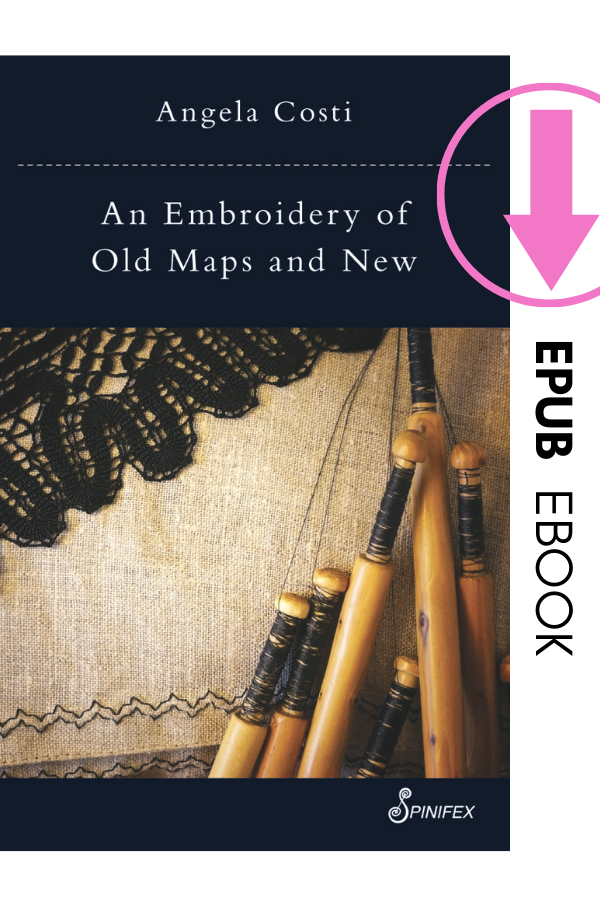
I can see how I carry Yiayia’s war
in the ample dunes of my belly,
the moment she smelt the guns,
she pinched the candle’s wick,
gathered the startled shadows of her children,
flung my baby-mother onto her back
and sprinted towards the neutral moon—
Migration and the memories of women’s traditions are woven throughout these poems. Angela Costi brings the world of Cyprus to Australia. Her mother encounters animosity on Melbourne’s trams as Angela learns to thread words in ways that echo her grandmother’s embroidery. Here are poems that sing their way across the seas and map histories.
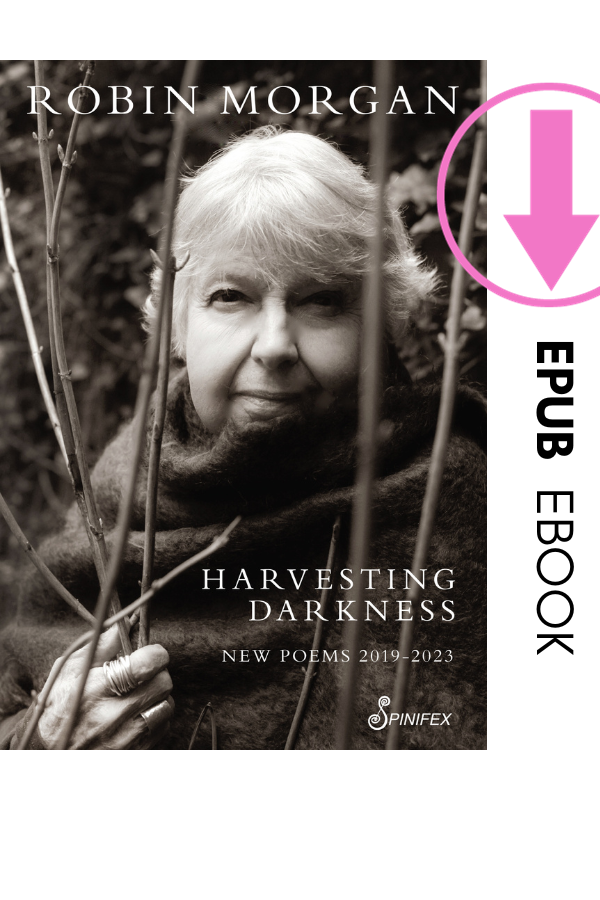
She sleeps naked, wearing pearls, to play her part.
Robin Morgan’s latest collection is a tour-de force: poetry that thrills the intellect and stirs the emotions. Robin shares her joys and intimacies which take centre stage and laments ‘the ringmaster’s desertion’ as death hovers in the wings and aging unfolds, while laughing at the pain / through the gridlocked traffic in my brain.
Light and shadow, sleep and wakefulness, holding tight and letting go, regret and contentment, order and chaos, battle it out simultaneously through the interplanetary and domestic worlds.
So trust disorder’s order,
be glad all permanence
is temporary, since
no matter what you lose
you gain: chaos composts
grief and love together.
SEPTEMBER 2023 | 64 pages

A poem can glisten like a fresh wound.
Usha Akella pays tribute to the lives of women from cultures across continents, while reflecting on her own life. Her poems are the medium for women who refuse to be silenced. She condenses a calm rage into ferocious words of precision and celebrates the women who have triumphed. All the while a subversive dusting of humour runs through the collection.
This is poetry that cannot be ignored.
Rage has no caste, needs no algorithm,
light a pyre with it
of chopped thumbs and scripted dreams

Pauline Hopkins (editor)
Feminists have long known that it’s all connected. The stories, the families, the country, the River . In this anthology, poets and short story writers create worlds with words. This book includes stories that draw on mythic traditions rewritten for our time. There are thieves, grandmothers, teenagers breaking out, dark caves to explore and real estate to sell; there are mysteries from the grave, experiments that go wrong, road trips, a circus, an opera, families that break and families that hold together; there are birds and animals and babies, and there is the pandemic. There is stillness and movement; closeness and distance.
This eclectic range of authors brings their unique perspectives to storytelling as they each grapple to understand the past and meet the challenges ahead, daring to share their joy and pain, their fear and anger, their hopes and disappointments. These are women who dare to remember, to claim their own stories and to wonder what may have been.
Memory’s a burden, forgetting even more so.
—‘Lost Bird’ by Merlinda BobisAll the stories I can think of turn out to be full of traps for the unsuspecting.
—‘Keep Telling’ by Marion Molteno
DECEMBER 2022 | 248 pages
The eyes catch a black bird close to an eerie sun. Instantly, a poem: an accident of composition. Or a tree, rock, light from a story heard, dreamt, read or remembered returns as if it were the only tree, rock, light in the planet. The poet is caught, returned to her first heart: poetry.
After four novels, Merlinda offers seventy-six poems from the stillness of contemplation to the spinning of tales, then to passage across different histories. Glass becomes eternal greens underwater, fish gossip about colonisation, a gumnut turns dissident, and the dreams of Captain Cook and Pigafetta circumnavigate the globe leaving a trail of blood, beads, and the scent of cloves. But in between, the poet hopes: ‘there could be accidents / of kindness here.’
In her latest collection of poetry, award-winning author Merlinda Bobis traces the accidents of art and life. Drawing on the journal of Pigafetta whose writings have become an accident of history, Merlinda Bobis composes with an attuned ear and her poems are rich with imagery; with breath and heart.
2017 | 184 pp

The eyes catch a black bird close to an eerie sun. Instantly, a poem: an accident of composition. Or a tree, rock, light from a story heard, dreamt, read or remembered returns as if it were the only tree, rock, light in the planet. The poet is caught, returned to her first heart: poetry.
After four novels, Merlinda offers seventy-six poems from the stillness of contemplation to the spinning of tales, then to passage across different histories. Glass becomes eternal greens underwater, fish gossip about colonisation, a gumnut turns dissident, and the dreams of Captain Cook and Pigafetta circumnavigate the globe leaving a trail of blood, beads, and the scent of cloves. But in between, the poet hopes: ‘there could be accidents / of kindness here.’
In her latest collection of poetry, award-winning author Merlinda Bobis traces the accidents of art and life. Drawing on the journal of Pigafetta whose writings have become an accident of history, Merlinda Bobis composes with an attuned ear and her poems are rich with imagery; with breath and heart.
2017 | 184 pp
Awards
Highly Commended, ACT Book of the Year Award, 2018
Reviews
Merlinda Bobis is a writer whose work transcends… Bobis’s writing, in both her poetry and her prose fiction, is at once reassuring and uncomfortable; it quietly sears as it sings. Her music affirms the power of art and language, offering a portrait of our world which is as unflinching as it is, sincerely, a love song. Read the full review here
—Jo Langdon, Sydney Review of Books
From its core, this collection radiates an ambitious vision of kindness. The notion that the heart has space enough to imagine the story that remains unfinished, to attempt to see what lies beyond our borders, is made compelling by Bobis’s immediately intelligent and vivid reading of the world. With a voice courageous as ever, Bobis stays full of novelty and surprise in her generous, beautiful entreaty to look and listen to one another anew. Read the full review here.
—Lucy Van, Cordite Poetry Review
Within the lyric lines and vivid imagery, Bobis takes the reader into an experience otherwise unfamiliar or alien. Drawing connections between images and texts, events across time and space, Bobis also expands the meaning of ecology from its physical definition. Every thing and image is an index or reference of another, image and texts are combinations of the known and unknown, our relations are mediated and determined by reasoning with elements beyond our control. One can navigate their fate through a ripple caused by the smallest fish; one can find their love in a different time or in virtual space. Read the full review here.
—Zeny May Dy Recidoro, SparkUp, BusinessWorld Publishing Corporation
A very vivid work. Sometimes immediately sensitive/sensual, sometimes deliberately rough-edged, but always well-expressed, well-principled and well-considered, and always thankfully ‘still tuning in’.
—Jennifer Maiden
In these troubled times tainted with fear, hate, and despair, ‘there is hope for us,’ the poems assure us. In them I hear an exquisite polyphony of voices: passionate and poised, sensuous and serene, lyrical and philosophical. Like incantations, these poems ask to be read and heard aloud.
—Subhash Jaireth
The volcanics of poem and story are among [Bobis’] driving forces. But here ‘the weight of what we have written’ carries a new urgency. What is at stake is the deep kinship of all life mediated by our own species. Just as a ‘tiny gumnut’ is a ‘primeval dissident’, so the ‘presuming poet’ must keep ‘tuning in’. Awe, grief, joy, love are among her companions of choice. The journey leaves none untouched.
—Patricia Sykes
Jan Fook
Renate Klein
The best-selling book that started the series exploring the significance of animals in women’s lives. Eighty-six women and girls from all across the globe contributed to this beautiful collection of stories, letters, poems and photographs, sharing the funny, sad and amazing tales of their relationships with dogs. Readers will cry and laugh as they enjoy this homage to their best friends: dogs they’ve grown up with; dogs with incredible character; dogs who’ve changed – even saved – women’s lives.
2001 | 208 pp