
Finola Moorhead

Finola Moorhead was born in 1947 in Mornington, Victoria into a Catholic family with Socialist leanings. Raised by a single mother, with two older sisters and a brother, she attended boarding school before applying to the University of Melbourne. After starting a Law degree Finola transferred to the University of Tasmania in the midst of Vietnam War protests, where she was taught by James McAuley and tutored by Margaret Scott. In 1972 Finola attended the Adelaide Writer’s Festival and met renowned authors Judith Wright and Roger McKnight. Inspired, she decided to become a writer herself and upon completing her first story and play, sent them off to The Herald Short Story Competition and The Australian National Playwright’s Conference Competition, both of which she won. Deciding at this point that she preferred writing to teaching, Finola then travelled around Australia spending time with writers such as Dorothy Hewett, before accepting a position on Meanjin magazine, where she worked alongside A.A Phillips and Clem Christesen.
She is a playwright, a poet, has written articles and short stories, and published five books under her own name, as well as appearing in anthologies and journals. Her books include: A Handwritten Modern Classic (1985), Quilt (1985), Remember the Tarantella (1987), Still Murder (1991/2002), Darkness More Visible (2000) and a collection of poetry, My Voice (2006). She is the author of three plays, Curtain Raiser, Horses and It Might As Well Be Loneliness.
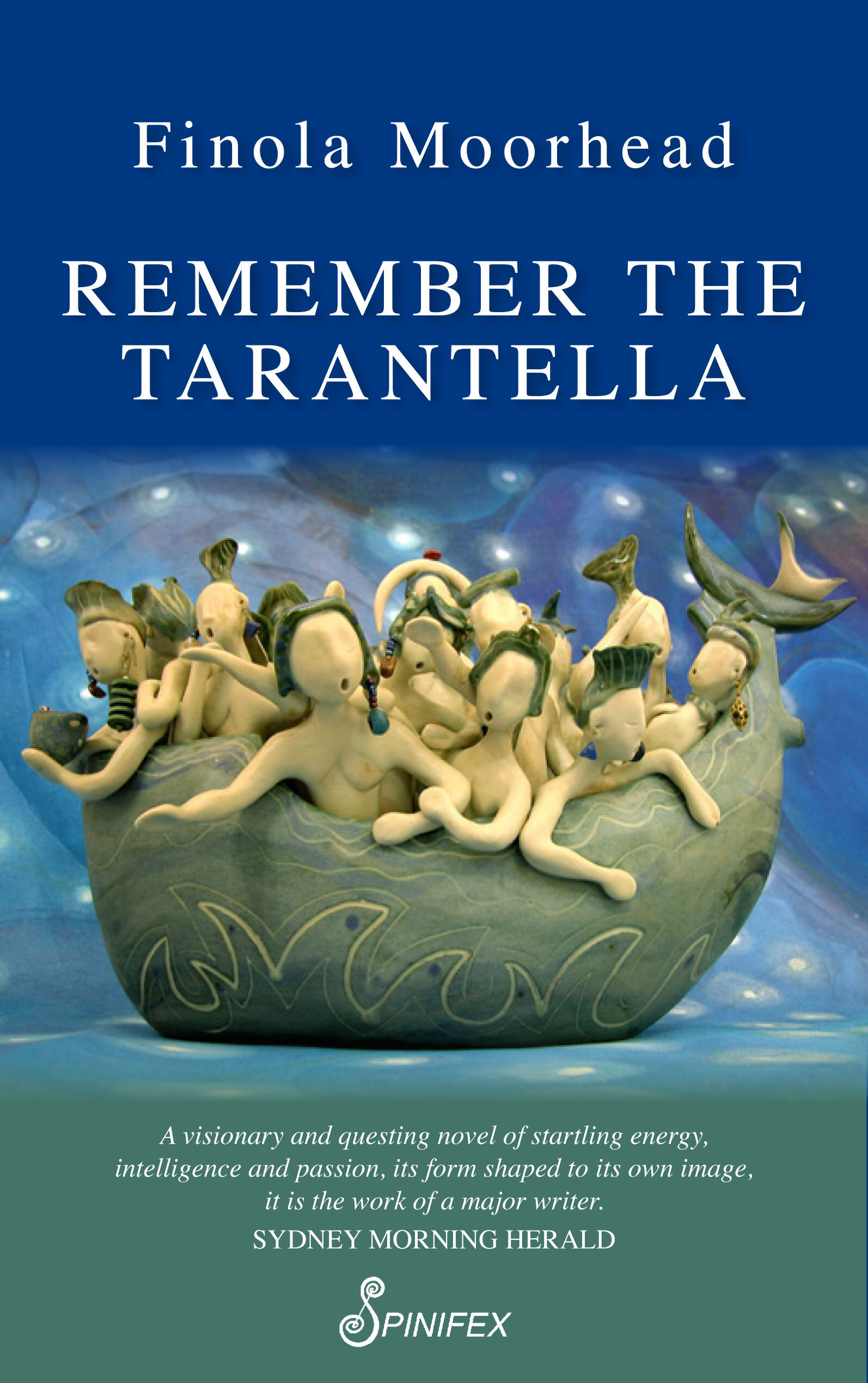
Remember The Tarantella is a remarkable work. It's learned and frivolous, female not feminine, silly and serious. Written in several strands of narrative, the many characters create a space as if reading were a dance party. Story is not the main objective. Private conversations and thoughts are always within earshot of the rhythm of others, like the stamping of feet and the beat of the music. This is concerto-like poetry; many instruments of different tones assist the reader to know who is who.
2011 | ISBN 9781876756932 | Paperback | 204 x 132 mm | 300 pages

Senior Detective Margot Gorman has been assigned to watch over a raving woman in an asylum. What could a madwoman know? And Peter, the sportsman, can he become a warrior in Vietnam? With a deft hand, the author challenges the traditional stereotypes of a crime novel with questions of politics, patriarchy, sanity and murder. First published in 1991, Still Murder was widely praised by reviewers for being a ‘cross-over’ novel, bringing together literary and crime styles of writing and narrative. This feminist classic edition has an Introduction by Marion Campbell and an Afterword by the author.
2002 | ISBN 9781876756338 | Paperback | 200 x 130 mm | 305 pp

When Margot Gorman finds a body in the women's toilets a tangle of mysteries opens up. Margot Gorman, ex-cop, is now a free agent, a triathlete and has the equivalent of perfect pitch in the sense of smell and, naturally, is a connoisseur of good wine. From murder and kidnap, drug dealing and gay bashing, to illegal mining and an underground network of cyberfeminists - the Solanacites - there are many skeins to be unravelled. A complex and intriguing novel that deals with the selfhood of women, it ranges from musings on the Amazons to a self-sufficient community in Australia's womenslands. There is mystery and philosophical enquiry in money, madness, motherhood and much more.
Finola Moorhead is the author of the award winning novel, Still Murder, the classic feminist novel, Remember the Tarantella and of a collection of essays and stories, Quilt.
2000 | ISBN 9781875559602 | Paperback | 232 x 153 mm | 650 pp
Ebooks

When Margot Gorman finds a body in the women's toilets a tangle of mysteries opens up. Margot Gorman, ex-cop, is now a free agent, a triathlete and has the equivalent of perfect pitch in the sense of smell and, naturally, is a connoisseur of good wine. From murder and kidnap, drug dealing and gay bashing, to illegal mining and an underground network of cyberfeminists - the Solanacites - there are many skeins to be unravelled. A complex and intriguing novel that deals with the selfhood of women, it ranges from musings on the Amazons to a self-sufficient community in Australia's womenslands. There is mystery and philosophical enquiry in money, madness, motherhood and much more.
Finola Moorhead is the author of the award winning novel, Still Murder, the classic feminist novel, Remember the Tarantella and of a collection of essays and stories, Quilt.
2000 | 650 pp

When Margot Gorman finds a body in the women's toilets a tangle of mysteries opens up. Margot Gorman, ex-cop, is now a free agent, a triathlete and has the equivalent of perfect pitch in the sense of smell and, naturally, is a connoisseur of good wine. From murder and kidnap, drug dealing and gay bashing, to illegal mining and an underground network of cyberfeminists - the Solanacites - there are many skeins to be unravelled. A complex and intriguing novel that deals with the selfhood of women, it ranges from musings on the Amazons to a self-sufficient community in Australia's womenslands. There is mystery and philosophical enquiry in money, madness, motherhood and much more.
Finola Moorhead is the author of the award winning novel, Still Murder, the classic feminist novel, Remember the Tarantella and of a collection of essays and stories, Quilt.
2000 | 650 pp
SPINIFEX FEMINIST CLASSIC COLLECTOR'S EDITION
The first observation is that the imagination is how you do what you know. A person who says he is a writer and uses many words to say that imagination beats experience has no imagination, especially if he cannot toss a sald, lets his wife buy his clothes.
Gertrude Stein in her 1926 lecture on ‘Composition as Explanation’ wrote: 'the creator of the new composition in the arts is an outlaw, until [s]he is a classic ...
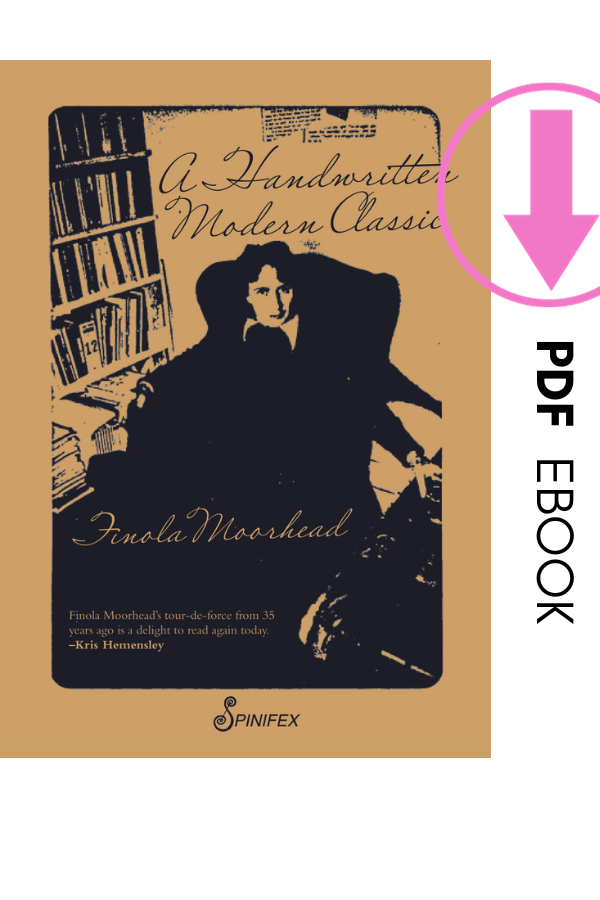
In the tradition of Gertrude Stein, Finola Moorhead set about writing A Handwritten Modern Classic in 1977. The result is musings and criticisms on protestors clashing with police over freeways, political change, conservatism, Malcolm Fraser, what love can do for you, and whether the old hate the young. With discussions on the politics of suicide and unshaven armpits, one of Australia’s most intriguing experimental writers has set her thoughts to writing, with mention of such famed writers as Socrates and Jane Austen, Coleridge and Tolstoy, as well as the battles between romanticism and jingoism in Australian writing. Written—by hand—in the tradition of European and American manifestos, this document challenges readers and writers alike not to fall for a romantic view of the world.
2013 | 75 pp

Remember The Tarantella is a remarkable work. It's learned and frivolous, female not feminine, silly and serious. Written in several strands of narrative, the many characters create a space as if reading were a dance party. Story is not the main objective. Private conversations and thoughts are always within earshot of the rhythm of others, like the stamping of feet and the beat of the music. This is concerto-like poetry; many instruments of different tones assist the reader to know who is who.
2011 | 300 pages
Remember The Tarantella is a remarkable work. It's learned and frivolous, female not feminine, silly and serious. Written in several strands of narrative, the many characters create a space as if reading were a dance party. Story is not the main objective. Private conversations and thoughts are always within earshot of the rhythm of others, like the stamping of feet and the beat of the music. This is concerto-like poetry; many instruments of different tones assist the reader to know who is who.
2011 | 300 pp

Senior Detective Margot Gorman has been assigned to watch over a raving woman in an asylum. What could a madwoman know? And Peter, the sportsman, can he become a warrior in Vietnam? With a deft hand, the author challenges the traditional stereotypes of a crime novel with questions of politics, patriarchy, sanity and murder. First published in 1991, Still Murder was widely praised by reviewers for being a ‘cross-over’ novel, bringing together literary and crime styles of writing and narrative. This feminist classic edition has an Introduction by Marion Campbell and an Afterword by the author.

Senior Detective Margot Gorman has been assigned to watch over a raving woman in an asylum. What could a madwoman know? And Peter, the sportsman, can he become a warrior in Vietnam? With a deft hand, the author challenges the traditional stereotypes of a crime novel with questions of politics, patriarchy, sanity and murder. First published in 1991, Still Murder was widely praised by reviewers for being a ‘cross-over’ novel, bringing together literary and crime styles of writing and narrative. This feminist classic edition has an Introduction by Marion Campbell and an Afterword by the author.
Finola Moorhead
SPINIFEX FEMINIST CLASSIC COLLECTOR'S EDITION
The first observation is that the imagination is how you do what you know. A person who says he is a writer and uses many words to say that imagination beats experience has no imagination, especially if he cannot toss a sald, lets his wife buy his clothes.
Gertrude Stein in her 1926 lecture on ‘Composition as Explanation’ wrote: 'the creator of the new composition in the arts is an outlaw, until [s]he is a classic ...
In the tradition of Gertrude Stein, Finola Moorhead set about writing A Handwritten Modern Classic in 1977. The result is musings and criticisms on protestors clashing with police over freeways, political change, conservatism, Malcolm Fraser, what love can do for you, and whether the old hate the young. With discussions on the politics of suicide and unshaven armpits, one of Australia’s most intriguing experimental writers has set her thoughts to writing, with mention of such famed writers as Socrates and Jane Austen, Coleridge and Tolstoy, as well as the battles between romanticism and jingoism in Australian writing. Written—by hand—in the tradition of European and American manifestos, this document challenges readers and writers alike not to fall for a romantic view of the world.
2013 | ISBN 9781742197999 | Paperback | 203 x 148 mm | 75 pp