
Carol Lefevre

Carol Lefevre holds a PhD in Creative Writing from the University of Adelaide, where she is a Visiting Research Fellow. Her novel Nights in the Asylum, Picador (UK) and Vintage (Australia) was shortlisted for the Commonwealth Writers’ Prize, won the 2008 Nita B. Kibble Award for Women Writers, and the People’s Choice Award. If You Were Mine (2008) was published by Vintage.
She has published short fiction, essays, and journalism, and a non-fiction book, Quiet City: walking in West Terrace Cemetery (2016, Wakefield Press).
Her most recent book Murmurations, a novella in eight stories (2020, Spinifex Press) was shortlisted for the 2021 Christina Stead Prize for Fiction in the NSW Premier’s Literary Awards, and the Fiction Prize in the 2022 South Australian Festival Awards for Literature.
Carol continues to publish essays and short fiction, and contributes occasional seminars to the Department of English and Creative Writing at the University of Adelaide.

For the first time since he’d left the island he thought of the starlings massed at dusk in the winter trees behind the children’s home. He remembered the rustle of their wings when they twisted in skeins over the fields, or swelled and contracted high above the cliffs, dark wave after dark wave, lifting and falling in a kind of dance. Sister Lucy had said it was a murmuration. He was still quite young, and he had thought the birds were showing him a sign, that there was something written in their fluid patterns.
Lives merge and diverge; they soar and plunge, or come to rest in impenetrable silence. Erris Cleary’s absence haunts the pages of this exquisite novella, a woman who complicates other lives yet confers unexpected blessings. Fly far, be free, urges Erris. Who can know why she smashes mirrors? Who can say why she does not heed her own advice?
Among the sudden shifts and swings something hidden must be uncovered, something dark and rotten, even evil, which has masqueraded as normality. In the end it will be a writer’s task to reclaim Erris, to bear witness, to sound in fiction the one true note that will crack the silence.
APRIL 2020 | ISBN 9781925950083 | Paperback | 112 pages | 198 x 128 mm
Shortlisted:
Adelaide Festival Awards for Literature (Fiction) 2022
NSW Premier’s Award, Christina Stead Prize for Fiction 2021 Read the judges’ comments

Carol Lefevre is an Adelaide-based writer whose book, The Happiness Glass, explores the imaginative terrain between essays and short fiction. The narrative takes us from remote NSW to New Zealand and England through a series of deeply affecting experiences of poverty, domestic violence, loneliness, infertility, adoption and grief. Her writing is sharp, moving, insightful and beautifully poetic.
But what did teenage girls in country towns want with Latin and French and art? What use would it be to them?
The literary longings of a studious girl born into a working class family, hot afternoons in a dust-plain Wilcannia schoolhouse; the temptation to stay, and the perils of breaking free - The Happiness Glass reflects complex griefs in the life of Lily Brennan.
Lily’s story allows the author to navigate some of the difficulties of memoir, and out of its bittersweet blend of real, remembered, and imagined life, the portrait of a writer gradually emerges.
In fiction that forms around a core of memory, life writing that acknowledges the elusiveness of truth, Carol Lefevre has written a remarkable, risk-taking book that explores questions of homesickness, infertility, adoption, and family estrangement, in Lily Brennan's life, and in her own.
A superb collection I read with relish and grief.
–Brian Castro, author of Shanghai Dancing
2018 | ISBN 9781925581638 | Paperback | 210 x 148 mm | 154 pp
Ebooks

Carol Lefevre is an Adelaide-based writer whose book, The Happiness Glass, explores the imaginative terrain between essays and short fiction. The narrative takes us from remote NSW to New Zealand and England through a series of deeply affecting experiences of poverty, domestic violence, loneliness, infertility, adoption and grief. Her writing is sharp, moving, insightful and beautifully poetic.
But what did teenage girls in country towns want with Latin and French and art? What use would it be to them?
The literary longings of a studious girl born into a working class family, hot afternoons in a dust-plain Wilcannia schoolhouse; the temptation to stay, and the perils of breaking free - The Happiness Glass reflects complex griefs in the life of Lily Brennan.
Lily’s story allows the author to navigate some of the difficulties of memoir, and out of its bittersweet blend of real, remembered, and imagined life, the portrait of a writer gradually emerges.
In fiction that forms around a core of memory, life writing that acknowledges the elusiveness of truth, Carol Lefevre has written a remarkable, risk-taking book that explores questions of homesickness, infertility, adoption, and family estrangement, in Lily Brennan's life, and in her own.
A superb collection I read with relish and grief.
–Brian Castro, author of Shanghai Dancing

Carol Lefevre is an Adelaide-based writer whose book, The Happiness Glass, explores the imaginative terrain between essays and short fiction. The narrative takes us from remote NSW to New Zealand and England through a series of deeply affecting experiences of poverty, domestic violence, loneliness, infertility, adoption and grief. Her writing is sharp, moving, insightful and beautifully poetic.
But what did teenage girls in country towns want with Latin and French and art? What use would it be to them?
The literary longings of a studious girl born into a working class family, hot afternoons in a dust-plain Wilcannia schoolhouse; the temptation to stay, and the perils of breaking free - The Happiness Glass reflects complex griefs in the life of Lily Brennan.
Lily’s story allows the author to navigate some of the difficulties of memoir, and out of its bittersweet blend of real, remembered, and imagined life, the portrait of a writer gradually emerges.
In fiction that forms around a core of memory, life writing that acknowledges the elusiveness of truth, Carol Lefevre has written a remarkable, risk-taking book that explores questions of homesickness, infertility, adoption, and family estrangement, in Lily Brennan's life, and in her own.
A superb collection I read with relish and grief.
–Brian Castro, author of Shanghai Dancing
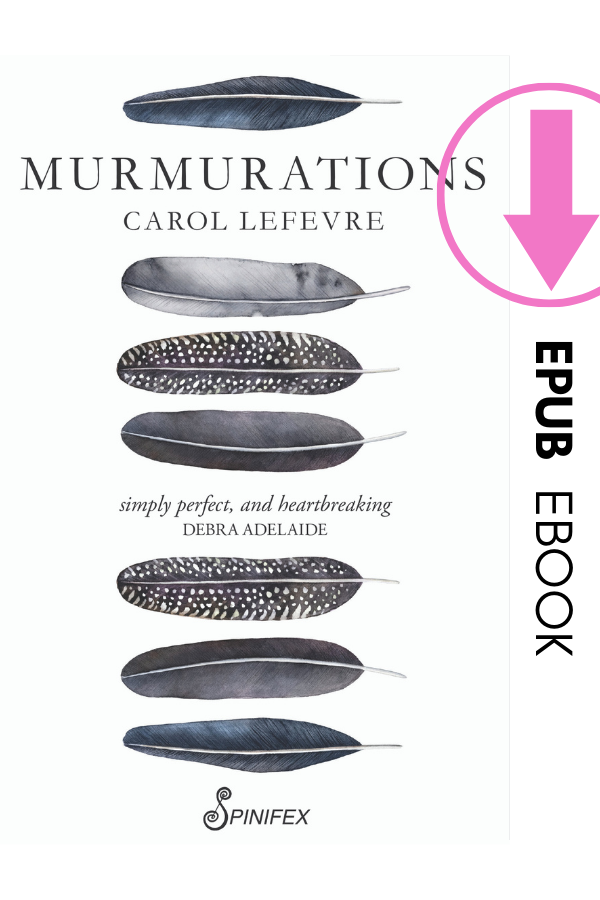
For the first time since he’d left the island he thought of the starlings massed at dusk in the winter trees behind the children’s home. He remembered the rustle of their wings when they twisted in skeins over the fields, or swelled and contracted high above the cliffs, dark wave after dark wave, lifting and falling in a kind of dance. Sister Lucy had said it was a murmuration. He was still quite young, and he had thought the birds were showing him a sign, that there was something written in their fluid patterns.
Lives merge and diverge; they soar and plunge, or come to rest in impenetrable silence. Erris Cleary’s absence haunts the pages of this exquisite novella, a woman who complicates other lives yet confers unexpected blessings. Fly far, be free, urges Erris. Who can know why she smashes mirrors? Who can say why she does not heed her own advice?
Among the sudden shifts and swings something hidden must be uncovered, something dark and rotten, even evil, which has masqueraded as normality. In the end it will be a writer’s task to reclaim Erris, to bear witness, to sound in fiction the one true note that will crack the silence.
With beautiful, clear-eyed insight, Murmurations charts lives edging towards revelation or despair. The women at the heart of these stories have the poise and mystery of figures in paintings. We’re drawn into intimacy with them through the grace of Carol Lefevre’s benevolent vision and quietly assured prose.
—Michelle de Kretser
Beautifully conceived and composed, Murmurations presents a series of stories that intriguingly fold into each other. There is not a false note here, not a single word out of place, not one detail that is irrelevant. By the end of the novella, the hidden griefs, fears and desires of people who are connected but emotionally estranged are revealed in such subtle, unexpected ways, you will want to re-read it straight away, and then again, and again.
—Debra Adelaide

For the first time since he’d left the island he thought of the starlings massed at dusk in the winter trees behind the children’s home. He remembered the rustle of their wings when they twisted in skeins over the fields, or swelled and contracted high above the cliffs, dark wave after dark wave, lifting and falling in a kind of dance. Sister Lucy had said it was a murmuration. He was still quite young, and he had thought the birds were showing him a sign, that there was something written in their fluid patterns.
Lives merge and diverge; they soar and plunge, or come to rest in impenetrable silence. Erris Cleary’s absence haunts the pages of this exquisite novella, a woman who complicates other lives yet confers unexpected blessings. Fly far, be free, urges Erris. Who can know why she smashes mirrors? Who can say why she does not heed her own advice?
Among the sudden shifts and swings something hidden must be uncovered, something dark and rotten, even evil, which has masqueraded as normality. In the end it will be a writer’s task to reclaim Erris, to bear witness, to sound in fiction the one true note that will crack the silence.
With beautiful, clear-eyed insight, Murmurations charts lives edging towards revelation or despair. The women at the heart of these stories have the poise and mystery of figures in paintings. We’re drawn into intimacy with them through the grace of Carol Lefevre’s benevolent vision and quietly assured prose.
—Michelle de Kretser
Beautifully conceived and composed, Murmurations presents a series of stories that intriguingly fold into each other. There is not a false note here, not a single word out of place, not one detail that is irrelevant. By the end of the novella, the hidden griefs, fears and desires of people who are connected but emotionally estranged are revealed in such subtle, unexpected ways, you will want to re-read it straight away, and then again, and again.
—Debra Adelaide

The wooden stair was just as she had imagined it, even down to the creak in its second-to-bottom step. But the tower room was lovely beyond anything she could have dreamed – afloat at the level of the treetops, it seemed to Dorelia more like a boat than a room, with everything that might trouble her banished.
Widowed after a long marriage, Dorelia MacCraith swaps the family home for a house with a tower, and there, raised above the run of daily life, sets out to rewrite the stories of old women poorly treated by literature.
Throughout this winding story, Dorelia and the elderly artist Elizabeth Bunting are sustained by a friendship that reaches back to their years at art school, and bonded by the secrets of a six-month period when they painted together in France.
The loneliness of not belonging, of being cut adrift by grief, betrayal, or old age, binds these twelve connected stories into a dazzling composite novel. Within its complex crossings and connections, young and old inhabit separate yet overlapping firmaments; grown children, though loved and loving, cannot imagine their parents’ young lives. For most, the past is not past, but exerts a magnetic pull, while future happiness hinges on retreat, or escape.
OCTOBER 2022 | 300 pages

The wooden stair was just as she had imagined it, even down to the creak in its second-to-bottom step. But the tower room was lovely beyond anything she could have dreamed – afloat at the level of the treetops, it seemed to Dorelia more like a boat than a room, with everything that might trouble her banished.
Widowed after a long marriage, Dorelia MacCraith swaps the family home for a house with a tower, and there, raised above the run of daily life, sets out to rewrite the stories of old women poorly treated by literature.
Throughout this winding story, Dorelia and the elderly artist Elizabeth Bunting are sustained by a friendship that reaches back to their years at art school, and bonded by the secrets of a six-month period when they painted together in France.
The loneliness of not belonging, of being cut adrift by grief, betrayal, or old age, binds these twelve connected stories into a dazzling composite novel. Within its complex crossings and connections, young and old inhabit separate yet overlapping firmaments; grown children, though loved and loving, cannot imagine their parents’ young lives. For most, the past is not past, but exerts a magnetic pull, while future happiness hinges on retreat, or escape.
OCTOBER 2022 | 300 pages
Carol Lefevre
The wooden stair was just as she had imagined it, even down to the creak in its second-to-bottom step. But the tower room was lovely beyond anything she could have dreamed – afloat at the level of the treetops, it seemed to Dorelia more like a boat than a room, with everything that might trouble her banished.
Widowed after a long marriage, Dorelia MacCraith swaps the family home for a house with a tower, and there, raised above the run of daily life, sets out to rewrite the stories of old women poorly treated by literature.
Throughout this winding story, Dorelia and the elderly artist Elizabeth Bunting are sustained by a friendship that reaches back to their years at art school, and bonded by the secrets of a six-month period when they painted together in France.
The loneliness of not belonging, of being cut adrift by grief, betrayal, or old age, binds these twelve connected stories into a dazzling composite novel. Within its complex crossings and connections, young and old inhabit separate yet overlapping firmaments; grown children, though loved and loving, cannot imagine their parents’ young lives. For most, the past is not past, but exerts a magnetic pull, while future happiness hinges on retreat, or escape.
OCTOBER 2022 | 9781925950625 | Paperback | 300 pages | 216 x 140 mm