
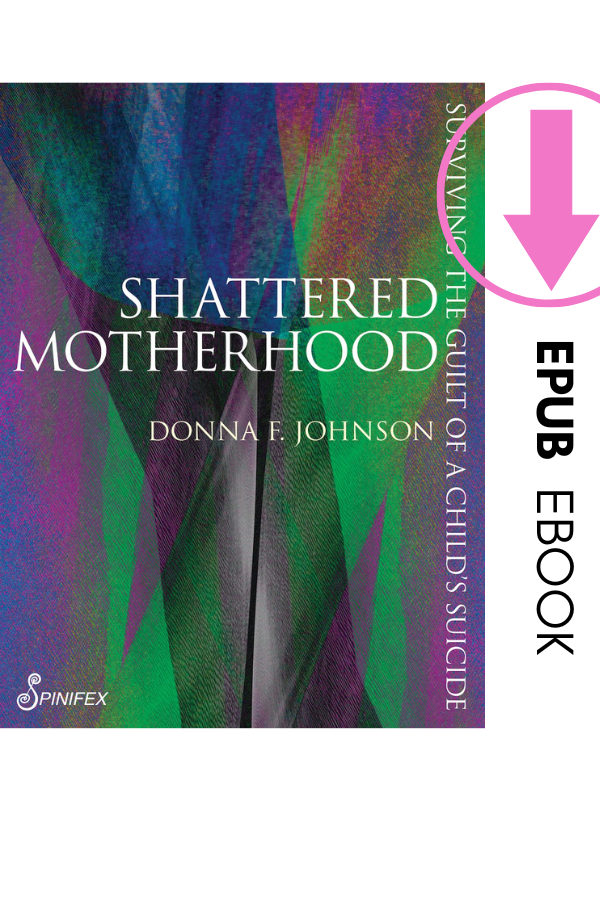
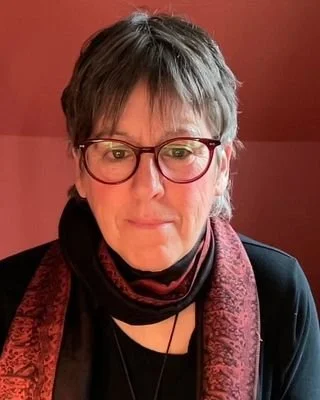
Donna Johnson, author of Shattered Motherhood: Surviving the Guilt of a Child’s Suicide
Radical Feminist Voices: Spinifex Panel 2, FiLiA, Brighton UK, 12 October 2025
https://www.spinifexpress.com.au/shop/p/9781922964144
First, heartfelt thanks from all of us on this panel to Susan and Renate. We’re quite aware that without you, books like ours would never be published.
So, what does surviving the suicide of a child have to do with radical feminism? How can a radical feminist analysis possibly help a mother grieving such a profound and terrible loss?
These are the questions that animate my book, Shattered Motherhood. I raise them cautiously; conscious that I’m on sacred ground. Conscious that most women aren’t asking for a feminist analysis of their experience; least of all women suffering to this degree. Feminism puts women at the centre of our own lives, and when you have lost a child to suicide, the last thing you feel is worthy to think about yourself, and about how the structures of your life are colluding to make your suffering worse. I’m conscious too that I am not a mother myself, nor have I ever lost a loved one to suicide, let alone a child. Who am I to propose a path on a journey I myself have not travelled?
Notwithstanding all the reasons I really shouldn't have written this book, I have written it, following where the argument of my life and work have led me.
I worked for 16 years in a women’s shelter before becoming involved in the subject of suicide. Looking back, I see how my work with abused women prepared me to recognize the plight of mothers whose kids have taken their own lives. Battered women taught me how little we value mothers, their tears are the cheapest fluids on earth, to borrow from Germaine Greer. Battered women taught me how women cope, or fail to cope, with trauma. Battered women taught me how to read women’s silences. Battered women taught me to recognize when a woman is slipping beneath the surface of her own life.
The book started out as an attempt to break the silence about a neglected cohort of women. I wanted to put mothers of suicided kids at the centre of their own lives; to give them a metaphorical ‘room of their own’ where they could be fully in their grief, fully known in their suffering. Were mothers’ grief more visible, more understood, perhaps they would have more compassion for themselves, and perhaps we as a society would be better at supporting them. But as I came to realize that mothers are judged and condemned for their children’s suicides through the power politics of motherhood, the book morphed into a radical feminist manifesto on maternal guilt.
The death of a child in any circumstances is a trial that pushes a mother to the limits of her endurance. When the death comes by the child’s own hand, the mother is in addition placed on trial, by society, and in her own mind. The charges are bogus, but it doesn't matter; they act on her life as if they are real. Complicating things for her is the fact that nobody is actually blaming her, in fact, everybody’s telling her it’s not her fault. Women live in this crazy-making space where the forces acting on our lives are both invisible and denied. Oblivious to these forces, we fall prey to them. A mother can spend the rest of her life atoning for her child’s suicide.
Maternal guilt is a skilled operative, functioning in full view; making us laugh as it plunders our lives. We joke about it, trivialize it, accept that it somehow goes hand-in-hand with motherhood. “Guilt comes home from the hospital with the baby.” “Out comes the afterbirth, in comes the guilt.” “Motherhood is guilt, period.” Guilt shows up all over the place in a mother’s life, in more or less manageable proportions. But when it shows up at the suicide of her child, it’s no longer a joking matter, and it’s no longer manageable. But by then, it’s too late. The child’s suicide comes to seal the mother’s pre-existing belief that she is to blame for everything. A mother might eventually give up the guilt, in 10 years, or 15, because she has grown tired. Because she is weary of it. Because she knows it does not serve her. But if women are to be empowered, the guilt needs to be rejected on principle. Because it is a scam.
____________________
The seed for Shattered Motherhood was planted in a conversation I had with a grieving mother way back in 2006. I was working as a counselor in a police crisis unit. We responded to sudden deaths of all kinds: accidents, homicides and suicides.
One afternoon I was visiting a woman named Judy whose 21-year-old son had taken his own life. She was barely functioning. We sat in silence for a long time. Eventually she started to speak.
“What kind of a mother has a child who commits suicide? What kind of a mother am I that this could happen to my child? That I couldn’t see it coming? That I couldn’t prevent it?”
I wasn't sure what to say. She was already seeing a psychologist. She had already heard the platitudes a thousand times about what a great mother she’d been. Everybody was telling her to let go of the guilt. She wasn’t able to.
We sat in more silence. I asked if there was anything under the sun that would help. She sat up and looked me straight in the eye.
"I need to meet another mother who has been through this. I need to see that she has survived—and that she is not a monster.”
I felt a chill rundown my spine. Never had a woman given me such insight into her inner world with a single word. It’s a term reserved for perpetrators of the worst atrocities. How could it possibly be connected to an ordinary mother? I didn't know it then, but I know it now, Judy was providing powerful insight into the social construction of motherhood. Into what we do to mothers.
I assured her I'd find her a group for mothers in the same situation, quickly discovering that no such resource existed. Despite disturbing rates of suicide among young people, the depth of this crisis for their mothers was not on anybody’s radar.
So, as you Brits say, “Never mind!” I decided I’d start my own group. I started my own group for mothers, right there at the police station, and it quickly became a lifeline for the mothers. The group offered them a depth of compassion and a kind of knowing they could not find anywhere else.
What it is that mothers ‘know’ is a theme I explore in the book. At first, I thought it was about their shared grief as mothers; a depth of sorrow that only she who carries and nurtures human life within her own body and soul can appreciate. I wonder now if it’s also a preconscious sense of their shared condition as mothers under patriarchy.
But despite the group being a lifeline, nothing could shake the women’s belief that their children’s suicides were directly related to their failures as mothers.
It was complicated, because of course guilt is a common reaction in survivors of suicide. And the mothers weren’t asking to be absolved of their guilt; on the contrary, they were stepping up for their punishment. I found much to admire in their sense of duty. What a different world we would have if everybody felt this level of responsibility towards children.
But I was suspicious of the guilt, because I had seen it before, in my previous work. It is the abused woman who carries the guilt for her partner’s violence and for the harms done to the children. And I couldn’t square the mothers’ persistent sense of failure with all they had sacrificed and suffered for their kids. Most had been forced to raise their children in challenging circumstances. When their kids began to flounder, it was the mothers who had shouldered the burden of care. Several had been failed by the systems they turned to for support.
Besides which, there are so many other influences in kids’ lives. To start with, the racist, classist, homophobic, misogynist, porn-saturated society in which they grow up.
And what about the fathers? The fathers, who were very often abusive, addicted or absent…? The fathers seemed to be off the hook in some presumptive way.
I was also familiar with Adrienne Rich’s work on the ‘institution of motherhood’, with its impossible prescription for selflessness and perfection in women. Mothers are given all the responsibility, none of the power, and all of the blame.
The women’s profound sorrow I understood. But feeling they had contributed to their child's death through their failures and inadequacies as mothers? No. I couldn't accept that. It was clear to me that the guilt needed to come off.
But nothing I nor anyone said made a difference.
I wrote this book because I wanted to take the guilt off the mothers. In the process of writing, I realized that only mothers themselves can remove it. The only sure route out of guilt is for mothers to come to consciousness about the oppressive conditions in which they are forced to mother. To reject on principle the guilt fostered in women from cradle to grave.
And so in the book, I embark upon a process of consciousness-raising, beginning with myself, and inviting the reader to join with me. Gradually connections start to be made…between my sexual assaults and yours; between my mother's depression and yours; between our second-class status as women and the intractable guilt of the world’s mothers.
Gradually we come to see that motherhood, like everything else in women's lives, is a political struggle. Not all women are mothers, but all mothers are women, and mothers ‘mother’ in a world that fails women in every conceivable way: controlling when and how we give birth; reducing our bodies to market commodities; allowing us to be beaten and raped by the fathers of our children—then tying us to these same men for life via the family courts; prosecuting us for trying to protect our own kids. (See the work of Hague Mothers for a most obscene example of the violation of mothers’ human rights.) And of course, allowing us to be murdered along with our children in our own homes. How can mothers possibly feel good about themselves in a world such as this?
When I read Caitlin’s book (Sex Dolls, Robots and Woman Hating: The Case for Resistance) about men’s growing attraction to sex dolls as ‘better than the real thing’, my first thought was for the soul-destroying impact on mothers. Though a woman be degraded, objectified and violated in the bedroom, she still has to get up in the morning and make breakfast for her kids.
Women are groomed and gaslit to accept so much that is bad for us. If there is anger in my book, and I hope there is, it is because I find what we do to mothers abhorrent. I see mothers as heroes. I wrote the book in homage to mothers, for all they give, sacrifice and suffer for their kids. The final chapter is a call for men and society to atone to mothers.
Maternal guilt is a nefarious patriarchal construct—depriving us of the full beauty and brilliance of our reproductive powers, devaluing our contributions, and fostering in us the belief that in the midst of all this neglect and abuse, we are the ones who are screwing up.
Patriarchy’s coup de grâce is manipulating mothers into thinking that they are responsible for their child’s suicide.
The good news is that we can take back our lives—and our motherhood—through the power of our own clear thinking. Shattered Motherhood is a call to women to come to consciousness about the conditions imposed upon us, and to reject them, and chart a different course.
As I was writing the book I saw Sarah Polley’s incredible film Women Talking at the theatre. Eight women who have been horrifically violated by men in their own community climb into a hayloft to face up to what’s happening and decide their course of action. The film is a work of feminist imagination where women take back their lives through the power of their own thinking and naming. A single, soul-searching conversation becomes a meditation on the universal plight of women. The film fired my imagination and powered my book. I have adopted the metaphor of ‘the hayloft’ to describe any place where women gather to face up to the condition of our lives, and begin to imagine a different world.
Feminist analysis cannot remove the immense sorrow of losing a child to suicide. But understanding the structures operating on her life can restore a mother to sanity, to her own goodness, and to the goodness and integrity of her relationship with her child.
I’m going to end with the words of a mother who wrote to me after reading my book. She lost a child early, though not to suicide. I love her words, because after all is said and done, they return us to a place of ambiguity, which is, ultimately, the place where we all live.
“How can one ever feel sure they did everything possible to prevent their child's suicide? Of course you could have done more. More, more, more. That’s what mothers think, and that’s what other people think too (deep down). At least mothers care, really care, and that comes back to bite you sometimes. Somebody has to care beyond all reason, or we’d all be dead.”

For a mother, the death of a child under any circumstances is unbearable. When the child is severed from the mother’s life by his or her own hand, the cleaving is particularly brutal. It is a bereavement with no equivalence in human experience.
If you are a mother today, you are mothering in patriarchy. What that means, and how it might impact a mother grieving the loss of her child to suicide, is a subject Donna Johnson explores in this profound book. Johnson, in her counselling role in a police service, worked closely with mothers who lost a child to suicide, supporting them through those first traumatic days, weeks and months as the impact of suicide reverberated throughout their lives.
What struck her was the absence of specific supports for mothers and the prevalence of a type of paralysis in the mothers. The burden of overwhelming guilt, shame and a huge sense of failure – emotions not shared by the fathers of the children – impeded the possibility of mothers recovering from their child’s suicide. In Shattered Motherhood, Donna Johnson argues for specific supports for mothers in these circumstances; supports that meet their unique needs, recognise the depth of their suffering and provide them with proper care. Through a feminist lens, she considers the institutions of marriage, motherhood and the family as well as the suffering of mothers who have lost a child to suicide.
Johnson articulates her belief in the power of women coming together to name their own experiences, feel their own pain and search for their own solutions.
FEBRUARY 2025 | ISBN 9781922964144 | Paperback | 180 pages | 135 x 180 mm
THIS BOOK IS PART OF THE SPINIFEX SHORTS COMPLETE COLLECTION
Read more about Donna F. Johnson here.
Donna F. Johnson
For a mother, the death of a child under any circumstances is unbearable. When the child is severed from the mother’s life by his or her own hand, the cleaving is particularly brutal. It is a bereavement with no equivalence in human experience.
If you are a mother today, you are mothering in patriarchy. What that means, and how it might impact a mother grieving the loss of her child to suicide, is a subject Donna Johnson explores in this profound book. Johnson, in her counselling role in a police service, worked closely with mothers who lost a child to suicide, supporting them through those first traumatic days, weeks and months as the impact of suicide reverberated throughout their lives.
What struck her was the absence of specific supports for mothers and the prevalence of a type of paralysis in the mothers. The burden of overwhelming guilt, shame and a huge sense of failure – emotions not shared by the fathers of the children – impeded the possibility of mothers recovering from their child’s suicide. In Shattered Motherhood, Donna Johnson argues for specific supports for mothers in these circumstances; supports that meet their unique needs, recognise the depth of their suffering and provide them with proper care. Through a feminist lens, she considers the institutions of marriage, motherhood and the family as well as the suffering of mothers who have lost a child to suicide.
Johnson articulates her belief in the power of women coming together to name their own experiences, feel their own pain and search for their own solutions.
FEBRUARY 2025 | ISBN 9781922964151 | 180 pages