
Commodifying Women, Erasing Mothers: Renate Klein on the Global Surrogacy Industry
In a deeply researched and impassioned essay for Arena Quarterly, Dr Renate Klein, radical feminist scholar, long-time Spinifex author and publisher, exposes the resurgence of surrogacy as a global industry built on “disaster and catastrophe”, commodification, and the erasure of mothers.
In A-Listers and Baby-Makers: The Return of Surrogacy, Klein traces how the surrogacy industry, once widely condemned, has returned to public favour, aided by celebrity endorsements, online platforms, and shifting political attitudes. This return, she argues, is no accident—it is the result of sustained media normalisation, economic desperation in the Global South, and the neoliberal recasting of surrogacy as a matter of personal choice.
“Let’s be clear. The implicit purpose of surrogacy is to create motherless babies.”
She interrogates the language and marketing of the industry, noting how surrogacy agencies present themselves “with elaborate websites that show images of beautiful women, not unlike prostitution or porn sites.” And she documents how social media platforms now feature direct advertising from hopeful commissioning parents, often seeking to bypass legal and ethical frameworks entirely.
“It is capitalism writ large.”
The piece is particularly critical of the so-called “progressive” support for surrogacy. Klein challenges the notion that surrogacy is a feminist or liberating practice, noting how some on the political left defend it in the name of “choice” while ignoring its structural violence. She cites Swedish feminist Kajsa Ekis Ekman, who called surrogacy “‘reproductive prostitution’ and … violence against women.”
“Surrogacy thrives on disaster and catastrophe.”
The article draws on multiple harrowing real-world examples—abandoned babies in Ukraine, trafficked women in Greece, and Australian couples caught up in international scandals—to illustrate the human cost of this industry. Klein reminds readers that behind every happy surrogacy story are women whose autonomy is overridden, whose pregnancies are controlled, and who are often left with physical or emotional trauma.
Klein is unequivocal in her stance:
“In commercial surrogacy, children are clearly both sold and trafficked.”
She also highlights the contradiction in Australia’s legal stance: despite past apologies from Australian governments for the forced removal of children, all states and territories currently allow “altruistic” surrogacy:
“Powerful words—and yet all Australian states and territories today continue to allow so-called altruistic surrogacy in which babies are taken away from their mothers.”
Klein finishes by calling attention to growing global resistance—from the Declaration of Casablanca to feminist networks in Europe and Australia—and reiterates the urgent need for abolition:
“We need to remember that no one has a ‘right’ to a child, whether in a couple or single, heterosexual or homosexual, and whether by ‘altruistic’ or ‘commercial’ surrogacy.”
This article is essential reading for anyone concerned with women’s rights, reproductive justice, and global capitalism’s reach into the most intimate corners of life.
🔗 Read the full article now at Arena Quarterly: A-Listers and Baby-Makers: The Return of Surrogacy by Renate Klein


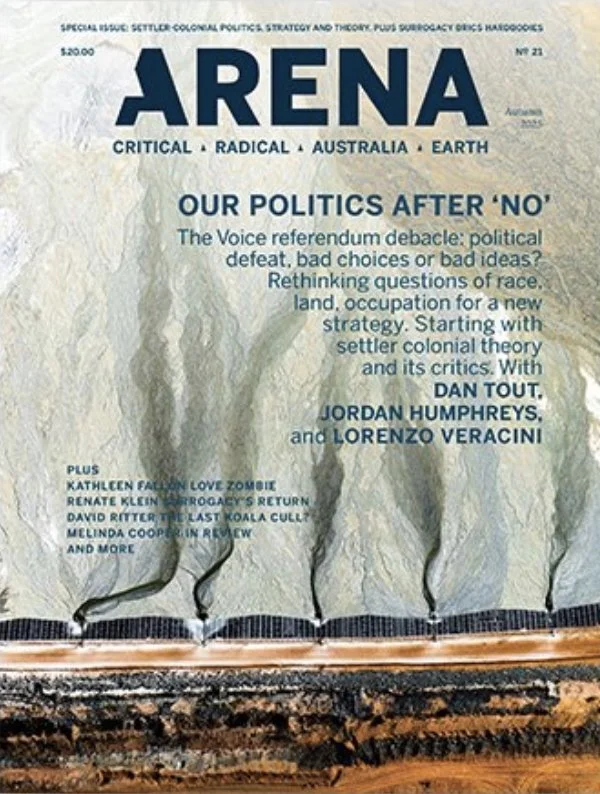
Read the full article A-listers and baby-makers: the return of surrogacy? here

Dr Renate Klein is a long-term feminist health advocate, a biologist and social scientist who has written on reproductive technology including surrogacy since the 1980s.
Penny Zagarelou-Mackieson
Dr Penny Zagarelou-Mackieson delves into the minefield of issues and political interests associated with the seemingly mundane topic of birth certificates.
She outlines why a birth certificate is an important legal document of universal concern – because it is a person’s primary means of identification throughout their entire life with intergenerational significance for the identities of their offspring.
Penny highlights that for certain individuals, however – those who are adopted, donor-conceived, or born of surrogacy – governments treat the parentage information on their official birth certificate differently to most people’s.
In the case of adoptees, the original birth certificate is cancelled and replaced with a new birth certificate that records the name(s) of the adoptive parents – as if the adoptee were naturally born to them. Penny provides an extensive history of changes to birth registration requirements and birth certificates in Australia since compulsory birth registration was introduced there in 1838, demonstrating that the treatment of birth certificates in adoptions was designed last century for the purpose of secrecy. Increasingly, closed adoption practices were intended to prevent adoptees from knowing that they were adopted, the identities of their natural parents, and their own natural identity.
In the cases of those who are donor-conceived and born from surrogacy arrangements, the parentage information recorded on their official birth certificates is treated in a similarly deceptive manner through the application of legal presumptions and mechanisms of parentage – which are genetically/biologically incorrect. As in adoption, these practices promote secrecy and erasure of birth mothers.
Penny addresses several significant challenges and harms associated with the intentionally different treatment of parentage information on birth certificates; considers options to address those problems; and argues a case for birth certificate reform – with a view to achieving equal treatment of genetic/biological parentage information on all birth certificates regardless of the circumstances of one’s conception, birth or socio-legal parenting arrangements.
This book is an important read for people genuinely concerned about human rights, identity, birth mothers and equality.
4 AUGUST 2026 | 9781922964465 | Paperback | 152 × 228 mm | 270 pages