
 Image 1 of 1

Reviews
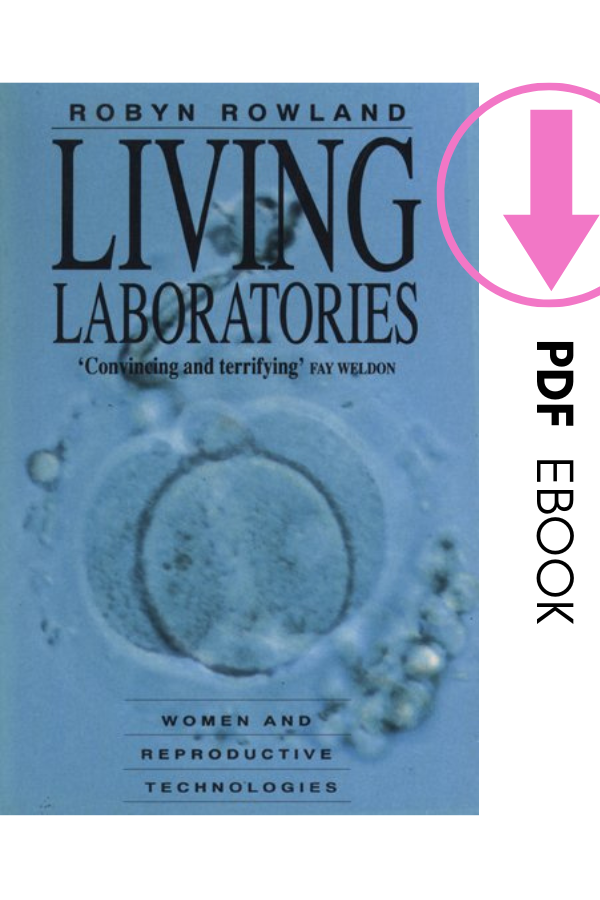
‘convincing and terrifying.’
— Fay Weldon
‘Rowland presents an effective argument and major contribution to sociology in her careful explication of the specific techniques, personal experiences, legal ties, and ethics of medical science that are involved in reproductive technology. She issues a call to action to bring the implications of reproductive technology to light to counteract the fallacious belief that, through its use, medical science has enhanced women's lives and increased women's freedom of choice. I hope this book gains substantial readership within academia and, perhaps even more important, among women who are considering participating in reproductive technologies.’
— American Journal of Sociology, Vol. 99, No. 3 (Nov, 1993)‘…sociologist Robyn Rowland argues new technologies many women have become alienated reproductive capacities. Just as bad, Rowland believes, the possibility of drawing on technological innovations to real needs. In Living Laboratories, Rowland confronts the of choice at the outset and claims that with individualism and choice- instead of the more properly feminist precepts of sharing and collectivity- as the central imperatives governing reproductive technology, women are losing out to the male experts in the battle for control over their own fertility and procreative potential.
— Signs, Vol. 20, No. 3 (Spring, 1995)
The strength of this work is the author’s ability to show the exploitation of women through the present and future trends of reproductive technologies. Scientists would be provoked to look through a feminist lens and reflect on the values which often under lie the medical model, and the physical and biological sciences.
— Social Science & Medicine, Vol. 38. No. 2 (Jan, 1994)
Robyn Rowland
Imagine an unborn foetus having children. In a world where frozen embryo banks and test-tube babies are presented as the ‘norm’, the culling of immature eggs from a female foetus is no longer science fiction. How does this affect our concepts of parenting and mothering? What are the ethical and moral implications of research into human reproduction? Robyn Rowland argues that women have become ‘living laboratories’ in a book that has achieved the status of a classic.
1992 | 366 pages