
Sheila Jeffreys


Watch the launch for Penile Imperialism on our YouTube channel.
Sheila Jeffreys is a radical feminist activist who has worked mainly against male violence and for lesbian feminism. She joined her first Women’s Liberation Movement group in the UK in 1973 and became a lesbian in 1977. In 1991, she moved to Australia to teach at the University of Melbourne, and retired back to the UK in 2015. She is the author of twelve books on issues such as the history of sexuality, lesbian feminism, prostitution, gay men’s politics, beauty practices, the threat of patriarchal religion to women’s rights, and the politics of transgenderism. In 2018, she published The Lesbian Revolution: Lesbian Feminism in the UK 1970–1990 and in 2020, her autobiography Trigger Warning: My Lesbian Feminist Life. In 2022, she wrote Penile Imperialism: The Male Sex Right and Women’s Subordination.

In this blisteringly persuasive and piercingly intelligent book, Sheila Jeffreys argues that women live under penile imperialism, a regime in which men are assumed to have a ‘sex right’ of access to the bodies of women and girls.
She reasons that the ‘sexual revolution’ that began in the 1960s unleashed an explicit male sexual liberation and that even now, under current laws and cultural mores, women do not have the right to self-determination in relation to their bodies.
Sheila Jeffreys argues that the exercise of the male sex right has mainstreamed misogynist attitudes and so-called sexual freedom has meant the freedom of men to use women and children with impunity.
The power dynamics of sex, rather than being eliminated, has been eroticised, supported by state regulations and structures that have further entrenched male domination. And while men’s sexual fetishisms such as BDSM and transvestism have been normalised, women now have to fight as their spaces are being erased and their voices silenced in a faux inclusivity that has ‘naturalised’ sexual harassment.
Sheila Jeffreys contends that women’s human rights are profoundly harmed and sexual violence is used more than ever to enforce social control of women.
This is a sobering and brilliant analysis of the modern predicament of women that is impossible to ignore.
SEPTEMBER 2022 | 9781925950700 | Paperback | 376 pages | 234 x 153mm
THIS BOOK IS PART OF THE GENDER CRITICAL COLLECTION
——————————
ALSO AVAILABLE AS INDIVIDUAL CHAPTERS for AUD $10.00

“I am in the very fortunate position of having been able to contribute to two waves of feminism: The Women’s Liberation Movement and the new wave that is taking place now.”
Trigger Warning: My Lesbian Feminist Life is both an engaging autobiography and a fascinating account of feminist history. From the heady days of the Women’s Liberation Movement through to the backlash against radical feminism as neoliberal laissez-faire attitudes took hold. Fast forward to the current re-examination of feminism in light of the #MeToo movement and an emerging new wave of radical feminism.
Sheila Jeffreys' bold account makes it clear that the feminism and lesbianism she has championed for decades is needed more than ever. With honesty and frankness, she tells of victories and setbacks in her unrelenting commitment to women’s freedom from men’s violence, especially the violence inherent in pornography and prostitution. We also learn what her steadfastness has cost her in terms of personal and professional rewards.
Trigger Warning places radical feminism within a cultural, social and intellectual context while also taking us on a personal journey. Sheila Jeffreys has tirelessly crossed the globe to advance radical feminist theory and practice and we are invited to share in the intellectual and political crossroads she has encountered during her life.
Accessible yet detailed and rigorous, this landmark volume is essential reading for everyone who has ever wondered what radical feminism really is.
SEPTEMBER 2020 | ISBN 9781925950205 | Paperback | 234 x 153mm | 240 pages

eBook Available
A SPINIFEX FEMINIST CLASSIC
“A rigorous, savvy contemporary intellectual history … Read this book.” – Andrea Dworkin
The sexual revolution of the 1960s and 1970s is remembered as a time of great freedom for women. But did the sexual revolution have the same goals as the Women’s Liberation Movement? Was it truly liberation for women or just another insidious form of oppression?
In this provocative book, Sheila Jeffreys argues that sexual freedom sometimes directly opposed actual freedom for women. Anticlimax traces sexual mores and attitudes from the 1950s to the 1990s, exploring the nature of both straight and gay relationships and offering original and compelling commentary on Lolita, Naked Lunch,The Joy of Sex, the Masters/Johnson report, and other representations in the literature on sexuality.
At the root of sexual liberation, Sheila Jeffreys finds an increasing eroticisation of power differences within heterosexual, lesbian and gay communities. Her alternative vision of sexual relations based on equality is a major statement in the debates over sex and violence, that remain relevant in discussions over SlutWalk, sexualisation of girls and the pervasiveness of porn culture.
"Anticlimax…laid bare the myth of the 1960s sexual revolution." –Julie Bindel
2011 | ISBN 9781742198071 | Paperback | 200 x 125 mm | 360 pp
For more paperback copies, please visit IPG Book in the US or Gazelle Book Services in the UK

There are (at least) two competing views on prostitution: Prostitution as a legitimate and acceptable form of employment, freely chosen by women; And men’s use of prostitution as a form of degrading the women and causing grave psychological damage.
In The Idea of Prostitution, Sheila Jeffreys explodes the distinction between forced and free prostitution, and documents the expanding international traffic in women. She examines the claims of the prostitutes’ rights movement and the sex industry, while supporting prostituted women. Her argument is threefold: the sex of prostitution is not just sex; the work of prostitution is not ordinary work; and prostitution is a choice not for the prostituted women, but for the men who abuse them.
2008 | ISBN 9781876756673 | Paperback | 217 x 140 mm | 394 pp

eBook Available
Sheila Jeffreys examines the activities of feminist campaigners around such issues as child abuse and prostitution and how these campaigns shaped social purity in the 1880s and 1890s. She demonstrates how the thriving and militant feminism of late nineteenth and early twentieth centuries was undermined, and asserts that the decline of this feminism was due largely to the promotion of a sexual ideology which was hostile to women’s independence. The circumstances about which she writes are frighteningly familiar in the present political climate.
1997 | ISBN 9781875559633 | Paperback | 218 x 140 mm | 256 pp
For more paperback copies, please visit IPG Book in the US

The backlash against feminism has been documented powerfully by Naomi Wolf and Susan Faludi: within the lesbian community too, there has been a parallel backlash. A lesbian sex industry is now making a profit from women’s oppression, teaching lesbians to turn the pain of abuse and subordination into ‘pleasure’ and calling it liberation. Feminist theorist Sheila Jeffreys challenges the patriarchal and racist assumptions of the sex industry. In The Lesbian Heresy she advocates the continued creation of lesbian culture, community, friendship and ethics based on principles of equality and resistance. And for this call to freedom, lesbian feminists are deemed heretics.
1993 | ISBN 9781875559176 | Paperback | 250 x 175 mm | 208 pp
Ebooks available - see our Ebook Store for PDF and EPUB versions

“A rigorous, savvy contemporary intellectual history … Read this book.” – Andrea Dworkin
The sexual revolution of the 1960s and 1970s is remembered as a time of great freedom for women. But did the sexual revolution have the same goals as the Women’s Liberation Movement? Was it truly liberation for women or just another insidious form of oppression?
In this provocative book, Sheila Jeffreys argues that sexual freedom sometimes directly opposed actual freedom for women. Anticlimax traces sexual mores and attitudes from the 1950s to the 1990s, exploring the nature of both straight and gay relationships and offering original and compelling commentary on Lolita, Naked Lunch, The Joy of Sex, the Masters/Johnson report, and other representations in the literature on sexuality.
At the root of sexual liberation, Sheila Jeffreys finds an increasing eroticisation of power differences within heterosexual, lesbian and gay communities. Her alternative vision of sexual relations based on equality is a major statement in the debates over sex and violence, that remain relevant in discussions over SlutWalk, sexualisation of girls and the pervasiveness of porn culture.
"Anticlimax…laid bare the myth of the 1960s sexual revolution." –Julie Bindel

There are (at least) two competing views on prostitution: Prostitution as a legitimate and acceptable form of employment, freely chosen by women; And men’s use of prostitution as a form of degrading the women and causing grave psychological damage.
In The Idea of Prostitution, Sheila Jeffreys explodes the distinction between forced and free prostitution, and documents the expanding international traffic in women. She examines the claims of the prostitutes’ rights movement and the sex industry, while supporting prostituted women. Her argument is threefold: the sex of prostitution is not just sex; the work of prostitution is not ordinary work; and prostitution is a choice not for the prostituted women, but for the men who abuse them.
2008 | 394 pp

The backlash against feminism has been documented powerfully by Naomi Wolf and Susan Faludi: within the lesbian community too, there has been a parallel backlash. A lesbian sex industry is now making a profit from women’s oppression, teaching lesbians to turn the pain of abuse and subordination into ‘pleasure’ and calling it liberation. Feminist theorist Sheila Jeffreys challenges the patriarchal and racist assumptions of the sex industry. In The Lesbian Heresy she advocates the continued creation of lesbian culture, community, friendship and ethics based on principles of equality and resistance. And for this call to freedom, lesbian feminists are deemed heretics.
1993 | 208 pp
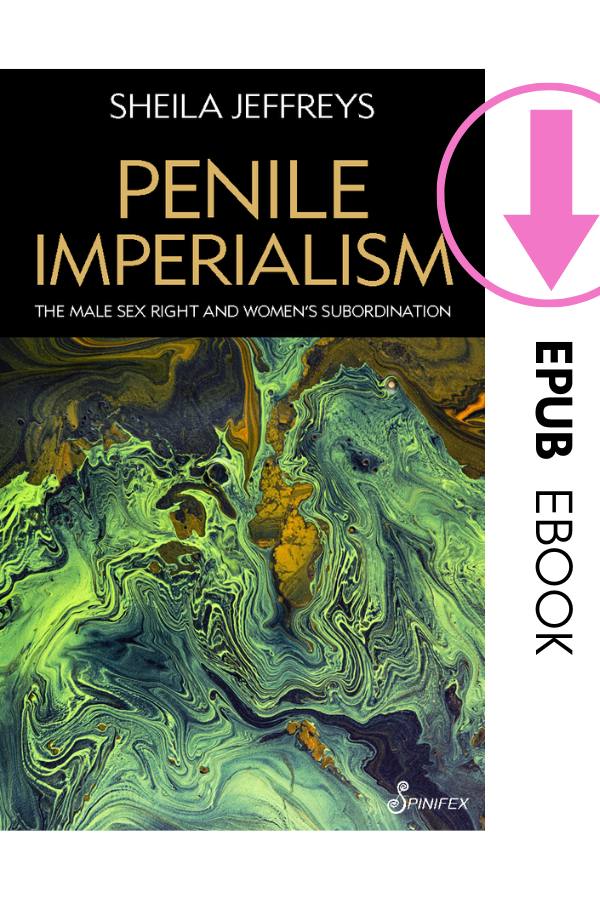
In this blisteringly persuasive and piercingly intelligent book, Sheila Jeffreys argues that women live under penile imperialism, a regime in which men are assumed to have a ‘sex right’ of access to the bodies of women and girls.
She reasons that the ‘sexual revolution’ that began in the 1960s unleashed an explicit male sexual liberation and that even now, under current laws and cultural mores, women do not have the right to self-determination in relation to their bodies.
Sheila Jeffreys argues that the exercise of the male sex right has mainstreamed misogynist attitudes and so-called sexual freedom has meant the freedom of men to use women and children with impunity.
The power dynamics of sex, rather than being eliminated, has been eroticised, supported by state regulations and structures that have further entrenched male domination. And while men’s sexual fetishisms such as BDSM and transvestism have been normalised, women now have to fight as their spaces are being erased and their voices silenced in a faux inclusivity that has ‘naturalised’ sexual harassment.
Sheila Jeffreys contends that women’s human rights are profoundly harmed and sexual violence is used more than ever to enforce social control of women.
This is a sobering and brilliant analysis of the modern predicament of women that is impossible to ignore.
SEPTEMBER 2022 | 376 pages
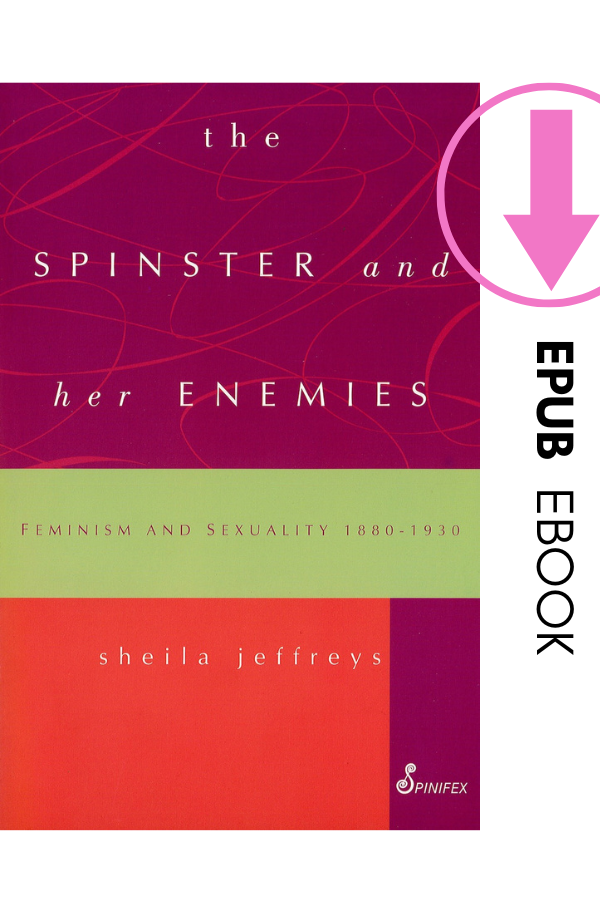
Sheila Jeffreys examines the activities of feminist campaigners around such issues as child abuse and prostitution and how these campaigns shaped social purity in the 1880s and 1890s. She demonstrates how the thriving and militant feminism of late nineteenth and early twentieth centuries was undermined, and asserts that the decline of this feminism was due largely to the promotion of a sexual ideology which was hostile to women’s independence. The circumstances about which she writes are frighteningly familiar in the present political climate.
1997 | 256 pp

“I am in the very fortunate position of having been able to contribute to two waves of feminism: The Women’s Liberation Movement and the new wave that is taking place now.”
Trigger Warning: My Lesbian Feminist Life is both an engaging autobiography and a fascinating account of feminist history. From the heady days of the Women’s Liberation Movement through to the backlash against radical feminism as neoliberal laissez-faire attitudes took hold. Fast forward to the current re-examination of feminism in light of the #MeToo movement and an emerging new wave of radical feminism.
Sheila Jeffreys' bold account makes it clear that the feminism and lesbianism she has championed for decades is needed more than ever. With honesty and frankness, she tells of victories and setbacks in her unrelenting commitment to women’s freedom from men’s violence, especially the violence inherent in pornography and prostitution. We also learn what her steadfastness has cost her in terms of personal and professional rewards.
Trigger Warning places radical feminism within a cultural, social and intellectual context while also taking us on a personal journey. Sheila Jeffreys has tirelessly crossed the globe to advance radical feminist theory and practice and we are invited to share in the intellectual and political crossroads she has encountered during her life.
Accessible yet detailed and rigorous, this landmark volume is essential reading for everyone who has ever wondered what radical feminism really is.

A brilliant overview of the oppression all women face – the system of male domination – and how feminists have fought back against it. Sheila Jeffreys provides a sometimes startling, always incisive, picture of the struggles she and other radical feminists have faced to protect the rights of women and girls over decades of activism. As well as outlining the many recognisable forms of oppression faced by women today – including pornography, violence, reproductive slavery and domestic servitude – Jeffreys highlights others that are sometimes ignored, such as the subordination of women through the cultural imposition of femininity and sexual harassment.
She dares to challenge the modern orthodoxy that ‘equality’ should be a goal of feminism. She points out how men’s power and status is acquired from the subordination of women, and nothing less than a radical transformation of society is required for women to achieve liberation. Sheila Jeffreys takes on the men’s sexual rights movement. She considers the new cult of gender ideology: the insult of transgenderism with its promotion of ‘womanface’ – the fetish of imitating and insulting women as comparable to blackface. She calls out the threat posed by men pretending to be women which risks reversing the hard-won gains made by feminists in the last 50 years.
Jeffreys develops a lesbian feminist critique of queer politics and celebrates the glories of lesbian community, friendship, art, literature, culture and ethics.
This four-pronged book – on feminist theory, on industries that exploit women like surrogacy and prostitution, on men’s sexual rights movement, and on lesbian feminism – provides an essential handbook for every woman who dares to dream of a better future for women and girls. Read it in book clubs and consciousness-raising groups and discuss.
AUGUST 2025 | ISBN 9781922964250 | Paperback | 258 pages
Chapter Downloads

In this Conclusion, Sheila Jeffreys explains that a new wave of international feminist resistance has been awakened by the developments described in this book in which men have asserted their male sex right through the sex industry and campaigns to normalise the sexual paraphilias. She describes how feminists are organising and the successes
they have achieved in defeating some of the demands that male sexual rights campaigners have made.
26 pages | 593 KB

In this chapter, Sheila Jeffreys looks at the success that transvestites have had in shaping the world to the service of their sexual interest. She examines some of the impacts of this major societal shift which now stretches from the entry of men with female gender identities to all of women’s spaces, to the transformation of language and the erasure of all mention of women and mothers, to the great misogynistic campaign against women and women’s rights that is taking place internationally.
The chapter will cover the on and offline violence, abuse and insult towards women and particularly feminists from trans-aligned men, and the attempts to silence women through punishments such as getting them sacked, to destroying their livelihoods and careers in publishing, entertainment, media, academia, politics. Jeffreys also looks at the normalisation of drag in which gay men dress up as ‘women’ which has mainstreamed misogynist attitudes through the media and entertainment industries.
50 pages | 781 KB

In this chapter, Sheila Jeffreys examines another movement to normalise a paraphilia, that which is focussed on men’s cross-dressing behaviour, or transvestism. What is now generally called the ‘transgender rights movement’ began in the 1990s. Before that time transvestism was understood by the medical profession to constitute a form of sexual fetishism and seen as a mental health problem. This understanding was transformed in the 1990s and in the following two decades to the point at which men with this sexual fetish were recognised by much of the medical profession, in popular culture and, most importantly, by governments and legislatures as having female ‘gender identities’ which rendered them, for all rights purposes, members of the category women. This was an extraordinary transformation, which will be explained here.
50 pages | 766 KB

In this chapter, Sheila Jeffreys examines the campaign which originated in San Francisco in the 1970s to normalise sexual violence under the name sadomasochism (S/M) as an important component of the male sex right. It is now generally included under the umbrella term BDSM (Bondage, Discipline and Sadomasochism) or simply ‘kink’. The campaign took a similar form to those carried out on behalf of other paraphilias such as transvestism and paedophilia. The proponents, who were mostly male, sought to promote and normalise their practice through support groups, conventions, fairs, and public display. They sought, as a most important facet of their campaign, to change the psychiatric diagnosis of their practice so that it was seen as an ordinary form of sex rather than connected in any way with mental illness. They campaigned to change the law so that their practice could not be seen as criminal and to prevent discrimination over matters such as child custody.
50 pages | 749 KB

In this chapter, Sheila Jeffreys examines a paradigm case of how male practitioners have campaigned to normalise a sexual perversion. A campaign to decriminalise men’s sexual use of children emerged from the sexual revolution of the 1960s and the gay liberation movement. It was one of the many forms of men’s sexual behaviour that harm women and children which experienced a makeover during the wave of sexual liberalism that flowed from that time. By the 1970s a campaign to reduce or eliminate age of consent laws was well underway in many countries including the US, the UK, the Netherlands and France. The campaign was defeated by a considerable outcry against it, mainly, in the UK, by radical lesbian feminists.
44 pages | 748 KB

In this chapter, Sheila Jeffreys examines the way in which the exercise of the male sex right serves to enforce the social control of women through sexual violence. The scale, scope and variety of forms of men’s sexual violence towards women is very considerable and cannot be covered here. In this chapter Jeffreys will concentrate on sexual violence against women in the public world outside the home, looking at the effects on women’s lives of men’s sexual practices from sexual harassment to sex murder, which are at two ends of the spectrum. It will not cover stranger rape. These forms of men’s violence restrict women’s lives and opportunities. They circumscribe women’s human rights to work, to freedom of assembly and freedom of movement, and freedom to take part in cultural and political activities. Sexual harassment in the form of sexualised outdoor advertising and graffiti serves to mark the built environment as male and limits women’s rights to equal citizenship. The focus of this chapter is the practice seen, before feminists named it in the 1970s and made its harms visible, as benign or natural, sexual harassment.
48 pages | 748 KB

In this chapter, Sheila Jeffreys examines the structures and mechanisms by which the societies of male domination ensure the availability of women and girls to men for the expression of the male sex right, concentrating on the industry of prostitution in the West. She will look at the way in which pimp states organise and provide prostitution to their male citizens through permissive legislation and toleration or through state regulation. Jeffreys will consider the scope of the industry and delineate its harms.
The chapter will also include the ways in which the exchange of women for sexual use underpins the governments, diplomacy and industry of male domination through ‘sex parties’ hosted by heads of state and tycoons.
52 pages | 776 KB

In this chapter, Sheila Jeffreys shows how the male sex right is expressed in heterosexual marriage and cohabitation. She argues that though most women in marriage and in heterosexual relationships now have the right to accuse their male partners of rape, the male sex right, or conjugal right as it was called in law, still appertains. The chapter is concerned with the sexual encounters that are not generally called rape, but unwanted or coercive sex, or here, because they are so normative, ‘everyday’ sex. The power relationship of male domination and female subordination constructs the sex that happens in heterosexual relations and the exercise of various forms of force ensure that women do not have the right to self-determination in relation to their bodies. The scope of this chapter is limited to ‘conjugal rights’ in the dominant culture of the UK, US and Australia.
44 pages | 704 KB

In this chapter, Sheila Jeffreys argues that male sexuality should be understood as a construction from and expression of male dominance. In the writings of sexologists and social scientists, sexuality is seen as either a product of biology, a result of family relationships or, if it is recognised as socially constructed, a product of a number of forces none of which consists of the power relations of male domination. This chapter looks at how sexologists in the twentieth century ordained a correct
form of sexuality that follows a template of male power and women’s powerlessness. It describes how the radical feminist theorists of the 1970s and 1980s radically challenged the scientists and explained male sexual behaviour as an emanation of male domination. It shows how the sexologists of today still promote the idea that sexuality is the product of biology. It ends with an examination of the ways what is called ‘sex therapy’ acts as a conduit to disseminate sexological ideas and train both practitioners and clients to eroticise inequality.
44 pages | 687 KB

In this Introduction, Sheila Jeffreys outlines the main arguments and contents of the book. It explains that women live under penile imperialism, a regime in which men are assumed to have a ‘sex right’ of access to the bodies of women and girls which is delineated by sexologists, the scientists of sex, protected by governments and the law, and reproduced in culture. It argues that penile imperialism profoundly harms the human rights of women and girls to privacy and dignity, to freedom of movement and expression, to political representation and to opportunities. The book argues that the ‘sexual revolution’ of the 1960s and 1970s unleashed a specifically male sexual liberation which created a sense amongst many groups of men that they should be able to realise their ‘sexual freedom’, a freedom which generally involves being able to sexually use women and children.
16 pages | 581 KB
Translations

German, Australian and Spanish editions of The Lesbian Heresy

La herejía lesbiana: una perspectiva feminista de la revolución sexual lésbica from Labrys Editorial in Spain

The Japanese edition of The Idea of Prostitution
Sheila Jeffreys
A brilliant overview of the oppression all women face – the system of male domination – and how feminists have fought back against it. Sheila Jeffreys provides a sometimes startling, always incisive, picture of the struggles she and other radical feminists have faced to protect the rights of women and girls over decades of activism. As well as outlining the many recognisable forms of oppression faced by women today – including pornography, violence, reproductive slavery and domestic servitude – Jeffreys highlights others that are sometimes ignored, such as the subordination of women through the cultural imposition of femininity and sexual harassment.
She dares to challenge the modern orthodoxy that ‘equality’ should be a goal of feminism. She points out how men’s power and status is acquired from the subordination of women, and nothing less than a radical transformation of society is required for women to achieve liberation. Sheila Jeffreys takes on the men’s sexual rights movement. She considers the new cult of gender ideology: the insult of transgenderism with its promotion of ‘womanface’ – the fetish of imitating and insulting women as comparable to blackface. She calls out the threat posed by men pretending to be women which risks reversing the hard-won gains made by feminists in the last 50 years.
Jeffreys develops a lesbian feminist critique of queer politics and celebrates the glories of lesbian community, friendship, art, literature, culture and ethics.
This four-pronged book – on feminist theory, on industries that exploit women like surrogacy and prostitution, on men’s sexual rights movement, and on lesbian feminism – provides an essential handbook for every woman who dares to dream of a better future for women and girls. Read it in book clubs and consciousness-raising groups and discuss.
5 AUGUST 2025 | ISBN 9781922964243 | Paperback | 152 mm x 229mm | 258 pages