
Diane Bell

📷 Sitthixay Ditthavong
Diane Bell OAM is a feminist anthropologist, author, and social justice advocate. She is Emerita Professor of Anthropology at both the George Washington University in Washington, D.C., U.S.A., and the Australian National University, Canberra. Over the past four decades, she has undertaken extensive fieldwork with Australia's First Nations peoples in Central and Southeast Australia, as well as comparative research in North America.
Her ten books—written or edited—along with numerous scholarly articles, have focused on Indigenous women’s ceremonial lives, land rights, native title, law reform, human rights, violence against women, religion, the environment, and feminist theory and practice. Her groundbreaking work Daughters of the Dreaming has been in continuous print since 1983, and her 1998 book Ngarrindjeri Wurruwarrin: A world that is, was, and will be received the NSW Premier’s Gleebook Award for Cultural and Literary Criticism. In 2012, she was awarded the Medal of the Order of Australia for services to literature, and in 2023, she was awarded the Hazel Rowley Literary Fellowship for her forthcoming biography, The Queen and the Protector.
Diane began her working life as a primary school teacher in the 1960s. As a single mother, she returned to full-time study in the 1970s, completing a BA Hons at Monash University (1975) and a PhD at the Australian National University (1981). She has since held senior academic positions in Australia and the USA, consulted for NGOs, Indigenous organisations, and governments, and has been honoured for her work as a writer, academic, and advocate.
After 17 years in the United States, Diane retired from George Washington University and returned to Australia, settling on Ngarrindjeri country, along the Finniss River in South Australia. There, she prepared the Ngarrindjeri Consent Determination Native Title Report, ran for the federal seat of Mayo in the 2008 by-election, furthered her creative work as Writer and Editor in Residence at Flinders University, and taught at the University of Adelaide. Through her involvement in environmental organisations, she has been a vocal advocate for the return of water to the Murray–Darling River system.
Now based in Canberra, Diane continues to write, speak, strategise, and advocate for a more just society—an enduring theme that unifies her scholarly, creative, and activist pursuits.
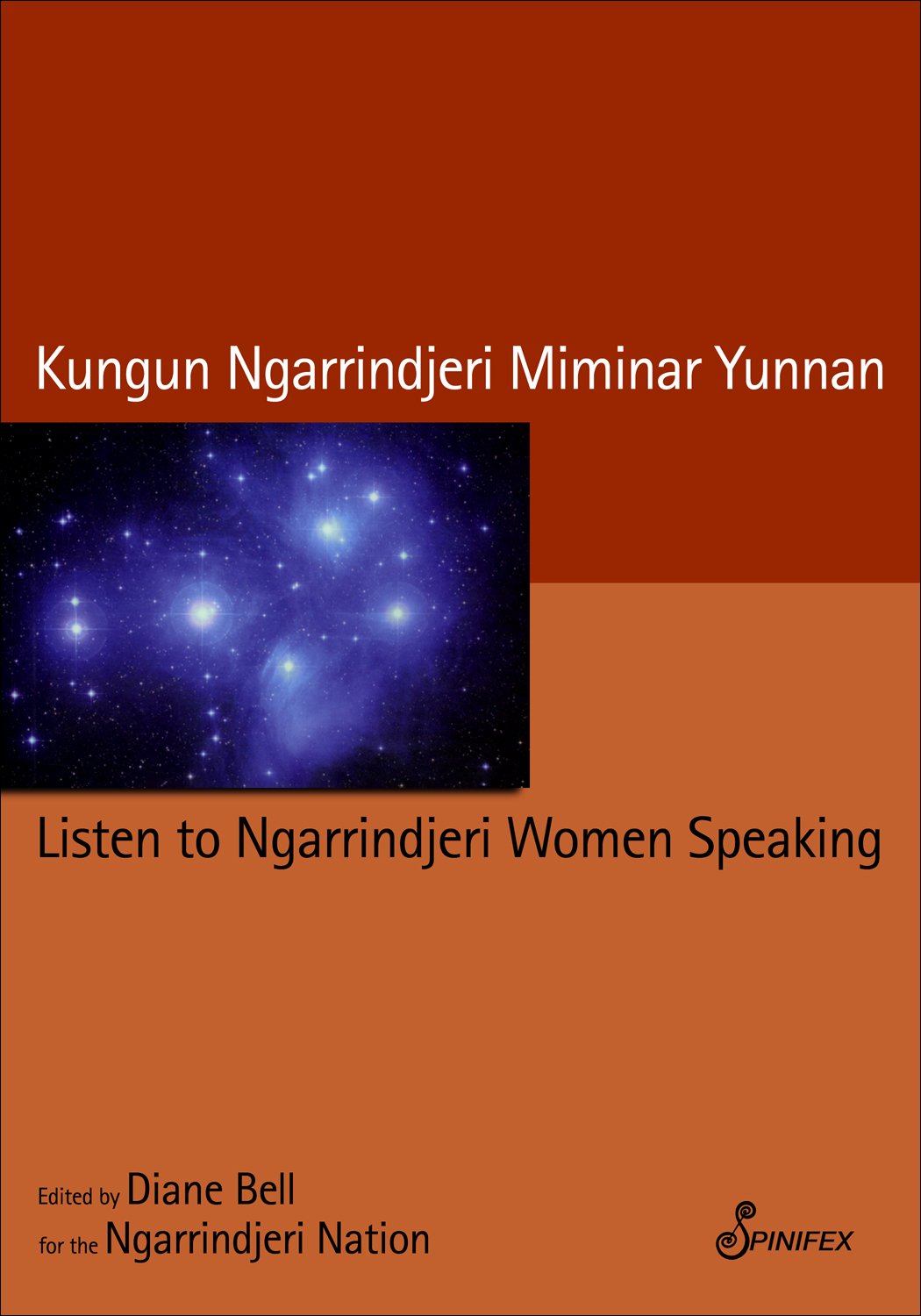
When the Ngarrindjeri women of South Australia asked Diane Bell if she would work with them in the running of some workshops to develop a booklet about culture and governance, none of them realised quite where it would take them. This book is the result. It has developed from a booklet to a book that outlines their visions for the future. A future in which their culture is respected, their stories heard, their laws carried out.
2008 | ISBN 9781876756697 | Paperback | 248 x 176 mm | 145 pp

eBook Available
“Sex, silence and sin”, this is what newly appointed professor, Dee P. Scrutari, writes in her notebook as she turns her anthropological gaze on the tribe of “non-reproducing males” who dominate St Jude's, a prestigious Catholic liberal arts college. Evil is in the air. Something is awry.
What happened to the previous occupant of her newly-painted office? Professor Scrutari's fieldwork begins. Her notebooks fill. And the mystery mounts: disturbing odours that no air cleanser will disperse, turbulent faculty meetings, tenure politics, intrigue around women's bodies, and a strange ginger cat. The mix is complicated by secret student alliances, predatory priests, the end of a marriage and new love, an imperious college president, a lumbering dean, a faction-ridden Religious Studies Department, a radical mass and a dissident feminist liturgy.
The determined anthropologist doodles and decodes the symbols and signs of evil as she teams up with a band of colleagues marginalised by the department - a liberation theology nun, a gay priest, and a Jew - and three feisty women students. They strategise and sleuth as they attempt to solve a number of campus mysteries.
"Evil," Dee declares, "is visceral, pervasive, subtle, not an abstract concept at all." Evil is about now. Evil is a novel full of vivid characters you know, or want to know. It is at once funny, witty, sobering, profound and provocative; full of affection for the academic world Diane Bell so lovingly describes; and is concerned to nurture against the darker forces she seeks to identify and expose.
2005 | ISBN 9781876756550 | Paperback | 232 x 154 mm | 290 pp
For more paperback copies, please visit IPG Book in the US or Gazelle Book Services in the UK

Women are rarely mentioned in the literature as owners of country in their own right or as decision-making individuals; they appear as wives and mothers, their relationship to the jukurrpa always mediated through another. Yet I believe women enjoyed direct access to the jukurrpa from which flowed into rights and responsibilities in land, a power base as independent economic producers and a high degree of control over their own lives in marriage, residence, economic production, reproduction and sexuality. Living in the community, developing friendships that have spanned decades, award-winning author Diane Bell shines a light on the importance of women's role in Australian Aboriginal desert culture.
As maintainers of land, ritual and culture, Indigenous women of central Australia share the patterns of their lives in this remarkable and enduring book. Daughters of the Dreaming (first published in 1983) is an outstanding study of Aboriginal women's lives, and a fine precursor to her award-winning Ngarrindjeri Wurruwarrin.
2002 | ISBN 9781876756154 | Paperback | 230 x 150 mm | 242 pp

Since the 1960s radical feminists have worked to articulate a vision of the world in which all women are safe and are acknowledged as human beings in their own right. Their projects include Take Back the Night campaigns, establishing women’s refuges, rape crisis centres, health centres, organising against pornography and developing courses in Women’s Studies. The richness of the practice and the theory of radical feminism is often misrepresented or unknown. Radically Speaking tells this important story.
1996 | ISBN 9781875559381 | Paperback | 242 x 176 mm | 654 pp
THIS BOOK IS PART OF THE RADFEM STARTER LIBRARY

Women are rarely mentioned in the literature as owners of country in their own right or as decision-making individuals; they appear as wives and mothers, their relationship to the jukurrpa always mediated through another. Yet I believe women enjoyed direct access to the jukurrpa from which flowed into rights and responsibilities in land, a power base as independent economic producers and a high degree of control over their own lives in marriage, residence, economic production, reproduction and sexuality. Living in the community, developing friendships that have spanned decades, award-winning author Diane Bell shines a light on the importance of women's role in Australian Aboriginal desert culture.
As maintainers of land, ritual and culture, Indigenous women of central Australia share the patterns of their lives in this remarkable and enduring book. Daughters of the Dreaming (first published in 1983) is an outstanding study of Aboriginal women's lives, and a fine precursor to her award-winning Ngarrindjeri Wurruwarrin.

“Sex, silence and sin”, this is what newly appointed professor, Dee P. Scrutari, writes in her notebook as she turns her anthropological gaze on the tribe of “non-reproducing males” who dominate St Jude's, a prestigious Catholic liberal arts college. Evil is in the air. Something is awry.
What happened to the previous occupant of her newly-painted office? Professor Scrutari's fieldwork begins. Her notebooks fill. And the mystery mounts: disturbing odours that no air cleanser will disperse, turbulent faculty meetings, tenure politics, intrigue around women's bodies, and a strange ginger cat. The mix is complicated by secret student alliances, predatory priests, the end of a marriage and new love, an imperious college president, a lumbering dean, a faction-ridden Religious Studies Department, a radical mass and a dissident feminist liturgy.
The determined anthropologist doodles and decodes the symbols and signs of evil as she teams up with a band of colleagues marginalised by the department - a liberation theology nun, a gay priest, and a Jew - and three feisty women students. They strategise and sleuth as they attempt to solve a number of campus mysteries.
"Evil," Dee declares, "is visceral, pervasive, subtle, not an abstract concept at all." Evil is about now. Evil is a novel full of vivid characters you know, or want to know. It is at once funny, witty, sobering, profound and provocative; full of affection for the academic world Diane Bell so lovingly describes; and is concerned to nurture against the darker forces she seeks to identify and expose.
2005 | 290 pp

When the Ngarrindjeri women of South Australia asked Diane Bell if she would work with them in the running of some workshops to develop a booklet about culture and governance, none of them realised quite where it would take them. This book is the result. It has developed from a booklet to a book that outlines their visions for the future. A future in which their culture is respected, their stories heard, their laws carried out.
2008 | 145 pp

In Ngarrindjeri Wurruwarrin Diane Bell invites her readers into the complex and contested world of the cultural beliefs and practices of the Ngarrindjeri of South Australia; teases out the meanings and misreadings of the written sources; traces changes and continuities in oral accounts; challenges assumptions about what Ngarrindjeri women know, how they know it, and how outsiders may know what is to be known. Wurruwarrin: knowing and believing.
In 1995, a South Australian Royal Commission found Ngarrindjeri women to have “fabricated” their beliefs to stop the building of a bridge from Goolwa to Hindmarsh Island. By 2001, in federal court, the women were vindicated as truth-tellers. In 2009, the site was registered, but scars remain of that shameful moment.
In the Preface to the New Edition, Diane Bell looks to the world that “will be”, where talented, committed Ngarrindjeri leaders are building the infrastructure for future generations of the Ngarrindjeri nation and challenging the very foundation of the State of South Australia.
The Apology to the Stolen Generations in 2008 and its evocation of an inclusive “us” has propelled the Ngarrindjeri on the path to “practical reconciliation”. But progress has been uneven. Petty politics, procrastinations and prevarications stand in the way of its realisation.
Diane Bell writes as an insider who is clear about the bases of her engagement with her Ngarrindjeri friends and colleagues. The story will continue to unfold and Diane Bell will be there. There is unfinished business.
Awards
Winner, NSW Premier’s Gleebook Award for Cultural and Literary Criticism
Finalist, The Age Book of the Year
Finalist, Queensland Premier’s History Award
Finalist, Gold Medal of the Australian Literary Society
Finalist, Kiriyama Award
2014 | 730 pp

Since the 1960s radical feminists have worked to articulate a vision of the world in which all women are safe and are acknowledged as human beings in their own right. Their projects include Take Back the Night campaigns, establishing women’s refuges, rape crisis centres, health centres, organising against pornography and developing courses in Women’s Studies. The richness of the practice and the theory of radical feminism is often misrepresented or unknown. Radically Speaking tells this important story.
1996 | 654 pp

Translations & Rights Sales
Radically Speaking edited by Diane Bell and Renate Klein
Selections in Complex Chinese: Fembooks;
UK: Zed Books
eBook Available
Diane Bell
In Ngarrindjeri Wurruwarrin Diane Bell invites her readers into the complex and contested world of the cultural beliefs and practices of the Ngarrindjeri of South Australia; teases out the meanings and misreadings of the written sources; traces changes and continuities in oral accounts; challenges assumptions about what Ngarrindjeri women know, how they know it, and how outsiders may know what is to be known. Wurruwarrin: knowing and believing.
In 1995, a South Australian Royal Commission found Ngarrindjeri women to have “fabricated” their beliefs to stop the building of a bridge from Goolwa to Hindmarsh Island. By 2001, in federal court, the women were vindicated as truth-tellers. In 2009, the site was registered, but scars remain of that shameful moment.
In the Preface to the New Edition, Diane Bell looks to the world that “will be”, where talented, committed Ngarrindjeri leaders are building the infrastructure for future generations of the Ngarrindjeri nation and challenging the very foundation of the State of South Australia.
The Apology to the Stolen Generations in 2008 and its evocation of an inclusive “us” has propelled the Ngarrindjeri on the path to “practical reconciliation”. But progress has been uneven. Petty politics, procrastinations and prevarications stand in the way of its realisation.
Diane Bell writes as an insider who is clear about the bases of her engagement with her Ngarrindjeri friends and colleagues. The story will continue to unfold and Diane Bell will be there. There is unfinished business.
Awards
Winner, NSW Premier’s Gleebook Award for Cultural and Literary Criticism
Finalist, The Age Book of the Year
Finalist, Queensland Premier’s History Award
Finalist, Gold Medal of the Australian Literary Society
Finalist, Kiriyama Award
2014 | 9781742199184 | Paperback | 234 x 152 mm | 730 pp
For more paperback copies, please visit IPG Book in the US or Gazelle Book Services in the UK
www.ipgbook.com
www.gazellebookservices.co.uk